Let me get my declarations out of the way. I enjoy the odd whisky, and I’m partial to a dram of The Macallan, though some evenings you’ll find me with a glass of red. I’ve also got family who work in the whisky industry, so I know a duty rise is felt well beyond the price of a bottle.
But this is about fairness, plain and simple. A unit of alcohol in a dram of Speyside malt is exactly the same as a unit in a pint of lager, yet Scotch pays £33.99 in duty per litre of pure alcohol while draught beer pays £19.45. That’s about 1.7 times as much tax for the same alcohol.
October’s Budget, John Healey’s first as Chancellor, made it worse, with the fourth rise in spirits duty in four years. The Scotch Whisky Association reckons tax will now take 74% of the price of an average bottle: more than £7 of every £10 you spend. That’s a political choice, and it punishes the one drink Scotland makes better than anyone else on earth.
Same alcohol, very different bills
Every drink is now taxed on the alcohol in it. The rates are anything but equal.
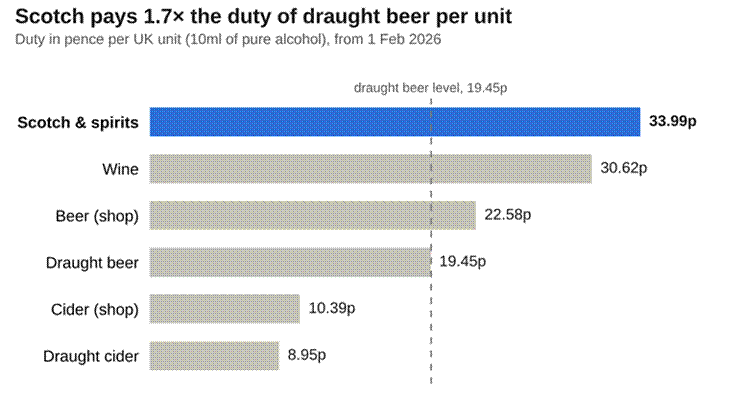
Source: HMRC Alcohol Duty rates from 1 February 2026. Standard rates, before Small Producer Relief.
Far more than a drink
Scotch isn’t a niche indulgence. Last year distillers sent £5.36bn of it to more than 160 markets, 43 bottles leaving Scotland every second, under names known the world over: Johnnie Walker, the planet’s best-selling Scotch, The Macallan, Glenfiddich, The Glenlivet, Chivas Regal, Ballantine’s, Talisker and Laphroaig.
Our heroes want a piece of it too. Sir Kenny Dalglish, Liverpool’s most famous No 7, has just lent his name to Gordon & MacPhail’s Vintage Moments, 15 box sets of rare single malts from the landmark years of his life. Singer-songwriter Cammy Barnes has even given the spirit a smash hit song, ‘Whisky Roll’, and only last night he won Artist of the Year at the Scottish Music Awards, held at Glasgow’s Barrowlands.
Whisky makes up roughly a quarter of the goods Scotland sells abroad and adds £5.3bn a year to our economy. It keeps 41,000 people in work here, many in glens and on islands with few other employers, and supports 25,000 more across the UK. Its visitor centres welcomed 2.7 million visits in 2024, more than 60% from overseas, making them, together, Scotland’s most visited attraction.
New distilleries keep adding to the draw. A stone’s throw from this website’s East Kilbride offices, the Kean family has turned their farm into Jackton Distillery, which produces Raer whisky, grows its own barley, opened its own malt house last year, and offers tours, tastings and cottages to stay in, all about eight miles from Glasgow. That’s exactly the investment a sensible tax system should encourage. Yet nearly one Scottish distillery in five is financially challenged, and this is the industry the Treasury has chosen to tax hardest.
Doing the sums
Scotland has always known what a bottle of Scotch is worth. In Whisky Galore, Compton Mackenzie’s 1947 novel and the much-loved films it inspired, the islanders of Todday race to rescue thousands of cases from a wartime shipwreck before the authorities get their hands on them. They clearly knew how valuable those bottles were. Had they known today’s duty, they might have rowed out even faster.
A standard 70cl bottle of Scotch at 40% pays £9.52 in duty, rising to £9.95 in February. Put the same alcohol into draught beer and the bill would be £5.45. In the pub, draught relief leaves out every spirit, so a 25ml dram pays about 34p, the same as a pint of 6.7% cider with nearly four times the alcohol.
It’s getting worse, too. The Wine and Spirit Trade Association reckons a bottle of Scotch will cost £2.29 more than in July 2023, while a can of 5% vodka and cola will have got a penny cheaper. Nor is the Treasury getting rich on it: spirits receipts fell £154m year on year between April 2025 and January 2026, even as rates rose.
Meanwhile India halved its tariff on Scotch and Washington scrapped its 10% levy this summer. Delhi and Washington cut the tax on Scotch this year. Westminster put it up.
The other side of the argument
To be fair, the Treasury has a case. The 2023 reforms deliberately made stronger drinks dearer for public health reasons, and its own evaluation found that’s broadly what happened. Draught relief is a deliberate helping hand for the local pub. And alcohol duties raise around £12bn a year, so a freeze is a tax cut someone else pays for.
The Walrus is a moderate drinker and takes the health argument seriously. But harm comes from units, not from whether they started life in a still or a brewery, and that same evaluation couldn’t find a measurable drop in alcohol-related harm. If the goal is fewer units, the answer is one rate per unit.
Over to you, Chancellor
Mr Healey still has the wider review of the duty system to put this right. Three changes would make a real difference:
1. Freeze spirits duty until the gap with beer starts to close.
2. Let spirits served in pubs share in draught relief.
3. Set a path to a single rate per unit of alcohol over this Parliament.
This isn’t a plea for special treatment, just the same treatment. Scotland’s MPs and MSPs, whatever their party, should be making that case loudly.
When that day comes, I’ll raise a dram of The Macallan, and very probably a glass of red, to a tax system that finally treats a unit as a unit.
Declaration of interest: ScottishNews.com’s publisher, Hero Media & Entertainment, owns the Scottish Whisky Awards, which will be held on 26 November at the DoubleTree by Hilton Glasgow.