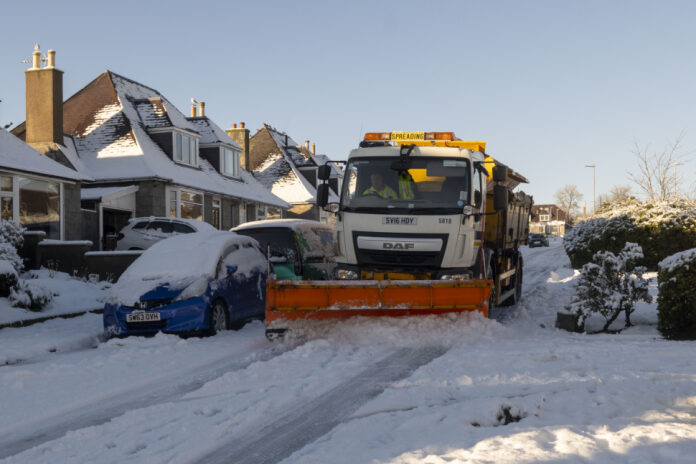
An extra £200,000 has been added to this winter’s budget for gritting roads and pavements in Aberdeen with an anticipated spend of £1,774million for the 2026/2027 season.
A report agreed yesterday (8 September 2026) by councillors at Net Zero, Environment and Transport Committee about the Roads Winter Service Plan said roads and pavements will be prioritised for gritting as the Council cannot be everywhere at once.
Aberdeen City Council Co-Leader Councillor Ian Yuill said: “Last winter we had a particularly severe spell of harsh weather in December and January. It was useful to allocate contingency funding for additional gritting material and staff overtime.
“For the approaching winter, the Council has again increased the budget for gritting. It is important to be prepared for the snow and ice. Hopefully, we will have a milder winter.”
Aberdeen City Council Net Zero, Environment and Transport committee vice-convener Councillor Miranda Radley said: “Our staff cannot be everywhere at once but they do go above and beyond to ensure the city’s key roads and pavements are kept gritted according to the agreed prioritised plan.
“It is never too early to think about getting ready for winter. People will soon be able to apply for a free one-tonne salt bag as well as getting access to the big community salt bins in 20 locations around the city. As always, I hope this winter will be a mild one.”
The report said it is not feasible to treat every road, pavement, and cycleway around the city at the same time so they are being prioritised, with main routes given top priority. Roads are split into primary, secondary, and other routes, and pavements/cycleways are split into priority one and two routes.
The report to committee said salt stock levels will be at 11,500tonnes at the start of the gritting season – 14,680t was used last year - and this stock can be topped up with regular programmed deliveries throughout winter.
The report to committee said 11,500tonnes is sufficient to provide a basic level of winter maintenance during a mild to average winter however more severe winters, such as winter 2025/2026, have seen significantly higher levels of spend which were funded from the Council’s contingencies.
Snowfall, which began in late December 2025 and continued through the first two weeks of January, saw accumulation at levels not seen since 2010 and very rarely experienced in the past 30 years. The period of snow was followed by around a month of near-daily rainfall which turned into ice overnight. Additional budget provision of £355,000 was provided from the Council’s Contingencies budget to deal with the challenging conditions in winter 2025/26.
The report said the effects of climate change continue to present challenges to the winter service with winter weather behaviour being highly unpredictable. Prior to winter 2025/2026, a pattern of weather behaviour whereby temperatures rise during the day, often accompanied by precipitation, before falling rapidly through late afternoon and evening times was a common challenge for winter treatment.
Historically, an early morning grit was often sufficient to treat routes for a 24 hour period, however this pattern of fluctuating temperatures have seen regular requirements for routes to be treated multiple times through the day as wash off and freeze thaw removes residual salt. The effect of this has been the requirement for greater numbers of gritter runs to treat the primary route network, increasing labour, salt, and fuel costs.
A secondary impact of the changed weather patterns effect on gritting has been to lessen the extent of secondary and tertiary network which can be treated on days of continued action. Rain throughout the day requires priority one routes to be retreated rather than the focus moving on to lower priority roads.
There are currently more than 900 salt bins throughout the city based on historic requests and 50 of these will be replaced in a trial with new, larger capacity bins which can be lifted by a lorry mounted crane or a telehandler when empty allowing them to swapped out with full bins. The committee agreed to continue the policy of not issuing any additional salt bins but to further promote the issue of one tonne bags of salt for community use.
The one-tonne community salt bags are given to residents or community groups willing to carry out self-help winter treatment.
In addition, there are 20 large capacity grit bins from which the public can collect salt in locations such as supermarket or community centre car parks.