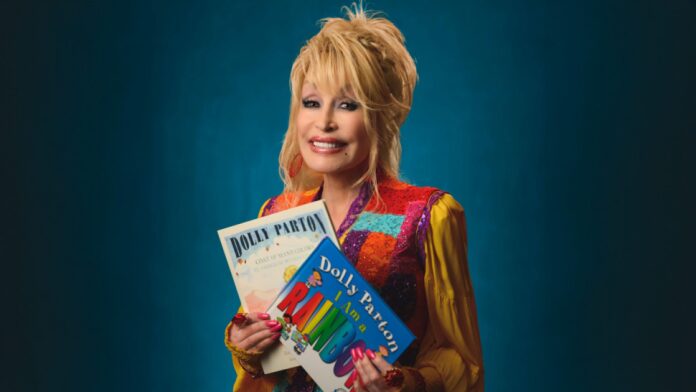
Every month, around 9,500 children across Scotland receive a book through their letterbox thanks to Dolly Parton’s Imagination Library.
For some, it is the beginning of a bedtime reading routine. For children moving between foster homes, those books can offer something familiar at a time when much of their life is changing.
Inspired by her father’s inability to read and write, Parton created a programme that brings books into children’s homes, free to their families. In Scotland, its work reaches communities through partnerships with councils, libraries, housing associations and local charities.
There was an outpouring of emotion when the singer died on 25 August, stories remembering her achievements included revelations around how the work of her foundation had reaches homes in Scotland.
Helena Barrett-Duncan, the Dollywood Foundation’s regional director for Scotland, explains how the singer’s deeply personal mission has helped Scottish families discover the pleasure of reading together – and why there is an ambition to reach many more.
What does the Imagination Library do in Scotland?
We’ve been in Scotland since about 2011, even though the programme has been running globally for the past 30 years.
We currently have about nine and a half thousand children who receive books every month. We work with a number of local programme partners who help deliver the programme and bring the Imagination Library books to their community.
That was the genius of Dolly’s model: we work with local programme partners who match-fund her contribution so that the programme can be sustained and her legacy can live on.
The local programmes we work with range from small community councils or community development trusts to libraries, early years charities, housing associations and local councils.
Can you give some examples of how that works in Scottish communities?
In Renfrewshire, for example, the council provides the books for all children aged two to five. They’ve mailed over 200,000 books, which is fantastic.
They have their programme completely embedded across their early years service, with Dolly ambassadors in every single nursery across the local authority.
We also have smaller programmes. We received funding from wind farm funds to work with a number of local communities and villages in South Lanarkshire, so we work with charities and local champions in the Clydesdale area.
We’ve been partnering with the Coalfields Regeneration Trust for a long time. They support ex-mining communities, so we have a number of programmes in ex-mining areas like Cowdenbeath.
We’re also working with libraries in Dundee, with Leisure and Culture Dundee. The libraries have been our main partner to deliver the programme there.
There is also a programme specifically for children with care experience. Who can receive those books?
The Scottish Government has been funding, through a partnership with Scottish Book Trust, our programme for care-experienced children.
That’s been running for 15 years now, and that’s any child with any kind of care experience from birth to age five.
Children in foster care, in kinship care, who’ve gone on to be adopted – they’re all eligible to receive the Imagination Library books through that programme.
Why were books and reading so important to Dolly?
She set the programme up originally in tribute to her dad. It was a really personal story for Dolly.
She talks about her dad as being the smartest man she ever knew, but he was really held back in life by his inability to read and write. She saw how much he was held back from fulfilling his dreams.
That’s why literacy and books and reading are so important to her, and she made it her mission to make sure that children shouldn’t be growing up in a house without books.
She also grew up, to quote her, “dirt poor”, in a small cabin in the Tennessee Smoky Mountains. She was bullied because she was poor, and she really wanted to remove any stigma from the programme.
That’s why the programme is based on giving all children in an area the books: every child having the opportunity to get books into their home and have those moments of joy and love that we know sharing a book with a parent or caregiver can bring.
What difference do those deliveries make to children and their families?
The thing about this programme is it’s a gift. It’s a moment of joy that literally comes through the letterbox.
We deliver it by post, and it keeps coming. It keeps coming every month.
For many of those children we’ve worked with who have care experience, they might have quite unstable lives. We get constant feedback about how this is a secure, stable thing that keeps coming.
Many of these children go to new foster homes or adoptive homes, and all they bring with them is a bag of books. These books will keep coming when they’re in their new home.
There are so many benefits to books and early shared reading experiences. They promote bonding and attachment for parent and child. They help promote early speech and language development. They support early literacy skills.
I think Dolly did this because she was so aware of what joy they can bring. It’s all about joy, and it’s all about love. That’s the feedback we get about the special moments these books create.
Can receiving books at home help families build a wider reading habit?
So many children across Scotland, sadly, are living in poverty, and parents are having to make decisions over what to spend their money on. It might not be books.
Many families don’t feel like books or libraries are for them. Once they start getting these books, they’re seeing the joy it brings. They’re seeing the impact it’s making on their child, lighting up their faces.
They’re enjoying it, and then they’re going to the library. They’re getting more books.
In Dundee, for example, they’ve seen a 26 per cent increase in children’s book borrowing since running the Imagination Library.
It’s building reading habits. It’s starting them young, and hopefully that will last a lifetime.
What are your hopes for the programme’s future in Scotland?
We’re hoping to grow this programme across Scotland over the coming years.
We’re working with the Scottish Government to expand the programme after the SNP made a manifesto commitment for a nationwide rollout of the Imagination Library.
We’re hoping for more and more books to get into the hands of children across Scotland as we move forward.
We really want to stress how important books and early literacy and early reading are, and how much we want to grow the Imagination Library across Scotland.
We’re always looking to work with new partners who want to bring it to their community.
Dolly was known around the world for her music. What does her legacy mean to you?
For me, the legacy is all those children opening a book and sharing a bedtime story with their parent or carer, going into a world of wonder and imagination, and starting to believe in themselves and believe in what the world could be.
She wanted to be known as the book lady. She talks about how the Imagination Library is one of the proudest things that she’s ever done, and the foundation is set up to continue that legacy for generations to come.
Everything she did was about love and kindness and joy, and I think we need more of that in the world.
I think that’s her legacy: let’s show love and compassion and kindness to one another.
Find out more about Dolly Parton’s Imagination Library in Scotland.