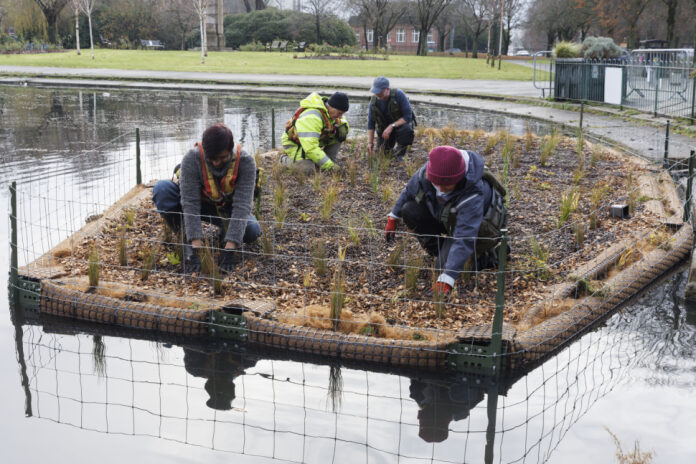
Seven floating gardens have been installed across Glasgow as part of an environmental legacy project following this summer’s Commonwealth Games.
The new floating islands are designed to improve water quality, encourage biodiversity and provide nesting sites for birds across five locations in the city.
The islands cover a combined area of 248 square metres, with installations at Elder Park in Govan, Richmond Park in the east end, Victoria Park in the west end, Queen’s Park on the southside and Hogganfield Loch nature reserve.
Designed and installed by Forres-based bio-engineering firm Biomatrix Water Solutions, the platforms have been constructed using recycled plastic from water pipes.
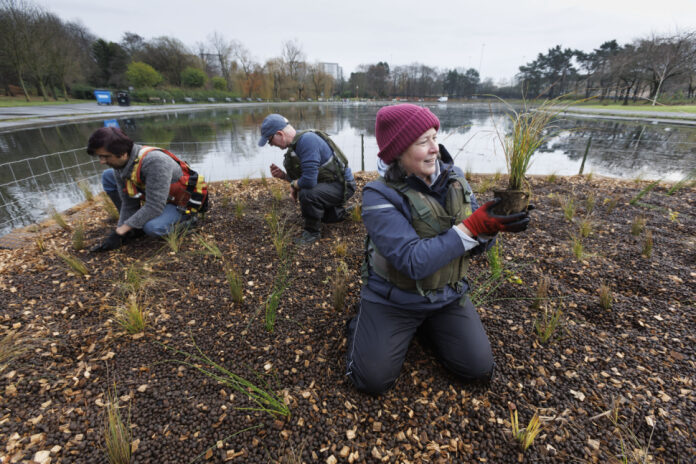
Community groups, including volunteers from local Friends of parks groups, have helped plant native Scottish species on the islands, including marsh marigolds, water forget-me-nots, water mint, bulrushes, reeds and sedges.
The vegetation creates new habitats for wildlife while helping to improve the health of the waterways.
Biomatrix Water Solutions’ Ellen Hebdon said: “One of the things we do with projects like these is getting communities involved with installations. People from all walks of life come and get planting.
“Algae is toxic, especially blue algae, and it smothers other things in the water. It’s not nice stuff. These islands are biomimicking a riparian edge, the natural edge of a river or a lakeside.
“There’s always work being done under the water but also work above the water by fungus, pollinators, all sorts of invertebrates raking around in the substrate, then ducks and small birds will move in. It’s great to see.”
The environmental engineer added: “I hope what we’re doing will encourage people to take time to pause for a minute, and have a think. To appreciate that they have something really nice.”
The project forms part of Glasgow 2026’s ambition to establish a blueprint for more sustainable international sporting events.
This summer’s Commonwealth Games, which attracted one million people to the city, were delivered with one-fifth of the carbon impact of the Birmingham Games in 2022.
An independent report found that all competition venues were powered by renewable energy, while two-thirds of the vehicles used in the Games’ transport fleet were electric or hybrid.
The report estimated that the approach prevented the release of 19,021 tonnes of carbon dioxide.
Organisers have also invested in verified carbon credits supporting a 100MW wind power project in Gujarat, India, which will host the centenary Commonwealth Games in 2030.
George Black, chair of Glasgow 2026, said: “The Games was experienced across the city for 11 days, but our commitment to Glasgow goes much further. As an event organiser, we wanted to give back to the host city and the communities that made Glasgow 2026 so special.
“We made decisions in designing this Games to reduce our environmental impact. As the first event as part of Commonwealth Sport’s reimagined model, we are proud to have worked with Glasgow City Council and Bupa to leave a lasting legacy in the communities that welcomed the Commonwealth so warmly.”
Councillor Angus Millar, Glasgow City Council’s city convener for climate, said: “Climate and sustainability are of global importance, with Glasgow firmly committed to being at the forefront of this issue.
“Some of the greatest innovations and solutions come from working in partnership, and it has been an honour to work with Glasgow 2026 and Commonwealth Sport to secure a green legacy from these Games.
“Building on our hosting of COP26, this is a city that collaborates with event organisers to prioritise the environment in the decisions made when staging major competitions such as the Commonwealth Games. These initiatives will enrich our biodiversity and leave lasting benefits for our communities for decades to come.”