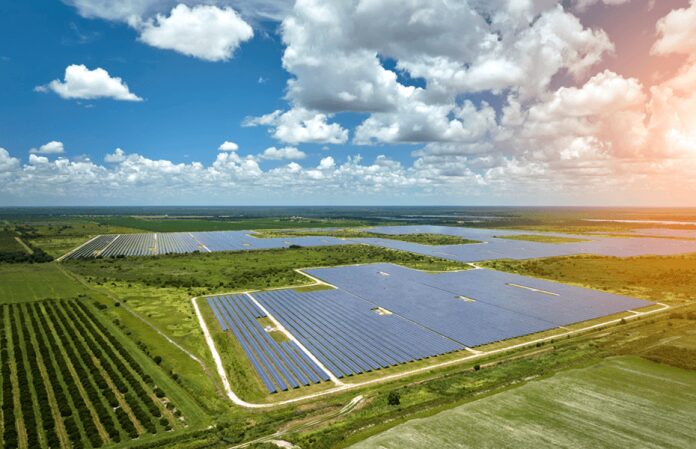
A giant solar and battery park planned for Perthshire could generate electricity equivalent to almost 5% of the amount currently used by Scotland’s businesses and public services.
The proposed Halfway Energy Park would stretch across the Carse of Gowrie between Errol, Inchture and Rait, on low-lying agricultural land between Perth and Dundee.
Renewable energy developer Aukera wants to build up to 500MW of ground-mounted solar generation alongside a 100MW battery energy storage system.
The scale of the development means it would be one of the largest solar projects proposed in Scotland.
Aukera says the solar element could generate renewable electricity equivalent to 4.67% of Scotland’s current annual non-domestic electricity consumption.
That includes electricity consumed by businesses and industry as well as public services including hospitals and schools.
The separate battery system would be capable of storing electricity generated by the solar panels and releasing it when required, helping to balance supply and demand on the national electricity network.
Plans for the development are currently at an early stage, with a scoping request submitted to the Scottish Government’s Energy Consents Unit.
Official documents describe Halfway Energy Park as a hybrid renewable development comprising up to 500MW of ground-mounted solar panels and up to 100MW of co-located battery storage.
The proposals also include inverter and transformer stations, substations, underground cabling, access tracks, temporary construction compounds, security fencing, CCTV, landscaping and biodiversity improvements.
The development would be built across the Carse of Gowrie, north of the River Tay, broadly between Inchture, Errol and Rait.
Its enormous footprint and potential impact on agricultural land have already generated concern locally.
A public consultation is being held at Errol Village Hall from noon until 7pm today, following an event at Inchture Village Hall on yesterday.
Residents and businesses are being invited to examine the proposals, meet members of the project team and submit feedback.
The consultation comes before any formal application for permission to construct the energy park.
Aukera currently expects to prepare its final design between November and March, with an application to the Scottish Government anticipated in March 2027.
Halfway would have a generating capacity considerably greater than 50MW, so the final decision would be taken by Scottish ministers under Section 36 of the Electricity Act 1989.
Halfway Energy Park would require its own substation to collect electricity generated across the site and increase its voltage to 400kV.
It is expected to connect to the national network through a separate new 400kV substation proposed by SSEN Transmission.
No new overhead electricity lines are proposed as part of Halfway Energy Park, with the developer saying its project cabling would be underground.
The 100MW battery storage facility is currently expected to sit next to the project’s substation.
The developer says safety measures are expected to include automated fire suppression, ventilation, fire-resistant barriers, separation between battery units and systems capable of isolating an affected battery module if a fault is detected.
The final battery design would be subject to further technical and safety assessments.
The proposals have attracted particular attention because of the agricultural character of the Carse of Gowrie.
More than 400 acres within the wider development area are currently expected to be allocated for environmental mitigation and enhancement rather than solar panels.
The developer is considering new hedgerows and trees, orchards, species-rich grassland and other measures designed to increase biodiversity.
It also says opportunities for continued agricultural activity, including sheep grazing between and beneath solar panels, will be explored.
Solar panels are currently expected to be no more than 3.5 metres high, with the emerging design assuming a minimum 100-metre separation between panels and residential properties.
Aukera says the development would operate for 40 years before being decommissioned and the land restored.
Construction is expected to take around 18 to 24 months.
The project is still at the pre-application stage and its final design could change as environmental studies and consultation continue.
Residents can submit feedback on the emerging proposals until 7 October, with another round of public consultation expected in November.