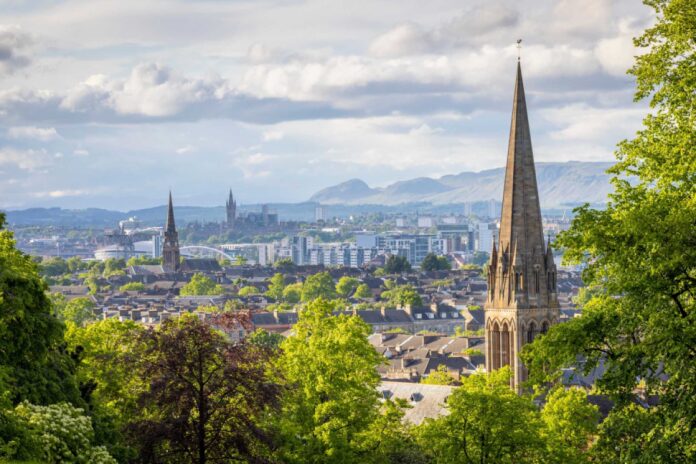
Council leaders in Glasgow and the surrounding areas have unveiled proposals for a £7.5 billion investment programme that could transform transport, housing and regeneration across the west of Scotland.
The ambitious ten-year plan would give the region greater control over public spending, major development projects and economic growth, bringing powers currently held by the Scottish and UK Governments closer to local communities.
It could also change how decisions are made about bus services, rail connections, housing developments and the future of town centres.
The proposals have been drawn up by Glasgow City Region, a partnership of eight councils covering Glasgow, Renfrewshire, East Renfrewshire, Inverclyde, North Lanarkshire, South Lanarkshire, East Dunbartonshire and West Dunbartonshire.
Together, these areas are home to 1.9 million people and account for approximately a third of Scotland’s economy.
The councils want to establish a single regional organisation, with greater financial powers and the ability to coordinate major investment across council boundaries.
Unlike the combined authority arrangements in Greater Manchester, the plans would not involve creating a new elected mayor.
Instead, the region would continue to be led collectively by its eight councils, with new arrangements for scrutiny and accountability.
The £7.5bn figure represents an ambition rather than money already secured. The councils are seeking a long-term funding agreement with both governments, alongside new ways to attract private investment.
What could change across Glasgow?
Transport is a central part of the proposals.
The new regional organisation could take greater responsibility for coordinating buses, trains, the Glasgow Subway and major transport infrastructure.
It would have more influence over routes, fares, ticketing and funding, with the aim of creating a better-connected transport network.
The framework also identifies the proposed Clyde Metro as an example of a project that could benefit from longer-term investment arrangements.
Strathclyde Partnership for Transport would continue to operate, but strategic decisions about transport priorities could move to the new regional organisation under the proposal. Any changes would require further agreement with the Scottish Government and other affected councils.
Housing and regeneration are another priority.
The region estimates that around 66,000 new homes will be needed by 2040, while more than 1,600 vacant and derelict sites have been assessed for potential development.
The councils argue that securing land, preparing sites and providing roads and utilities often require several organisations to coordinate funding and planning decisions.
One example highlighted in the proposals is Cowlairs in north Glasgow, where plans for around 1,000 homes involve land that has remained undeveloped for approximately 30 years.
A regional investment programme could help bring together the funding needed to unlock similar sites, alongside projects to regenerate town centres and support local businesses.
The plans also seek greater regional influence over skills and employment programmes, allowing training opportunities to be more closely linked to the needs of employers.
Where would the £7.5bn come from?
The draft framework sets out an illustrative funding model involving approximately £3bn in an integrated government settlement, £1.25bn in regional contributions, £1.25bn in additional government funding and £2bn from wider investment.
Much of the proposed settlement would bring together existing government spending over a longer period, rather than represent entirely new funding.
The regional contribution would be intended to come from returns generated by investment and a share of the additional economic value created.
The proposals also explore new financial powers, including the ability to borrow and reinvest income from development projects.
No increase in council tax is proposed. The framework does seek the option for regional council tax funding in future, but says this could only happen with the agreement of all eight councils.
Glasgow seeks greater powers
Councillor Ricky Bell, leader of Glasgow City Council and chair of the Glasgow City Region Cabinet, said the proposals would give the region powers already available to comparable areas in England.
He said: “For a decade, our eight councils have shown the enormous potential that lies in our partnership: but now is the time to take the next step.”
He added: “Bringing decisions on transport, skills, housing, regeneration and economic development together would allow us to plan for the long term, unlock investment and create more opportunities for people and businesses across the Region. Greater powers, greater flexibility and long-term investment would give us the tools to go further and faster.”
The proposals build on the existing £1.13bn Glasgow City Region City Deal, which has supported projects including the Govan-Partick Bridge, Balgray railway station and the new cruise ship terminal at Greenock.
The partnership now oversees a wider portfolio of programmes worth more than £2bn.
The new framework would allow the councils to make longer-term financial commitments through a single organisation, rather than relying on separate agreements for individual projects.
What happens next?
The draft framework will now be put out for public consultation.
Residents, businesses and community organisations will be invited to comment on the proposals, with consultation expected to continue until February 2027.
A final proposition is scheduled to return to Glasgow City Region Cabinet in March, before being taken forward with the Scottish and UK Governments.
Bell said: “This is a draft proposition, not a done deal. We want residents, businesses, communities and partners across Glasgow City Region to help us shape it and demonstrate the scale of our shared ambition before we take a final proposition forward with the Scottish and UK Governments.”