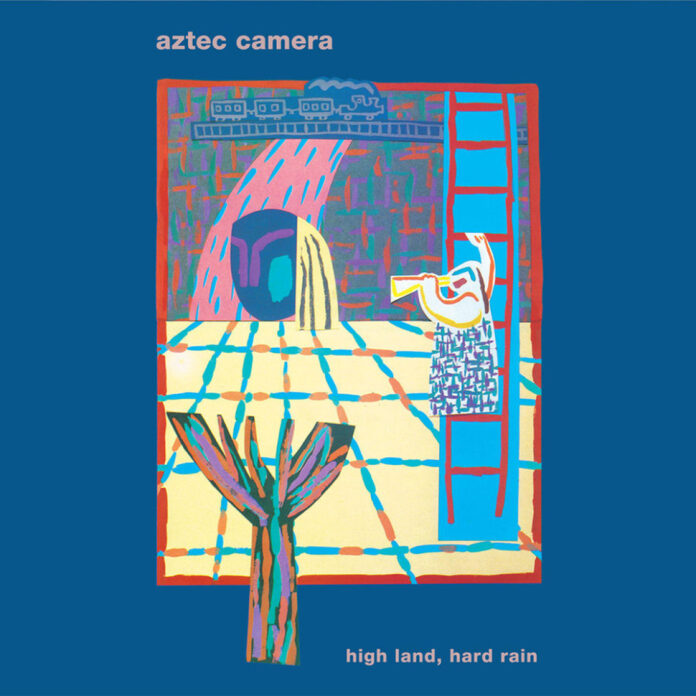
Aztec Camera’s debut album High Land, Hard Rain is widely considered as one of the most groundbreaking and best Scottish albums of all time.
The album was released in February 1983 through Rough Trade Records and was recorded in the space of three weeks at the International Christian Communication studio in Eastbourn.
What is High Land, Hard Rain about?
Roddy Frame said that the album’s acoustic sound was not deliberately planned. He was using an acoustic guitar partly “trying to be contrary when everyone else was getting more into [guitar] effects again,” adding that the acoustic sound “sounded refreshing” to him.
The album also featured two of Frame’s early compositions. “We Could Send Letters” was written in 1979, while “Lost Outside the Tunnel” had previously been performed by Frame’s pre-Aztec Camera band, Neutral Blue.
The single “Oblivious” was written with the specific intention of creating a pop hit. For its guitar part, Frame deliberately borrowed from Love’s 1967 song “Maybe the People Would Be the Times or Between Clark and Hilldale.”
“Pillar to Post” was likewise shaped by specific influences, with Frame deliberately attempting to emulate the sound of the Clash and artists associated with the Tamla-Motown label.
“Down the Dip” was the final song written for the album. Frame composed it while experimenting with different chord combinations before ultimately returning to simpler chord progressions. The song takes its inspiration from a local pub near Duncanrig Secondary School in East Kilbride, where Frame attended high school. The pub was originally called the Diplomat, commonly known as “The Dip,” and is now known as the Gardenhall Inn.
Track listing
- Oblivious
- The Boy Wonders
- Walk Out to Winter
- The Bugle Sounds Again
- We Could Send Letters
- Pillar to Post
- Release
- Lost Outside the Tunnel
- Back on Board
- Down the Dip
Front Cover
The artwork for Aztec Camera’s High Land, Hard Rain was created by Scottish artist and designer David Band. He was a friend of Roddy Frame and was part of the same Glasgow/London music scene.
Reception
NME revied the album in their 16 April 1983 edition and said: “So at last the Sound of Young Scotland shuffles from hip obscurity into the consciousness of the nation — is it not painful, dear smug reader and fan, to observe the slug like qualities of the remainder of the human race?
“The consolation in this case is that, unlike the struck-it-too-late-to-matter story of The Buzzcocks, what seemed at one time to have sunk to a pitiful simper has now emerged older but undeniably stronger.
“So as Orange Juice reach the commercial heights, the irony even stronger in their soul, Aztec Camera come to their time of reckoning with a statement that is tentative, certainly, but which has enough of a glint in its eye to indicate that their glorious potential is far from dead.
“In the two years since the love-drunk wonder of the first Postcard single there has been a distinct struggle for identity at the heart of Aztec Camera. ‘Just Like Gold’ was a precocious piece of magic, an articulate crystallisation of feeling sung with soaring honesty by sixteen-year-old Roddy Frame.
“There was a candid purity to its sound, an uncorrupted potential swimming in an artful stream of honesty. It was as sparkling, as profound and as essentially Scottish as Bill Forsyth’s cinema.
“After that silver dart, there was a painful lack of direction in the drippy follow-up ‘Mattress Of Wire’, and Bay City Rollers echoes in the power-pap production on ‘Pillar To Post’. The last single ‘Oblivious’, with which this collection begins, executed a neat reversal of the downward trend, though.
“There’s more than a note of manipulation in its tunefulness but there’s a bitter aftertaste in the syrupy sweetness, an ironic tingle to the claustrophobic certainty of the melody.
“There’s a hint here that Aztec Camera have found their feet and discovered a sound. If the remainder of the album was as sure footed it would be a quiet masterpiece.
“Unfortunately there’s still a hint of uncertainty. One of the chief problems is that Frame, although he’s proved himself as the sort of songwriter that Ben Watt would dearly love to be, is a wee bit limited in the vocal department, the result being that his sharply barbed poetry frequently finds itself drowned in the drabness of a repetitive format.
“The group seem aware of the problem, but their solution too often lies in orchestral arrangements which only submerge any cutting edge even further; take the horrendously
overblown version of ‘We Could Send Letters’.
“What is required is an abrasive touch to tease out the hardness of the lyrics. If they played it a touch tougher Aztec Camera could draw blood.
“On this album they’ve found some feelings they had left behind. and there’s an indication they are coming to terms with the sweet pain they are capable of inflicting. The fragile
re-awakening of pop continues.”
The album reached number 22 in the UK Albums Chart, while “Oblivious” became a significant pop hit.
Famous Fans
One of the most prominent fans of High Land, Hard Rain is Smiths guitarist Johnny Marr. In an interview with The Adam Buxton Podcast, Marr said: “I’d been wondering how come Aztec Camera who are our label mates were getting on the radio and we weren’t.
“They seem to have very breezy upbeat tunes, Walk Out to Winter and Oblivious. I respected Roddy because he’s one of the only other people I knew was the same age as me.”
Elvis Costello also named High Land, Hard Rain as his favourite record of 1983.