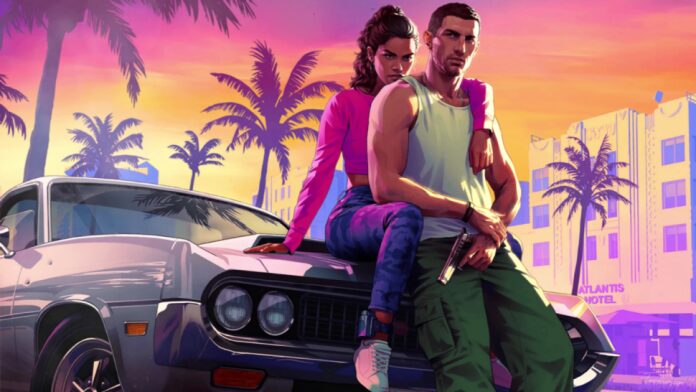
Grand Theft Auto VI was released on Thursday
The blocky brutalism of Dundee’s Old Glamis Road is a somewhat unlikely setting for the birth of the most lucrative entertainment franchise on the entire planet.
The chequered facade of the tall rectangular building, which alternates between grey and a slightly lighter grey, catches the eye but is unlikely to hold it, the tower standing moodily over a squad building which draws to mind little else but army barracks.
It’s not a location likely to put anyone in mind of Miami Beach, but there is a direct line between what is now Dundee and Angus College and the fictionalised version of the Sunshine State which will soon be responsible for a spate of sick days across the world.
For without that unassuming and unlovely breezeblock tower there would be no Grand Theft Auto VI.
The Kingsway Amateur Computer Club probably wasn’t the hippest place to be in the Dundee of the mid-1980s, but for teenagers Dave Jones, Russell Kay, Steve Hammond and Mike Dailly it might as well have been the centre of the universe.
It was there that they’d meet on a Thursday evening to indulge in their passion for computers and gaming, and a stroke of apparent misfortune for one of them would change everything.
Jones was laid off from his job as an electrical engineer at Timex and used his redundancy package to fund the purchase of an Amiga 1000, a machine which would seem laughably basic today - modern computers have around 64,000 times its 256kb of RAM - but which for the rest of the KACC must have seemed incredibly futuristic.
As Dailly would later recall: “The first game I saw him run was Defender of the Crown, and it’s fair to say after being used to spectrum and Plus/4 games, this was simply jaw dropping.
“To this day, I can’t look at this title screen without being impressed at it’s quality. It looked real.”
The quartet were all interested in developing their own games as well as playing them, and advances in technology meant that goal was increasingly achievable.
Kay and Jones collaborated on a game called Moonshadow, Hammond assisted Dailly with Freek Out - not an ironic spelling, the latter just didn’t know how to spell the word - and Jones and Dailly developed a game featuring a rotating eye which could shoot missiles in eight directions. Creativity clearly exhausted by the premise, it was titled the Game With No Name.
While those early developments are little remembered it allowed the KACC to hone their skills and by 1987 Jones, now at the Dundee College of Technology, was looking to find a commercial release for a shooter he’d been working on called Draconia.
Largely coded in his parents’ bedroom, it tasks players with destroying the defence mechanisms on the titular planet to kill some enemy aliens.
While working on the game he had dubbed his one-man production house Acme, and began seeking a distributor. As it turned out that name was already taken, so it was quickly switched to DMA Design - either standing for Direct Memory Access or Doesn’t Mean Anything depending on which anecdote he would later tell - and a publishing deal was secured with Psygnosis.
Released as Menace in 1988, it sold 20,000 copies and allowed Jones to fund further developments and also purchase a Vauxhall Astra.
The following year DMA had its first two employees: Dailly and, initially on a part-time basis, Hammond.
The former had dropped out of college by this point, or rather been asked to leave for “basically not attending” and it’s fair to say his mother was not best pleased that rather than enrolling in a YTS course he’d taken a job making video games with his friend.
Soon, however, DMA would have its first legitimate hit.
Lemmings featured anthropomorphic versions of the titular rodent trying to make their way through various perilous landscapes, with the player tasked with guiding them through said treacherous terrain lest they come to a grisly end.
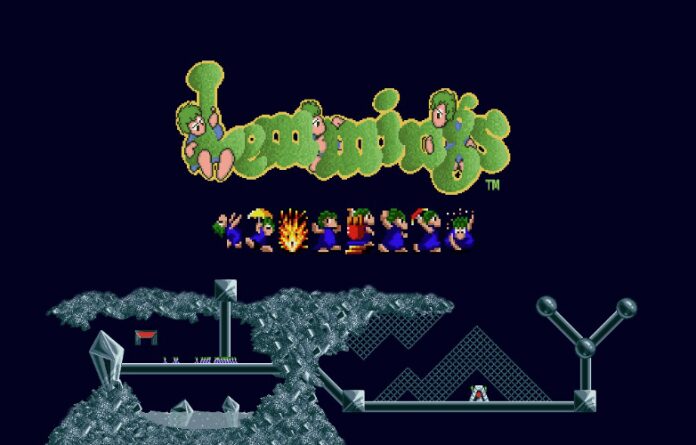
Developed by Kay, Dailly and Jones and ported to consoles other than the Amiga by Hammond, it would go on to sell over 20 million copies.
Rarely, if perhaps not uniquely, the game did not feature just one way to ‘solve’ a level, with players encouraged to use their own ingenuity to find a way to advance. That was an approach DMA would take into their next title, a game called Race and Chase which allowed players to choose whether they wanted to play as police officers or criminals.
By the time development began in 1995 DMA was employing 40 people at Dundee’s technology park, but there were some teething problems. It turned out, Dailly would later explain, that “no-one wanted to play as the cops”.
The story was overhauled, with players instead acting as a petty criminal whose goal is to accumulate wealth, make shady business deals and basically be thoroughly unpleasant on the way to becoming an underworld kingpin. With the change of focus came a change of title: the game would now be called Grand Theft Auto.
While we can be sure that Grand Theft Auto VI will feature a massive open world, cutting edge graphics and intricate storytelling, back in the mid-1990s the technology wasn’t necessarily there to meet the ambitions of the studio.
The writers would dream up scenarios inspired by The Godfather, Scarface and other mob movies and take them to the coders, who were working with technology which allowed them to basically build a series of blocks, and be told they were “f***ing mental” and to go back to the drawing board.
Its creators would later recall: “It could have been canned at any point. Every week they wanted to kill this game and we’d have to kind of argue to try and keep it.”
One compared its protracted development to “trying to nail jelly to kittens”.
Even by its 1997 release the game was unstable, with early critics decrying the graphics as “shoddy” and pointing out bugs in aspects of the game engine.
The public, though, didn’t seem to care and Grand Theft Auto sold a million copies in its first year, at least in part due to a savvy media campaign by the now-disgraced PR guru Max Clifford.
Seizing on its violent gameplay, he promised to “feed these stories into the ear of a lord somewhere, that there’s this game developed in Scotland which is utterly despicable”.
That turned out to be Lord Campbell of Croy, the former Scottish secretary, who first raised it in May 1997 then in a later session declared: “In future, when citizens find that their cars have been stolen and driven around, with damage done, or injury, they can attribute some of the blame to this computer game.”
The Daily Mail called it a “criminal computer game that glorifies hit and run thugs”, the Scottish Motor Trade Association branded it “deplorable”, while a group called Family and Youth Concern warned it would “make children think it is OK to rob cars and kill”.
Inevitably, this just made the teenagers and young adults of the world determined to see what all the fuss was about.
The success of Grand Theft Auto saw DMA bought over by Gremlin Studios and subsequently French developer Infogrames then, just before the release of the sequel, Take Two Interactive.
DMA was rebranded Rockstar North and given big budget backing to create Grand Theft Auto III.
Released in 2001 and set in a fictionalised New York, it was the first 3D instalment in the series and was fully open world, with better budgets and technology finally allowing the writers to bring their crime flick fantasies to consoles across the world.
Controversy remained - American conservative activist Jack Thompson sought to have the game banned after linking it to a murder - but GTAIII was a leap forward for the industry and is today recognised as one of the best and most important games of all time.
GTA: Vice City and GTA: San Andreas would follow, set in approximations of Miami and various locations in California respectively, and 2013’s Grand Theft Auto V grossed one billion dollars in its first three days of release.
GTA VI will return to Vice City, but throughout its history Grand Theft Auto has paid homage to its Scottish roots.
The in-game stock market is called the BAWSAQ, if you go down to the harbour in Grand Theft Auto V you’ll find a ship called Dignity before heading off to buy some wheels at Saul Tires or maybe grab an ice cream at the Sundae Post or some grilled meat at Greek restaurant Gyro Day.
In San Andreas players could bet on horses called Neigh Bother and Dundee Ned, or watch a show by a fictional Scottish metal band sporting Argentina shirts in homage to Dundee’s Claudio Caniggia.
Perhaps best of all though, is a large military fuel depot in the northern quarters of Las Venturas, which main character Carl has to infiltrate in one mission.
The fuel depot is operated by K.A.C.C - a little nod to the Kingsway Amateur Computer Club where it all began.