
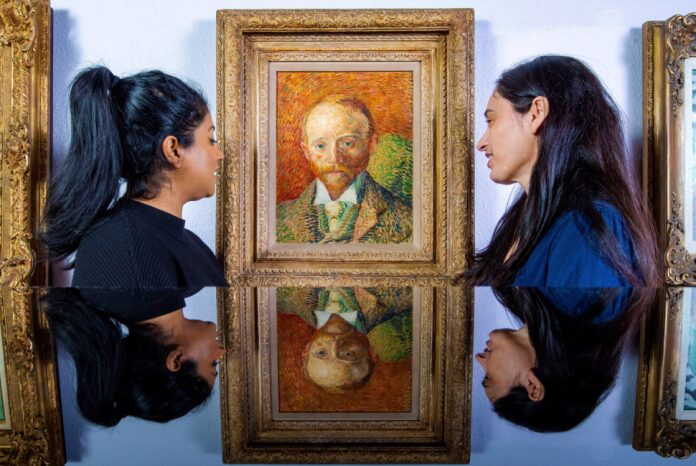
Alexander Reid lived with Vincent van Gogh in Paris, became one of his closest friends and helped transform Scotland’s appreciation of French art. His extraordinary story also involves a family mistake that cost a fortune.
For more than 40 years, one of Vincent van Gogh’s paintings was believed to be a self-portrait of the Dutch artist. The red hair, distinctive beard and intense expression seemed unmistakable.
There was just one problem. The man in the painting was Alexander Reid, a Glasgow art dealer who had shared a flat with the artist in Paris and would go on to become an influential figure in Scotland’s art world.
Their friendship was so close, and their physical resemblance so remarkable, that contemporaries frequently confused the two men.
Reid’s story is an unexpected link between Glasgow and one of the world’s most celebrated painters.
A Glaswegian in Paris
Born in Glasgow in 1854, Reid grew up surrounded by paintings. His father, James Reid, was involved in the city’s flourishing art trade, which catered to the wealthy industrialists and merchants who had made their fortunes during Glasgow’s economic expansion.
The younger Reid wanted to understand the exciting developments taking place in French painting.
In 1886, aged 32, he travelled to Paris and secured a position with Boussod, Valadon & Cie, an important international art dealership.
There he worked alongside Theo van Gogh, the younger brother of Vincent, who was managing the firm’s modern paintings department.
Theo invited Reid to share the apartment he occupied with Vincent at 54 Rue Lepic in Montmartre.
For around six months, the three men lived together, discussing paintings, visiting galleries and immersing themselves in the artistic changes taking place in Paris.
The city was home to artists including Claude Monet, Edgar Degas, Camille Pissarro and Paul Gauguin. Reid was encountering a movement that would transform his career.
He also developed a friendship with Vincent, who was still struggling to establish himself as a successful artist.
The Scottish artist Archibald Standish Hartrick, who knew them both, recalled that their resemblance was so striking that “they might have been twins”.
Van Gogh painted at least two surviving portraits of Reid in 1887.
One, showing his Scottish friend with a reddish beard against a background of swirling brushstrokes, would eventually become one of Glasgow’s most treasured paintings.
The Van Gogh paintings sold for £10
Perhaps the most remarkable episode in Reid’s relationship with Van Gogh concerns two paintings he sent home to Scotland.
They included a still life depicting a basket of apples and another portrait of Reid.
His father was far from impressed.
James Reid regarded Van Gogh’s unconventional painting style as unsuitable for the art market and feared that his son was developing poor commercial judgement.
According to research by art historian Frances Fowle, Reid’s father sold the two paintings to another dealer for a total of just £10.
The apple painting eventually entered the collection of the Saint Louis Art Museum in the United States. The other portrait has never been conclusively traced.
The episode illustrates how little commercial value Van Gogh’s paintings commanded during his lifetime, even among experienced art dealers.
Reid himself later admitted that he had failed to recognise the full extent of his friend’s genius.
A friendship that turned sour
The relationship between Reid and the Van Gogh brothers was not without difficulties.
Initially, Vincent enjoyed the Glaswegian’s company. Their shared enthusiasm for the French painter Adolphe Monticelli helped bring them together.
Reid recognised the commercial potential of Monticelli’s paintings, particularly among wealthy collectors in Scotland. As their careers developed, professional rivalry began to strain the friendship.
Vincent came to believe that Reid was becoming too concerned with the financial value of paintings rather than the artists who produced them.
Disagreements over the buying and selling of French art eventually damaged their relationship.
Yet Van Gogh would later express regret about his treatment of the Scot. In a letter to Theo in June 1889, he reflected that he had been “far, far too hard on him”.
By then, Reid was establishing himself as an important art dealer in Glasgow.
The man who brought Impressionism to Glasgow
Reid returned to Scotland in 1889 and opened a gallery on West George Street, drawing on the contacts and experience he had acquired in Paris.
Glasgow was becoming one of the wealthiest cities in Europe at the time, with industrialists, shipowners and merchants increasingly interested in collecting fine art.
Reid saw an opportunity to introduce them to paintings that were still considered controversial in many artistic circles.
He began promoting French artists including Monet, Degas, Pissarro and Édouard Manet.
In February 1892, he brought an exhibition featuring works by Degas and other French painters to Glasgow. It was one of the first serious attempts to establish a market for Impressionism in Scotland.
Winning over collectors was not easy. Many preferred traditional landscapes and portraits to the vibrant colours and experimental techniques associated with the new movement.
Nevertheless, Reid gradually helped develop a market for French modern art.
Among the collectors associated with his business were members of Glasgow’s wealthy industrial and shipping families, including William Burrell, whose collection would eventually become one of the city’s great cultural treasures.
Reid also promoted Scottish artists and helped establish connections between the Scottish and European art worlds. His influence continued into the 1920s, when Impressionist paintings were becoming increasingly desirable among collectors.
A memento of friendship
Perhaps the most enduring reminder of Reid’s extraordinary life is the portrait hanging in Kelvingrove Art Gallery and Museum.
Painted by Vincent van Gogh in 1887, it shows the Glasgow dealer with his red beard and thoughtful expression.
For decades, the work was catalogued as a self-portrait of Van Gogh.
The confusion was only resolved in 1928, when Reid’s son, A.J. McNeill Reid, recognised his father in a published catalogue of the artist’s work.
The portrait was subsequently acquired for Glasgow’s collection in 1974 at a cost of £166,250, with financial assistance including public subscriptions.
Today, it remains one of Kelvingrove’s most recognisable works.
Alexander Reid died in 1928, having spent decades championing artists whose paintings would come to be regarded as masterpieces.
Without the Glaswegian who once shared an apartment with Vincent van Gogh, some of the magnificent French paintings now associated with Scotland’s galleries might never have found their way here.