When Alan Cumming was appointed artistic director of Pitlochry Festival Theatre, he made a promise. The actor said he wanted to invite some of the world’s best theatre artists to Highland Perthshire, showcase Scottish talent and “share Pitlochry with the world, and the world with Pitlochry”.
Less than two years after taking up the job, his rural theatre revolution is gathering pace.
Cumming has helped turn the 75-year-old theatre into one of the most talked-about cultural venues in Scotland, attracting names including Ian McKellen, Graham Norton, Shirley Henderson, Simon Russell Beale and Ewan McGregor to a town with a population of a few thousand people.
His first season has combined Broadway creative teams, major Scottish actors, new writing, adventurous programming and big musicals, while plans already announced for 2027 suggest the ambition is only increasing.
Pitlochry Festival Theatre was well established when Cumming arrived. Under his predecessor Elizabeth Newman and long-serving chief executive Kris Bryce, the theatre had developed a formidable reputation as a producing house, while substantial investment had expanded and improved its facilities.
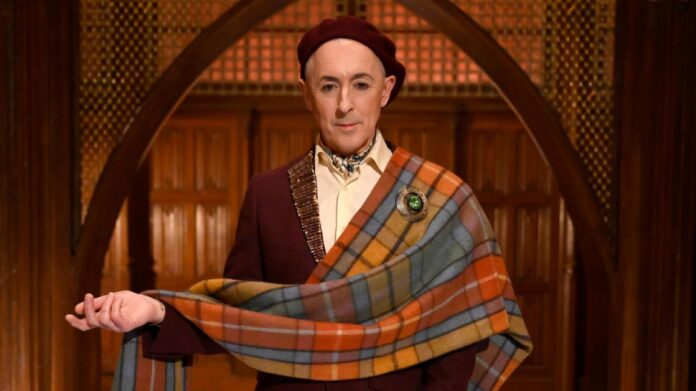
His appointment represented something of a homecoming. Born in Perthshire, Cumming began his professional theatre career in Glasgow and Edinburgh before becoming an international star through work including Cabaret on Broadway, The Good Wife, films including X2 and his more recent role hosting the US version of The Traitors.
His first full season opened with a new Scottish production of Once, reuniting members of the musical’s original Broadway and West End creative team, including Scottish director John Tiffany and movement director Steven Hoggett.
The 2026 programme has included world premieres, Scottish premieres and major revivals alongside productions involving some of the biggest creative names working in UK and American theatre.
Cumming himself starred opposite Shirley Henderson in A History of Paper, the musical by the late Scottish playwright Oliver Emanuel and composer Gareth Williams.
Then came I’ll Be Seeing You, a new Martin Sherman play about Liberace starring Simon Russell Beale and Fra Fee, which Cumming co-directed.
For the end of the year, he will take on another of theatre’s great roles when he plays Professor Henry Higgins in a new chamber production of My Fair Lady.
Maria Friedman, whose acclaimed revival of Stephen Sondheim’s Merrily We Roll Along transferred from London to Broadway and won the Tony Award for best revival of a musical, is coming to Pitlochry to direct the production.
It runs from 21 November until 31 December and is being presented by Pitlochry Festival Theatre in association with Sonia Friedman Productions.
It opens up the possibility of the Highland theatre becoming an incubator for productions with a life far beyond Scotland.
Cumming has spent decades building relationships across theatre, film, television and publishing, and Pitlochry is now benefiting from an address book few artistic directors could replicate.
Alongside the stars are Scottish writers, actors, directors and emerging artists, while new work sits beside crowd-pleasing musicals and familiar titles.
Pitlochry’s location is becoming an asset. Seeing a production there can be part of a trip to Highland Perthshire, with the theatre itself sitting beside the River Tummel and surrounded by some of Scotland’s most spectacular scenery.
Cumming is effectively selling the experience of coming to Pitlochry as much as an individual show.
Evidence of the building momentum will come in summer 2027 when Alan Cumming and Ewan McGregor will appear together in the world premiere stage adaptation of Supernova.
Adapted by Harry Macqueen from his acclaimed film, the production will be directed by John Tiffany and will run in Pitlochry from 24 July to 21 August next year.
Two internationally famous Scottish actors, the director behind Harry Potter and the Cursed Child and Black Watch, and the world premiere of a new stage adaptation could easily have been assembled for London. Instead, audiences will travel to Perthshire to see it first.
For years Pitlochry Festival Theatre has been known as the Theatre in the Hills. Under Alan Cumming, those hills increasingly look like one of the most interesting places to be in Scottish cultural life.