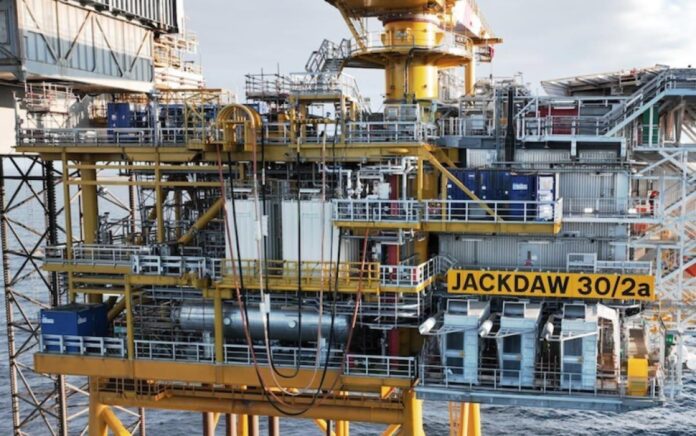
Gas has begun flowing from the £2.1 billion Jackdaw field in the North Sea as the UK Government faces mounting pressure over the future of oil and gas production.
The field, located around 150 miles east of Aberdeen, has started production less than a month after ministers granted fresh approval following a lengthy legal dispute.
Operator Adura, the Aberdeen-headquartered joint venture between Shell and Equinor, confirmed on Monday that gas is now being transported through the existing Shearwater production hub to the St Fergus terminal in Aberdeenshire.
At peak production, expected in the coming months, Jackdaw is forecast to produce enough gas to heat the equivalent of 1.4 million UK homes.
The development is expected to increase domestic gas production by around six per cent at its peak and has a projected operating life of up to 11 years.
The UK Government estimates it will contribute £2.9 billion to the economy, creating 27 direct jobs and safeguarding a further 273 positions.
Claire Mueller, Jackdaw project director at Adura, said: “Jackdaw is now helping to power Britain.”
She described the start of production as an important achievement for the North Sea workforce and said the project would reduce reliance on imported gas.
Offshore Energies UK welcomed the development and called for similar treatment of other projects awaiting approval.
Enrique Cornejo, policy director at the industry body, said: “The first gas from Jackdaw is flowing today, ready to heat our homes and power our industry.”
The project was originally approved by the previous Conservative government in 2022, but that approval was ruled unlawful by the Court of Session in January 2025.
The ruling followed a legal challenge over the failure to assess emissions produced when the extracted gas was eventually burned.
A new environmental assessment was subsequently considered by Energy Secretary Miatta Fahnbulleh, who agreed to fresh consent being granted on 14 October. The North Sea Transition Authority formally approved the project on 21 October.
The decision was welcomed by the industry but condemned by environmental campaigners, who argue that further fossil fuel production will increase emissions without significantly reducing household energy bills.
Friends of the Earth Scotland said the limited number of new jobs at Jackdaw highlighted the need for greater investment in a transition to renewable energy.
Attention is now turning to Rosebank, the much larger £8.7 billion oil and gas development west of Shetland.
The project, also operated by Adura, remains subject to a fresh approval process following the court ruling that overturned its previous consent.
Adura estimates that Rosebank and Jackdaw together could generate £1.4 billion in tax revenues before the end of the current Parliament, rising to £3.8 billion by the end of the next.
Industry representatives argue that Rosebank is important for sustaining employment, investment and the infrastructure that supports offshore production.
Environmental organisations oppose the development because of the greenhouse gas emissions associated with the oil and gas it would produce.
The issue has also exposed divisions within Labour.
Foreign Secretary Ed Miliband, who previously described Rosebank as climate vandalism when in opposition, confirmed on Monday that he would not resign from the Cabinet if the project receives approval.
Asked whether he would step down, he replied: “No, definitely not.”
He said the decision belonged to Energy Secretary Miatta Fahnbulleh and that he would abide by collective Cabinet responsibility.
Meanwhile, Conservative shadow energy secretary Andrew Bowie said Jackdaw should be the beginning of a wider approach to domestic production rather than an isolated decision.
He criticised Labour’s refusal to issue new exploration licences and its continued use of the windfall tax on North Sea producers.
The Jackdaw development also follows a change in the UK Government’s approach to the revenues generated by oil and gas.
Chancellor John Healey announced in October that a new Energy Wealth Fund would be established with an initial £2 billion allocation.
The fund is intended to reinvest proceeds from North Sea production into renewable and low-carbon energy projects, supporting jobs and the transition away from fossil fuels.
First Minister John Swinney wrote to Prime Minister Andy Burnham calling for the money to be directed towards communities and businesses in north-east Scotland.
He argued that Scotland should receive a lasting economic benefit from its offshore resources and questioned how the new fund would operate.
The Scottish Government has also continued to press for greater control over offshore energy decisions, including licensing and taxation.
Separately, the UK Government published details of its Energy Independence Bill on 4 November, confirming plans to end new licences for exploration in previously unlicensed areas.
The legislation would introduce Transitional Energy Certificates, allowing limited additional production close to existing fields and through established infrastructure.
Ministers argue that the measures would enable existing projects to operate throughout their remaining lifetimes while preventing new exploration in untouched areas of the North Sea.
The policy is designed to balance continued oil and gas production with the UK’s commitment to reach net zero by 2050.
The start of production at Jackdaw provides the first major test of that approach, with the much larger Rosebank decision still to come.