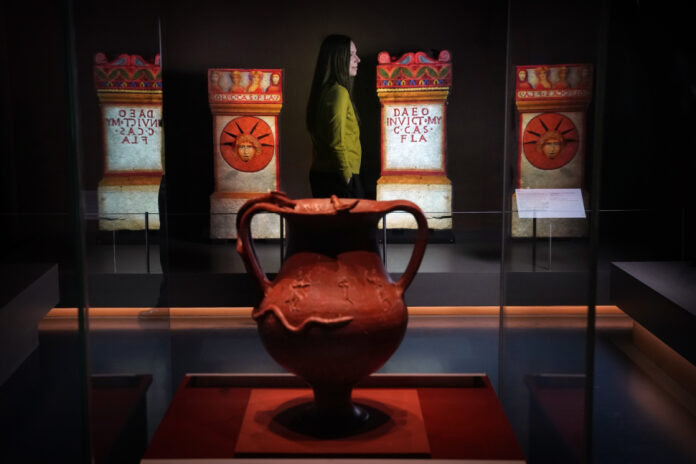
A 2,000-year-old face brought back to life, mysterious religious altars and the remains of a giant statue of a Roman emperor are among the treasures on display in a new exhibition exploring Scotland’s Roman past.
Roman Scotland: Life on the Edge of Empire has opened at the National Museum of Scotland in Edinburgh, bringing together archaeological discoveries, new research and rare objects from collections across Europe.
The exhibition challenges the familiar story of the Romans in Britain, which often ends at Hadrian’s Wall, and explores what happened when the empire pushed north into Scotland.
It reveals a lost world of soldiers, merchants, families, craftspeople and enslaved people living alongside Scottish communities whose lives were transformed by the arrival of an occupying army.
At its centre are extraordinary discoveries from Inveresk, near Musselburgh in East Lothian, where a Roman fort grew into a substantial settlement during the second century AD.
Excavations have revealed that the site was home to the most northerly known temple dedicated to Mithras, a mysterious god worshipped by members of the Roman military.
Two elaborate stone altars recovered from the temple have been conserved and are going on public display for the first time.
Dating from the AD 140s, the carvings provide a rare glimpse of the religious beliefs of soldiers stationed on Rome’s northern frontier.
Among the other highlights is the reconstructed face of a man who lived at Inveresk almost 2,000 years ago.
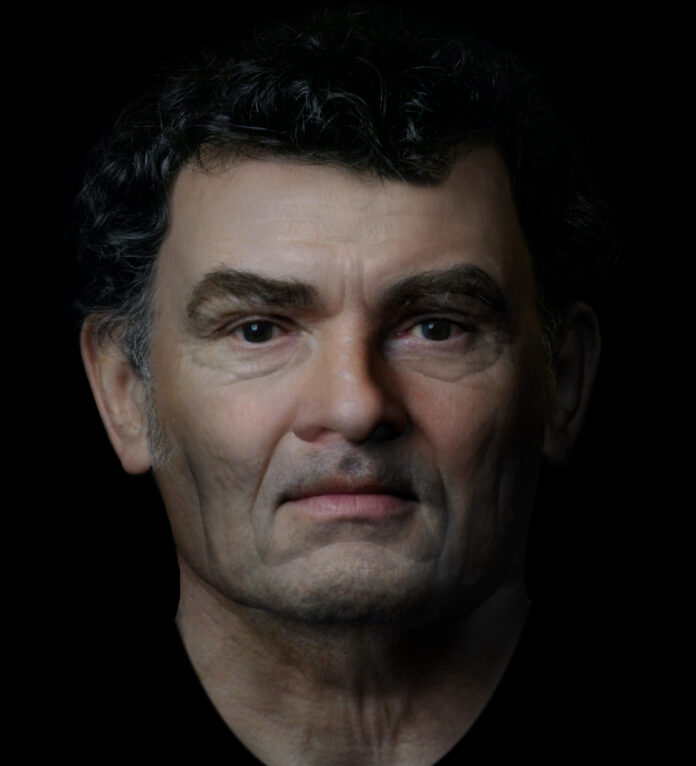
Scientists used DNA analysis, archaeological evidence and forensic facial reconstruction techniques to establish what the man may have looked like.
He had travelled hundreds of miles from southern Britain and was probably in his early 50s when he died between AD 140 and 165.
His skeleton revealed a broken nose which had healed and serious damage to his right elbow, suggesting a difficult and physically demanding life.
The man’s skull is displayed alongside a digital reconstruction of his face, offering visitors a striking connection with an individual who lived in Roman Scotland.
His burial is part of an even more mysterious discovery. Of six adult men found buried near Inveresk, four had been decapitated after death. Archaeologists have yet to establish why.
Another remarkable exhibit is a gilded bronze leg discovered in a bog near Hawick in the Scottish Borders in 1820.
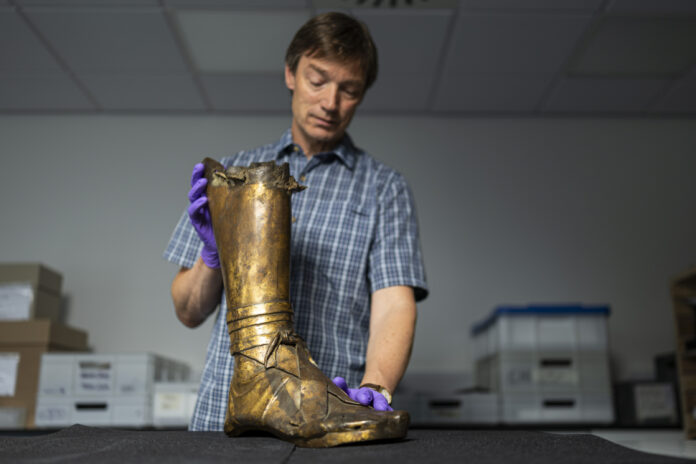
For more than 200 years, experts believed it was part of a statue brought north from elsewhere in Roman Britain.
New research suggests it belonged to a huge equestrian statue of Emperor Antoninus Pius, erected in southern Scotland to celebrate the Roman conquest.
The surviving leg has been used to reconstruct the appearance of the monument, providing a sense of the scale of imperial power once displayed in Scotland.
Dr Fraser Hunter, Principal Curator of Prehistory and Roman Archaeology at National Museums Scotland, said: “This really turns on its head our understanding of Rome’s second attempt at conquering Scotland.”
The exhibition also features a remarkable Roman brooch discovered near Pathhead in Midlothian in 2022.
Measuring just 6cm, it combines traditional Celtic metalwork with Roman designs and intricate red and yellow enamel.
Experts believe the valuable object may have been presented to a local leader as a diplomatic gift, demonstrating how the Romans attempted to secure influence through relationships as well as military force.
Objects from international collections include the earliest known surviving copy of De vita Iulii Agricolae, the Roman historian Tacitus’s account of the life of Agricola, who led campaigns into Scotland.
Together, the discoveries offer a more complicated picture of Roman Scotland than the familiar accounts of marching legions and frontier walls.
They show the extent of Rome’s ambitions, the communities that developed around its military bases and the different ways Scotland’s inhabitants responded to invasion.
The exhibition also explores why the Romans eventually abandoned their attempts to hold much of Scotland and what they left behind.
Roman Scotland: Life on the Edge of Empire runs at the National Museum of Scotland, Chambers Street, Edinburgh, until 18 April 2027.
Admission costs £13.50 for adults booking in advance or £15 on the day, with concessions and family discounts available.
A programme of accompanying events includes a Roman-themed Museum Late on Friday 20 November and craft demonstrations and pottery workshops on 21 and 22 November.
Tickets are available through the National Museums Scotland website.