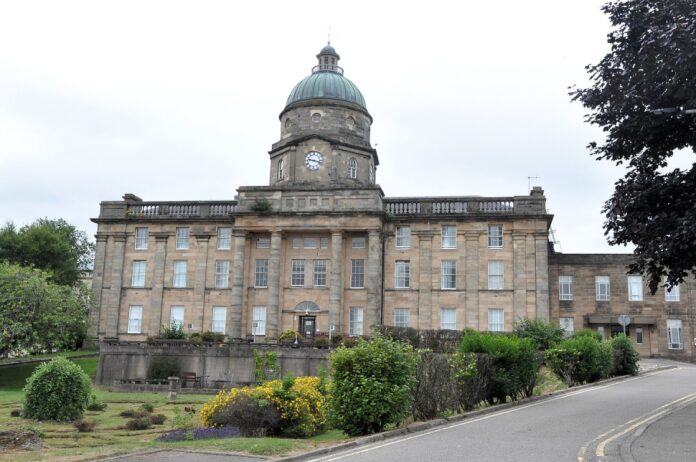
Dr Gray's Hospital. Photographer: Robert Cutts
Eighteen children underwent surgery at Dr Gray’s Hospital in Elgin after NHS Grampian had ordered the procedures to stop because of patient safety concerns.
The health board has confirmed the number of children affected and apologised to their families. NHS Grampian chief executive Laura Skaife-Knight said none of the children had been harmed.
The disclosure comes as the Scottish Government steps up its intervention at NHS Grampian, sending in a team of senior health service experts and warning that more direct control could follow unless urgent improvements are made.
Health Secretary Angela Constance told MSPs on Tuesday (17 November) that the board’s leadership had until the end of the year to demonstrate meaningful progress.
NHS Grampian will remain at Stage 4 of the government’s intervention framework, but ministers will consider escalating it to Stage 5, which would allow statutory intervention.
“The option to move to Stage 5 remains, and I will reassess the situation in six weeks’ time,” Ms Constance told the Scottish Parliament.
The announcement follows a highly critical report by Healthcare Improvement Scotland (HIS), published on 12 November, which exposed serious failings in patient safety, clinical governance and leadership across the health board.
Among the most alarming findings was the failure to implement restrictions on children’s surgery at Dr Gray’s Hospital.
Emergency paediatric surgery was suspended in June, followed by a temporary suspension of elective paediatric surgery on 9 July.
Inspectors discovered that some planned dental and ear, nose and throat operations had continued until 6 August, despite instructions to stop.
NHS Grampian chief executive Laura Skaife-Knight has now confirmed that 18 children were affected.
Speaking to STV News, she said no harm had been caused to the patients and that the health board had contacted their families.
The HIS report also identified major deficiencies in NHS Grampian’s investigation of a patient’s death during surgery.
Inspectors found that the subsequent review had failed to adequately examine the clinical decisions and actions of the surgeons involved.
More widely, the watchdog raised concerns about the health board’s failure to learn from serious incidents, poor communication between senior managers and clinicians, and weaknesses in accountability.
The report highlighted longstanding tensions between Dr Gray’s Hospital and Aberdeen Royal Infirmary, alongside difficulties recruiting and retaining medical staff.
The Scottish Government has now established an external intervention support team, led by Jim Crombie, deputy chief executive of NHS Lothian.
He will be joined by Chris Deighan, former medical director of NHS Lanarkshire; Pamela Johnston, former medical director of NHS Tayside; and Kay Fawcett, a former NHS nurse director who was part of the HIS review team.
The group will work alongside NHS Grampian’s management to improve patient safety, clinical governance and the organisation’s overall performance.
Healthcare Improvement Scotland has also been instructed to undertake a further review within three months, with ongoing independent assessments to follow.
Senior leadership changes are already under way.
Dr Graham Ellis, one of the Scottish Government’s deputy chief medical officers, took up the position of interim medical director on Monday (16 November).
John Connaghan has been appointed interim chairman, while four new non-executive board members are being recruited, replacing almost half of the board.
Ms Constance said the government was providing an unprecedented level of support but insisted that responsibility for delivering improvements remained with NHS Grampian’s board and chief executive.
She also sought to reassure communities in Moray about the future of Dr Gray’s Hospital, saying it would remain a key part of healthcare provision in the north of Scotland.
The intervention has renewed scrutiny of how long the Scottish Government has known about problems at NHS Grampian.
The health board has been subject to Stage 4 oversight since May 2025, when ministers intervened over its financial position, leadership and governance.
Scottish Labour’s health spokesperson Jackie Baillie questioned why ministers had not been alerted to serious safety concerns raised with government officials earlier this year.
Ms Constance said she had become aware of some issues at Dr Gray’s in August but had not seen the HIS diagnostic report until 29 October.
She has promised to provide Holyrood’s Health, Care and Sport Committee with a detailed timeline of the government’s involvement by the end of November.
Scotland’s Patient Safety Commissioner, Karen Titchener, has also warned that NHS Grampian must demonstrate genuine improvements rather than simply producing new plans.
She described the HIS findings as among the most serious patient safety reports seen in Scotland and said independent scrutiny was essential to establish whether changes were making a difference to patients.
NHS Grampian chief executive Laura Skaife-Knight, who commissioned the review, has accepted its findings.
“As a Board we own and accept the findings, we apologise to our patients, families and communities for letting them down and we commit to putting things right,” she said.
The health board is expected to set out its immediate priorities at a public meeting on 3 December, with a further extraordinary meeting scheduled for 21 January 2027.
Ministers will meanwhile reassess the level of government intervention within six weeks.
NHS Grampian has also established a dedicated helpline for patients and families concerned about their care, available on 08085 202030, Monday to Friday from 8am to 6pm.