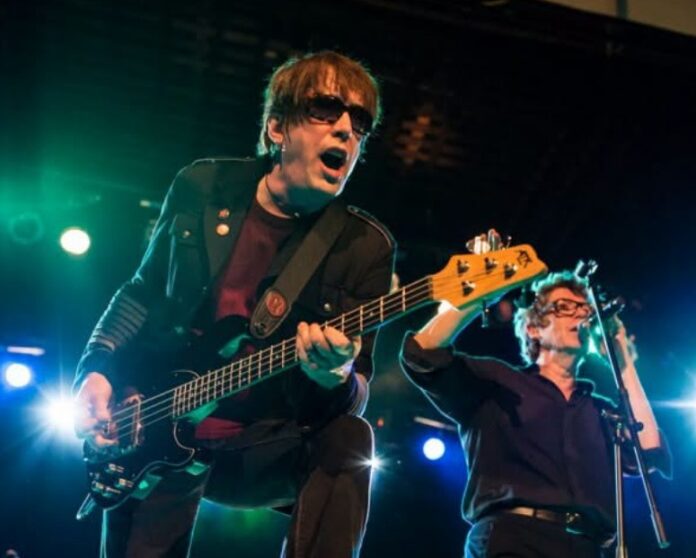
The Psychedelic Furs bassist Tim Butler has revealed he is still recovering from triple bypass surgery as the post-punk band prepares to head back to Scotland.
The musician had a pacemaker fitted after the major heart operation, which forced the Furs to scrap their entire spring and summer US tour earlier this year.
Though Tim is well enough to perform he admits it will be months before he is back to full strength.
Tim, 67, said: “I’m still recovering. It was a big thing to have a triple bypass and to have a pacemaker put in.
“It takes a few months to recover, and it’ll still take a few months to get back to 100 per cent. But I’m feeling good, and the shows are going well. So that’s all that matters, really.”
Tim formed the Furs with his older brother, singer Richard Butler, 70, in 1977.
The band will play Edinburgh’s Usher Hall on January 20 and the O2 Academy Glasgow two nights later. Both shows are part of an eight-date UK co-headline tour with East Kilbride’s The Jesus and Mary Chain.
And being off the road for so long has made Tim keener than ever to play live in Scotland again.
He said: “It’s been over a year since we’ve toured anywhere, so it’s great to get out playing. Great to get out of my bed and be walking around and playing.”
The Furs’ links with Scotland go back to the post-punk era.
Their first ever gig took place at Edinburgh’s Tiffany’s on March 17, 1980, before playing at Paisley’s original Bungalow Bar the following night.
At the time, licensing laws in Glasgow meant gig-goers would take a short train ride out of the city to Paisley Gilmour Street, a stone’s throw from the venue where up and coming bands could play to fee-paying crowds.
Tickets for the Furs’ Bungalow show cost £1.50 and the band’s name was misspelled.
So it’s probably just as well Tim’s memories of those early days in Scotland are hazy.
He said “It’s sort of a blur. I’m the one in the band that’s sort of the archivist. Richard will always ask me, ‘Do you remember this place? Do you remember that?’
“If I put my mind to it, I can remember the places. But it does tend to go into a haze of alcohol and drugs. It was the same with every band in the 80s. If you remember it, you weren’t there.”
He laughed as he recalled how the young Londoners thought Scotland would feel like another country.
He added: “It was a big thing, thinking Scotland was going to be a whole different country. We thought, are we going to need passports and stuff?
“We were sort of disappointed that the people were just the same, more or less.”
That first tour also took them to Aberdeen Ruffles.
Tim said: “We played Aberdeen and haven’t been back since. I don’t know why and we haven’t played Edinburgh for quite a while.
“My parents, when they retired, lived in Edinburgh for a few years. It’s just a beautiful city.”
But Tim saved his biggest praise for Glasgow’s Barrowland Ballroom, which the band last played in October 2025.
He said: “Barrowland is one of the best shows to play in the world. The atmosphere is magical. You can’t beat a sold-out Barrowland. It’s perfect.”
Recalling the first time the band played the venue, he said: “I remember the PA stacks being strapped down at the side of the stage and people jumping up and down. You could see the PA stacks moving, and it’s like, ‘Oh my God, the PA is going to topple over’.
“Glasgow audiences have always been great.”
The January 2027 shows reunite the Furs with the Jesus and Mary Chain after the two bands toured North America together in 2024.
Tim said: “We had fun. They were a bunch of nice guys and we like their music. I think it comes from the same basic area – the Velvet Underground, Iggy and the Stooges, that energy, that period of music. We sort of complemented each other.”
Both acts are built around a pair of brothers, with Jim and William Reid having learned to live with each other after a lengthy feud.
It’s a story as old as time when it comes to brothers making music.
Tim says he can’t understand it though he and Richard had their moments.
He said: “In the 80s we’d have fights and stuff. But after ten minutes it’d be over and we’d all be happy and partying together. Nowadays we realise we both have as important a part to play when it comes to the music.
“It’s good that Oasis made up, but I can’t see it with bands like the Kinks, where the Davies brothers don’t like each other.
“I think blood is thicker than rock and roll.
“Your brother or your sister are always going to be there for you, whereas music’s not.”
Tim believes post-punk music is now more popular than ever because the bands of that era were so inventive.
He said: “People were coming out of the punk thing, where everybody sounded the same and talked about anarchy. But then everyone went in different directions – you’d get a Depeche Mode and a Furs and a U2.
“A lot of people didn’t really know how to write a traditional song.
“It was just the fun of playing their instruments and coming up with different ideas and different sounds.”
He insists he’ll never tire of playing the band’s biggest hits, including Pretty in Pink, which went on to feature as the title track to the 1986 John Hughes film of the same name.
He said: “Whether it’s Love My Way or Pretty in Pink or The Ghost in You, when you get the audience singing along, especially in the choruses, there’s no drug that can replace that. We feed off them, and they feed off what’s coming off the stage.”
Another of the most famous songs by the band, President Gas, sounds as fresh as it did when it was recorded at a time when Ronald Reagan was US President.
And the musician hopes the mid-term results which have given the Democrats control of Congress and the Senate results will turn the rest of Trump’s term into “a lame duck presidency”.
The Furs are working on the follow-up to 2020’s Made of Rain for which Tim the band would not set a deadline.
He said: “There’s no pressure. If it started being a pressure like it was back in the day, all the fun would go out of it again.
“You’re in control of your own career, as opposed to being told, ‘Why don’t you write a song like this? This was a hit, write another one.’ No – you move on and do fresh stuff.”