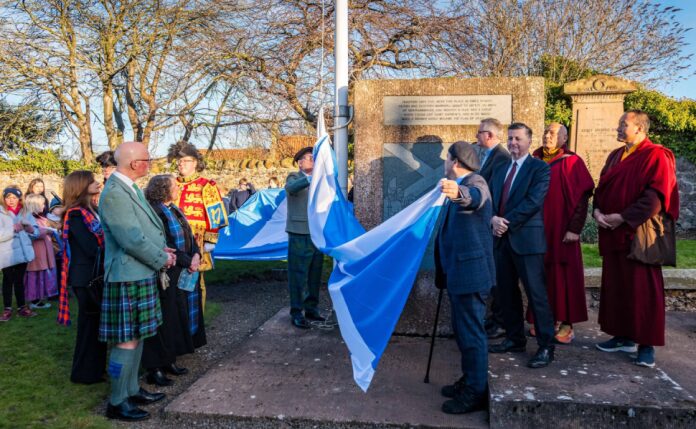
A few miles inland from the East Lothian coast, between Haddington and North Berwick, a small village has a remarkable place in Scotland’s national story.
In the churchyard at Athelstaneford, the Saltire flies throughout the day and is illuminated after dark. Tradition holds that it was in the surrounding countryside, almost 1,200 years ago, that the inspiration for Scotland’s national flag appeared in the sky.
A campaign supported by the Princess Royal is seeking to raise £300,000 to create a new monument commemorating the origins of the Saltire.
The existing memorial was unveiled on St Andrew’s Day in 1965. Decades of exposure to the elements have since taken their toll, with structural investigations concluding that repairing the concrete monument is no longer a viable long-term solution.
The Scottish Flag Trust launched its fundraising appeal on 30 November last year, marking the 60th anniversary of the memorial.
In the fundraising document, the trust says: “The Saltire stands as a universal symbol that unites everyone with Scottish Connections.
“This appeal is to create a new monument to commemorate the flag’s ancient story and replace the original deteriorating memorial in Athelstaneford Kirkyard and ensure a fitting and lasting testament to the Saltire’s remarkable story.”
The legend of the Saltire
According to tradition, in AD 832 an army of Picts and Scots led by King Angus mac Fergus was confronted by a larger Northumbrian force in East Lothian.
The armies are believed to have encountered one another near a crossing of the Peffer Burn, north of the present-day village.
Fearing defeat, Angus prayed for deliverance. A formation of white clouds appeared against the blue sky, resembling the diagonal cross on which St Andrew was traditionally believed to have been crucified.
The king interpreted the sight as a sign of divine protection, promising to adopt Andrew as Scotland’s patron saint if his forces were victorious.
The subsequent victory is said to have inspired the white cross on a blue background that would become the Scottish flag.
The precise date and location of the battle remain uncertain. The Scottish Flag Trust considers 832 to be the most likely date, while other historical accounts have suggested an earlier encounter.
What is better established is the importance of St Andrew’s Cross in medieval Scotland.
In 1385, the Scottish Parliament instructed soldiers to display a white cross of St Andrew on their clothing to distinguish them on the battlefield.
By the early 16th century, the white cross on a blue background had become an established design.
A new monument for Scotland
At the heart of the village today is the National Flag Heritage Centre, housed in a stone doocot built in 1583 by George Hepburn.
Restored and converted into a visitor attraction in the 1990s, the building contains an audiovisual presentation recreating the legend of the Saltire.
From a viewpoint behind the church, visitors can look across the farmland towards the area traditionally associated with the battle.
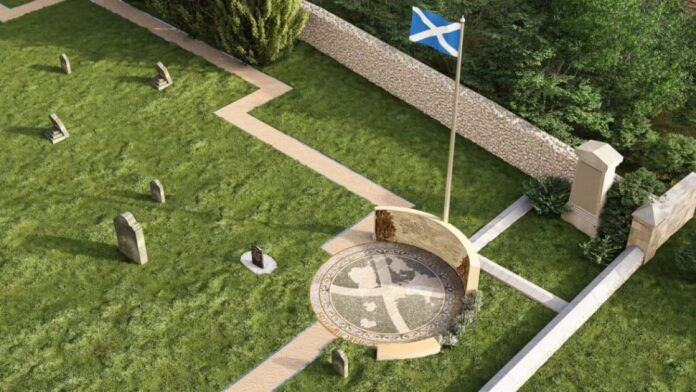
Plans for a new memorial have been drawn up by heritage architects Simpson & Brown and sculptor Tim Chalk.
The design incorporates bronze reliefs depicting the opposing armies, carved stone inspired by Pictish art and a world map marking the locations of Scottish societies established overseas.
The map will celebrate the international connections forged by generations of Scots who left their homeland and established communities around the world.
The monument will also be floodlit, maintaining the tradition of the Saltire flying continuously above Athelstaneford.
Speaking during a debate at the Scottish Parliament on 26 November, East Lothian MSP Paul McLennan said: “The saltire is a welcoming banner. It belongs to those born here, those who choose Scotland as their home.”
Athelstaneford will host its annual St Andrew’s Day celebration on Saturday 28 November.
The village’s enduring association with a symbol recognised around the world has secured its place in Scotland’s history.