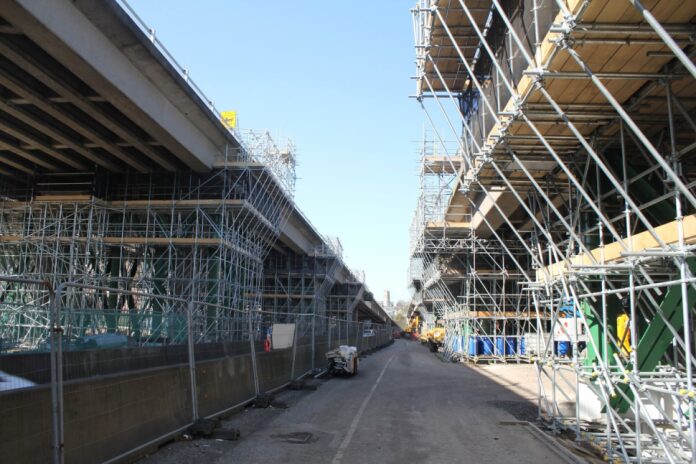
The cost of propping up the M8 through Glasgow could reach £152 million before a permanent solution is attempted, leaving transport planners facing another expensive decision: Repair the Woodside Viaducts, replace them or remove this section of motorway altogether.
More than five years after restrictions began, the temporary works remain unfinished. The latest published timetable targets the return of full eastbound capacity in autumn 2026, with propping on both carriageways expected to be completed in the second half of 2027.
For motorists, the immediate concern is when the narrowed lanes and diversions will end. For Glasgow, the larger question is what should follow decades of dependence on a motorway that carved a route through city neighbourhoods.
The current £126m–£152m estimated cost covers temporary propping, necessary before a permanent repair can even begin. Transport Scotland is developing that longer-term intervention as a separate project.
A Scottish Government information release put the estimated propping cost at £81.6m in 2023. The upper end of the current range is £70.4m higher – an increase of about 86%. Propping work was originally forecast to be complete in late 2024.
By May 2024, Transport Scotland had revised the estimated and expected full completion in early 2026, with the eastbound carriageway potentially available in summer 2025. Both milestones were missed.
Investigations in late 2020 and early 2021 found the concrete crossheads supporting the viaducts were in much worse condition than anticipated. Restrictions followed in March 2021 to reduce the load.
Engineers must install support systems at 23 locations, working around buried utilities and Subway tunnels. Each location requires an individual design. In spring 2025, a deep sewer near the Subway was found in a different position from that shown on records, creating further complications.
Transport Scotland’s undertook a consultation on the way forward for this troublesome section of the M8. Repairing and strengthening the viaducts carries an indicative construction cost of £125m–£200m and a duration of one to three years. Replacement is estimated at £200m–£500m over three to four years.
Removal is priced at less than £125m, with construction lasting one to two years.
The agency says the temporary props have a limited lifespan, require maintenance and occupy substantial space beneath the motorway, making them unsuitable as a lasting answer.
Glasgow City Council’s backing for removal has brought the wider future of the motorway into sharper focus. Demolition would create an opportunity to rethink the area, but business leaders have demanded a full assessment of the consequences for commuters, freight and access to destinations including Glasgow Airport and the SEC.
Transport Scotland’s removal scenario would divert traffic towards the M74 and local roads. Its initial assessment warns of substantial effects on traffic flows and journey reliability, alongside opportunities to improve walking, cycling and public space around the viaducts.
In July, Glasgow Chamber of Commerce called for completed technical modelling to be published before a decision. It said the removal scenario had been tested as a straight closure, without accompanying public transport investment or local road upgrades.
Chief executive Stuart Patrick said: “The modelling behind this consultation didn’t even test what removal plus investment in an alternative would look like.”
The chamber wants answers about the M74’s ability to accommodate displaced traffic, the implications for the Kingston Bridge and the long-term plan for the wider motorway corridor.
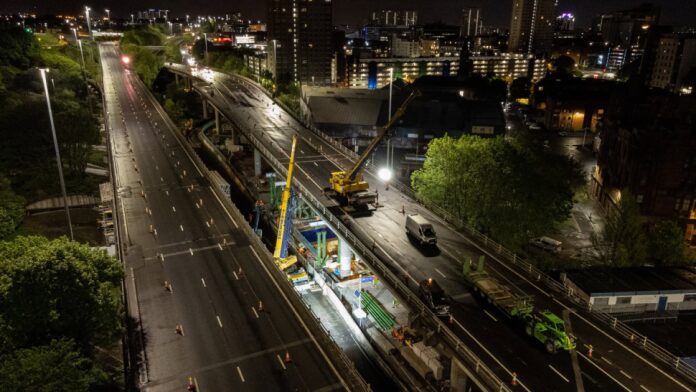
The scale of the engineering operation was underlined by the bridge-jacking programme that took place over the weekend, involving two triangular crosshead supports on the eastbound Woodside Viaduct.
Extended overnight closures between junctions 18 and 16 were in place to undertake the work, the final closure finished at 6am this morning. Diversions directed drivers onto the M74 and M73 or through local streets.
The operation forms part of the temporary support works needed to restore all four eastbound lanes later this year. It is a step towards lifting the restrictions, while the separate decision over the viaducts’ permanent fate remains unresolved. Whether the M8 has any future as a functional part of Scotland’s transport infrastructure is a question that demands an answer.