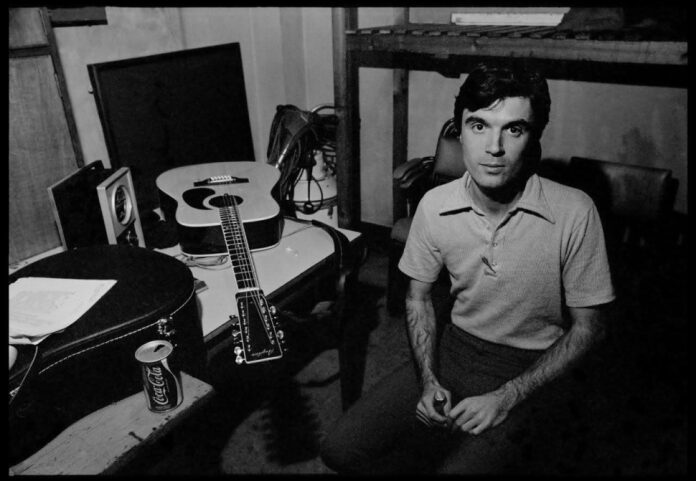
David Byrne is set to be honoured with the Outstanding Contribution to Music Award at the 2026 Scottish Music Awards.
Byrne’s story began in Dumbarton, where he was born in May 1952. Situated on the north bank of the River Clyde in West Dunbartonshire, the town lies just under 15 miles from Glasgow. He was the elder of two children born to Tom and Emma Byrne, both of whom had roots in Glasgow.
Tom was born and raised in Lambhill, while Emma’s academic achievements distinguished her from an early age. After finishing first in Glasgow in her eleven-plus examination, she earned a scholarship to attend Hillhead, then a private school.
Her academic success continued there, culminating in her receiving the prestigious Dux award, recognising her as the school’s top-performing pupil.
His parents first met at a dance in the years following the Second World War, when the young former Navy officer asked Emma to dance.
Their meeting eventually led to marriage a few years later, although their union was not without its difficulties. Speaking about the situation, Byrne recalled: “Some family members (on both sides) didn’t approve of the marriage, and boycotted the ceremony. Others threatened to sever their relationships to the young couple… Emma was able to take a few courses at the Glasgow Institute of Art and they soon set up home in nearby Dumbarton, where Tom found work as an electrical engineer.”
Following David’s birth, the Byrne family soon moved to Canada after Tom secured a position with Westinghouse Electric in Hamilton, Ontario.
The move offered the young family an opportunity to experience life in North America, with the intention of returning to Scotland after a few years. However, the arrival of David’s sister, Celia, meant those plans were put on hold. Despite settling overseas, the family continued to visit relatives in Scotland every couple of summers.
Around the beginning of the 1960s, the Byrnes relocated once more, this time to Arbutus, Maryland, where David would attend high school.
It was here that his interest in music began to take shape. He started out playing with a school band called Revelation before forming a duo, Bizadi, with Marc Kehoe. Byrne later established a band called the Artistics with Chris Frantz, a fellow student at the Rhode Island School of Design, who would eventually become the drummer for Talking Heads.
When the Artistics disbanded in 1974, Byrne and Frantz moved to New York City, with Frantz’s girlfriend, Tina Weymouth, joining them a few months later.
Encouraged by the pair to learn bass guitar, Weymouth became an integral part of the group, and Talking Heads officially took shape in 1975.
Their first live performance came on 5 June that year, when they opened for the Ramones at CBGB, the influential club in Manhattan’s East Village.
Two years later, the two bands found themselves sharing a bill in Glasgow over the same weekend in May 1977, alongside Television and Blondie.
At Strathclyde University, Talking Heads and the Ramones performed before to a crowd of around 100 people, with Blondie’s Debbie Harry watching from the back of the hall.
Talking Heads delivered a tightly arranged, rhythm-driven set, while the Ramones tore through songs from their self-titled debut album in a performance lasting around 30 minutes.
Byrne has already made two homecomings to Scotland this year. The Dumbarton-born musician played two sold-out nights at Glasgow’s SEC Armadillo in March before returning for three shows at the Edinburgh Playhouse in July as part of his Who Is the Sky? tour.
Although his family left Scotland for North America when he was young, Byrne has spoken frequently about the influence his birthplace has retained.
In an interview earlier this year, he said: “Scottish humour is very specific. I find it very funny and it can be very dark.”
Byrne has previously recalled returning to Scotland regularly as a child to visit aunts, uncles, cousins and grandparents. He said his Scottish accent stayed with him until he was around six or seven.
Byrne said that growing up partly outside American culture had given him a different perspective on the world, one that has shaped his trailblazing success in music over the decades.