“The time has come,” the Walrus said, “to talk of many things.” This column will do exactly that, every week, about the issues Scotland is talking about. And it starts with something almost nobody at Holyrood wants to discuss: giving power away.
More than a quarter of a century ago, Scotland got its own parliament. Power came north from Westminster and stopped in Edinburgh. It’s time it kept moving.
This week, in Motherwell, Prime Minister Andy Burnham said much the same. Visiting a college in the town alongside Scottish Secretary Douglas Alexander, he argued that devolution was “never supposed to stop at the doors of the Scottish Parliament”.
He called Scotland one of the most centralised nations in Europe and promised a new model of regional economic empowerment. His first concrete offer was to hand employment support out of the Department for Work and Pensions, shaped by the Scottish Government and delivered locally.
He couldn’t have picked a better stage. Motherwell was once the heart of Scottish steel, and the closure of Ravenscraig in 1992 showed what happens when a town’s economic fate is decided somewhere else. More than three decades on, much of that vast site still awaits its second life. If any town understands why economic power needs to sit closer to home, it is this one
Scotland is one of the most centralised countries in Europe.
It has 32 councils for 5.5 million people, many covering areas the size of small nations.
A councillor here represents thousands of residents; in much of Europe the figure is a few hundred. Local democracy that distant isn’t really local at all.
Worse, councils have steadily lost the means to act. Budgets are set in Edinburgh, much of the money arrives ring-fenced, and council tax has been frozen by ministerial decree.
Police and fire were merged into national services.
Councils are left to manage decline and take the blame for it. No wonder so many councillors are scunnered.
Moving real power down would change that, in four ways:
Better decisions. People in Dumfries, Lerwick and Lanarkshire know their own transport, housing and high streets better than a civil servant at Victoria Quay.
Accountability. When a council raises and spends its own money, voters know who to reward or punish. Today everyone can blame someone else.
Growth. Our city-regions compete with Manchester and Birmingham, whose elected mayors now hold real budgets for transport, skills and housing. Glasgow and Edinburgh deserve the same tools.
Healthier politics. Strong councils train future leaders, give opposition parties somewhere to govern, and stop Holyrood behaving like an oversized county council.
Burnham is worth listening to on this. As mayor of Greater Manchester he spent a decade showing what a city-region can do with real levers over transport, skills and housing. His diagnosis of Scotland is the right one, and his talk of bringing buses under public control in Glasgow will land well in Lanarkshire.
The Motherwell speech was long on principle and short on detail. He named no specific powers beyond employment support, and said nothing about the money that would have to follow them. Without fiscal devolution, local power is just local administration.
And there is an awkward truth in his offer. Power can only flow below Holyrood if Holyrood lets it go. Burnham framed it as a genuine offer to work with John Swinney’s government, but it is ministers in Edinburgh, not Westminster, who hold most of the keys.
Do Burnham and Swinney get on?
Better than many expected, so far. When they first met as Prime Minister and First Minister in Glasgow in July, Swinney’s office said Burnham had committed not to bypass Holyrood when devolving power.
Burnham’s offer was pitched as genuine, with both men openly accepting they will disagree on independence. The friction is real but contained: Swinney has made the North Sea windfall tax his biggest grievance, and Burnham will not discuss a second referendum.
Two pragmatists, wary of each other, each needing the other to deliver. It’s no’ a romance, but it’s no’ a stooshie either.
The more interesting response came from Stephen Flynn. The former SNP Westminster leader, now an MSP and Swinney’s Economy Secretary, said that if Burnham has good ideas the SNP will “take them and run with them”, while insisting the real shortcut to power is independence. That is a notably warmer tone than his party usually strikes towards Labour, and it comes from the minister whose brief covers exactly the economic powers Burnham is talking about.
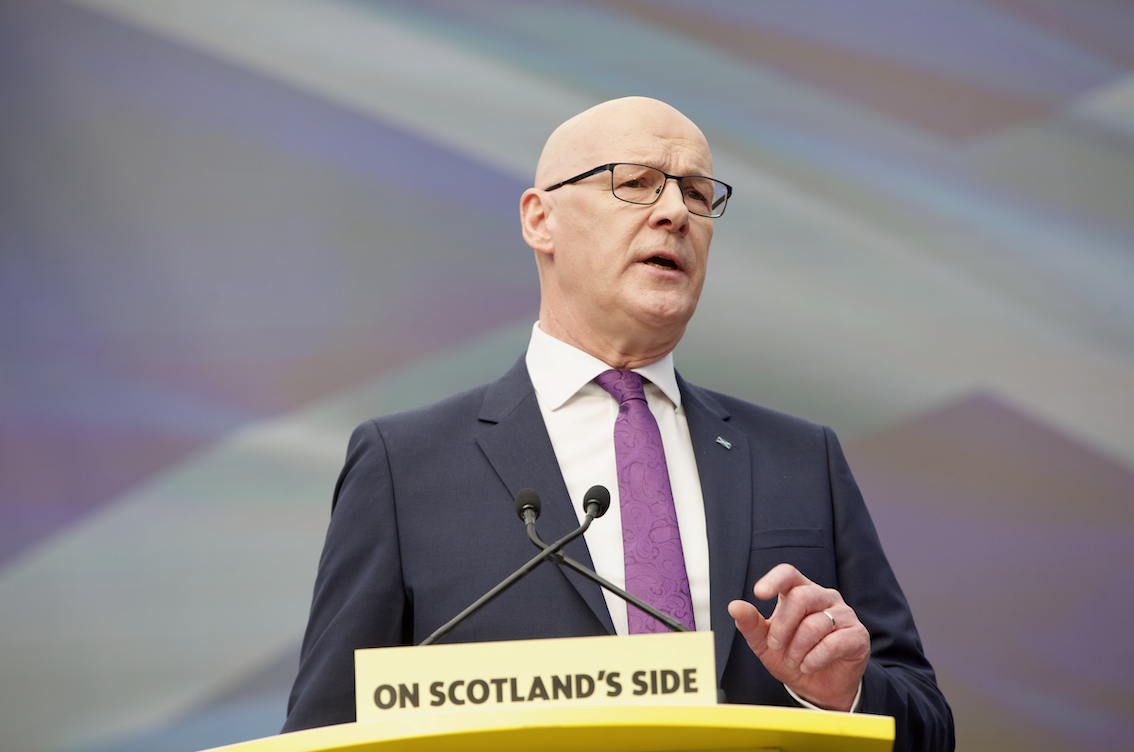
Is Flynn positioning himself as Swinney’s successor?
He has said in the past that he had not considered a leadership bid, but he is widely tipped as the frontrunner, and his move from Westminster to Holyrood this year made a run possible. Sounding open-minded and grown-up on devolution, while holding the independence line, is exactly how a wannabe First Minister would act.
A Walrus that only heard one side of the argument wouldnae be worth a button. The objections deserve a fair hearing.
The postcode lottery: Devolve power and services will differ from place to place. Potholes in Glasgow would be deeper than in Aberdeen some would argue ! Supporters call that local choice; critics call it unfairness, especially in care and education.
Capacity: Do councils have the people to do this? The hardest question of all, taken up below.
Unequal places: Wealthier areas with strong tax bases would pull ahead. Glasgow’s challenges are not Aberdeenshire’s, and some redistribution will always need a national hand.
Another layer: Regional mayors or combined authorities risk adding politicians and bureaucracy rather than replacing them.
Holyrood’s mandate: Ministers argue that national standards in health, schools and policing are exactly what voters elect a parliament to deliver.
The capacity question deserves more than a bullet point. Running employment support, regional transport or economic development is serious work, and it needs serious, smart, people.
Here is a simple question. How many of Scotland’s 1,226 or so councillors have ever run a business or managed a large budget?
Nobody knows.
The Scottish Government’s own survey of candidates at the 2022 council elections found that two-thirds were in some form of paid work and a third were not. It never asked what that work was.
We hand councils budgets running into hundreds of millions of pounds, and we do not even record whether the people overseeing them have ever run anything comparable.
To be fair, councillors do not sign off every invoice. Day-to-day spending is run by chief executives and finance directors, many of them highly capable professionals. The real test is whether councillors can set a clear strategy and hold those officials to account. That is a skill too, and on current evidence nobody can say how widespread it is.
The honest answer is that capacity follows responsibility. Manchester did not have a mayoral machine ready and waiting in 2014; it built one because it was given something worth doing. But it would be naive to pretend Scotland’s councils could take on major economic powers tomorrow. Hand them over before the talent is in place and the first high-profile failure will be used to argue for taking everything back.
Then there is the politics. A Labour Prime Minister urging an SNP government to give power away will look to some in Edinburgh like an attempt to go round them. Burnham’s refusal to rule a second independence referendum in or out will not settle those nerves.
These are real risks. None of them is a reason to do nothing.
If the talent question is the obstacle, here is a way through it. Scotland should elect three regional mayors: one for Strathclyde, one for Grampian and one for Edinburgh and the Lothians.
The names are deliberate. Strathclyde, Grampian and Lothian were real regions until 1996, and they still make economic sense.
Strathclyde covered almost half of Scotland’s people and remains the country’s industrial heartland, Motherwell included.
Grampian is the home of energy, from North Sea oil and gas to the offshore wind that must replace it.
Edinburgh and the Lothians are the engine of finance, tourism and the capital’s universities.
Each mayor would hold real levers over transport, skills, employment support, inward investment and strategic planning. They would absorb the existing city-region deal boards rather than sit on top of them, answering the fair charge that mayors simply add another layer.
Most importantly, the jobs would be big enough to attract big people. Bite the bullet. Pay them £500k per year.
The model is Manchester and the West Midlands, where the mayoralty drew candidates who had run large organisations and won large mandates. Scotland’s mayors should be people with three things rarely found together: serious business experience, political judgement, and the ability to lead and persuade people. A regional mayoralty, properly paid and properly powered, would tempt those people into public life in a way a seat on a council committee never will. We could fund this talent and high calibre support teams by demolishing some of the 130 plus quangos which at the last count cost Scotland £6.6bn per year.
And while I’m in a generous mood pay MSPs north of £100k and more talent will be attracted to roles which attract unwanted attention and the grief that politicians regularly have to put up with. Then we wouldn’t have to put up with Ministers who think Transport Scotland is a charity.
The Answer
Trust the people who live here to run their own affairs.
That means three things.
First, a fair, multi-year funding settlement that lets councils plan beyond the next budget.
Second, real tax-raising powers, starting with an end to the council tax freeze-and-thaw cycle and genuine reform of the tax itself.
Third, a statutory guarantee of local powers, so they can’t be quietly clawed back when Edinburgh changes its mind.
And a deliberate drive to build talent in local government, from better-paid councillors to shared expert teams across city-regions, so that new powers land on very capable shoulders.
Holyrood was built on a simple principle: decisions about Scotland should be made in Scotland.
Andy Burnham has opened the door. Holyrood should walk through it, rather than treat the offer as a trespass.
If the Scottish Government means what it says about decisions being made closer to home, it should prove it by going further than Westminster asks.
The time has come.