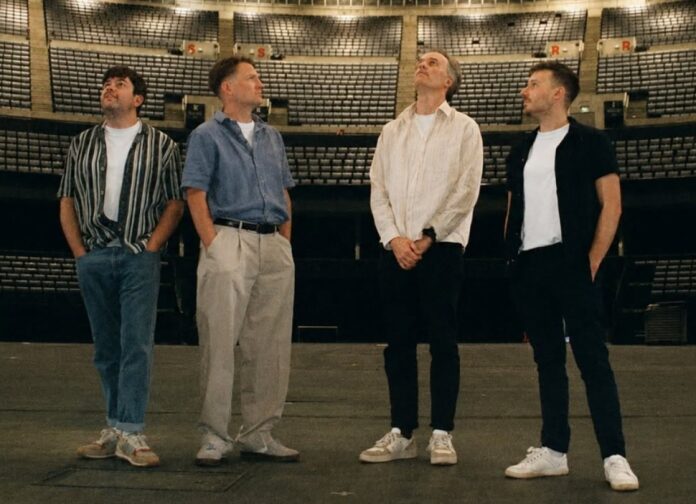
For Robert Robertson, selling out the Barrowland Ballroom once felt like the ambition. Ten years into Tide Lines, the singer is preparing to walk onto the stage at Glasgow’s OVO Hydro for the biggest headline show of the band’s career.
The Scottish four-piece will celebrate their tenth anniversary at the arena on Saturday 19 September. Formed in 2016, they have carried the Highland folk traditions at the heart of their music into rousing songs built for a crowd, steadily building an audience through touring and independently released albums.
Their debut single, Far Side of the World, remains a signature song, while Glasgow Love Story celebrates the city where the band found their voice. The Hydro follows three consecutive sold-out nights at the Barrowlands, another marker on a journey Robertson describes as a gradual ascent.
Ahead of the anniversary show, he spoke to Scottish News about the leap to an arena, his musical upbringing and why there is still no substitute for standing in a room with an audience.
Did you ever imagine Tide Lines would headline the Hydro?
No, certainly not. A few years ago, this wasn’t something that felt like a possibility. Obviously, you start a band and you’ve always got ambitions to take it as far as you can.
In 2019, we played the Barrowlands for the first time, and that felt like an ambition that was probably realistic: starting a band and getting into an iconic room like that.
A few years after that, we did the Barrowlands three nights in a row. It was at that point we started thinking: what next? There’s not much between that size and taking the big gamble of going for the Hydro.
We were reticent to do it because of the scale. When we finally decided to do it, we put it on sale and our fans reacted really positively. We’re a lot more relaxed than we were.
Has there been a breakthrough moment along the way?
We’ve never had one single go absolutely nuts, or anything on TikTok that’s rocketed us to millions of people. It’s just been doing the gigs, releasing the albums and growing the fanbase gradually to this point, where we can do the Hydro after ten years.
Because of that, the fans who are with us now really feel part of the story. That’s quite powerful. They’ve invested in it.
The first time you headline the Barrowlands and sell it out – I think we sold the first gig out in four or five minutes – that’s always like: wow, there are people here wanting to hear us.
A couple of years ago, we did the Shepherd’s Bush Empire in London, which is about 2,000 tickets. Our first gig in London had been to 150 people in the Water Rats. That felt like a big moment.
The things you always remember are the experience of standing up in front of thousands of people, then walking off stage and going: wow, they were all singing our songs.
Is connecting with an arena crowd very different from playing a small room?
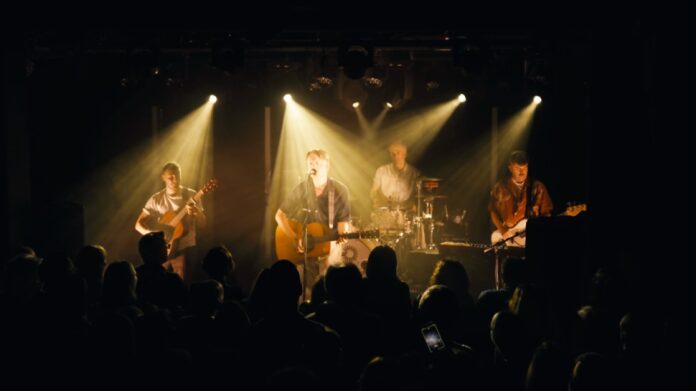
There are slightly different things you have to do, but the principle’s the same. Whether it’s 300 people or 10,000 people, you’re all there in this communal experience of being together in that room and celebrating music.
You’re all going through the same hour and a half of music together, but you’re all maybe experiencing it differently. You’ve all got different things going on in your lives, and you’re coming that night with different thoughts and feelings.
Music really unites you all in that room. I find that so powerful, whether it’s 300 in the art school in Glasgow, which we went back to this summer, or the big one in the arena. I find it equally moving.
What happens backstage before a Tide Lines gig?
We all stick together. When you’ve been touring with a band for ten years, you know each other pretty intimately, and we’re very good friends. We don’t have separate rooms or anything like that.
We’re usually just having a bit of a laugh backstage. Maybe ten minutes before we go on, especially for a big gig, you start having to really focus the mind. I’m the singer, so I do a lot of vocal exercises, and you’re looking at your setlist, getting it in your head.
A couple of the boys will probably have a wee wine before we go on, but I’ll leave it until afterwards for my singing voice. The first thing I go for is a cold can of lager as soon as we’re offstage.
What opportunities did you have to make music growing up in the Highlands?
It was very much that traditional Scottish Gaelic Highland thing, which was a brilliant musical upbringing. The outlets were basically ceilidhs, concerts, dances, accordion and fiddle clubs.
For the first 16 years of my life, that was what I did, and I loved it. Then I moved down to Glasgow and initially went towards places like the Park Bar, venues built around that tradition. That’s when I met Ross, the keyboard player in Tide Lines.
In the Glasgow music scene, the big melting pot of genres that it is, I started developing a sense that I wanted to take that folk tradition and carry it into something more mainstream and rock ’n’ roll. That’s where the seeds for Tide Lines were sown in my mind.
How did the band’s different musical tastes help shape the sound?
Gus, the drummer, isn’t from the same musical background as me whatsoever. His previous band was Sucioperro, a much heavier rock band.
Ali is more mainstream pop, I’m a big Springsteen fan, and Ross is into a lot of the electronic side of things. The four of us were able to merge all those sounds.
Glasgow was the perfect place to do that because it’s a city that’s very open to different genres. Even within the traditional canon, things like Celtic Connections are very wide in their scope.
Which artists were part of your musical upbringing?
Growing up in the Highlands, Runrig and Capercaillie, all those bands that were breaking boundaries in the Eighties and Nineties, inspired you to realise that this musical culture of ours can go far.
My dad’s not musical in the slightest, but he loves folk music and a lot of American stuff: Bob Dylan, Joan Baez, the Beach Boys, Nanci Griffith a bit later. I was exposed to a lot of that.
From a young age, I didn’t really see much of a difference between that and Scottish folk music, perhaps because they are one and the same if you go back far enough. That speaks to a lot of the Tide Lines influence, and why later I would get into Springsteen and more recent acts like the Killers. It all comes from the same place.
Does taking Gaelic music to audiences overseas have a particular meaning for you?
Definitely, very much so. Within an hour-and-a-half Tide Lines set, we’ll have a Gaelic song. Most of our songs are our own material written in English, but we’ll always put a Gaelic song in just to say: this is where it comes from, this is what we were brought up with.
We’ve had the privilege of doing that across Europe. You get local people in Berlin, Amsterdam or Copenhagen singing back the chorus, and it’s amazing. It feels like we’re doing something culturally important as well. There are a lot of bands that do it, and it’s always a really nice feeling.
Why is touring still so important when people can discover music online?
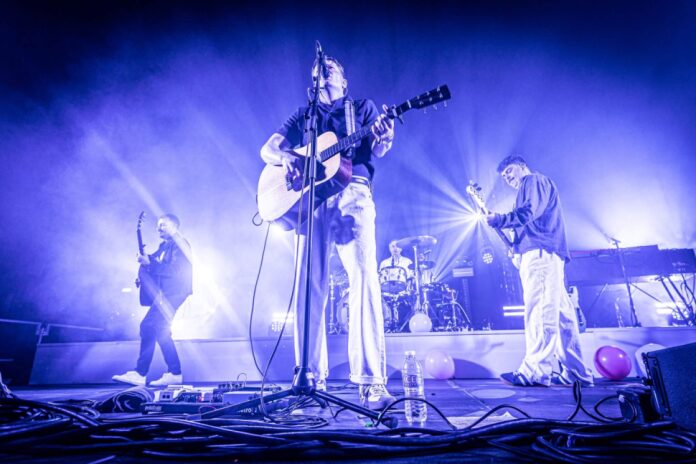
Any artist can become famous very quickly now, which is great, but there’s still no substitute for getting out and playing live. It hones your skills and your craft.
Every week I come across artists on Spotify and think: that’s magic. Sometimes they really mean something to you and they stick; other times you forget about them. If you stand and hear a band live, it’s going to be more difficult to forget about that.
We were just playing Lindisfarne Festival in Northumberland. I imagine probably 80 per cent of the audience had never heard of Tide Lines, but they were a brilliant crowd, ready to receive new music and really engaged.
By the end, we had them singing choruses. I left the stage thinking we’d definitely won new fans who had enjoyed an experience with us. You don’t get that personal connection online that you do when you’re looking at the whites of their eyes in person.
Will the Hydro feel like a gathering of the wider Tide Lines family?
We always feel very supported by our home communities, but there seem to be people coming from all over. When we were touring Europe earlier in the year, a lot of people were saying: we’ve booked flights to come to Glasgow to hear you.
The Tide Lines family seems to stretch far and wide, and I think it’s going to be a big celebration of that. We’ve got a big following within Glasgow, and our Glasgow shows are always our biggest shows. There’ll be a lot of local people as well. It’s going to be a great night. I’m really excited for it.
What do you want the next decade to bring?
We want to continue to do this because we feel very lucky. Singing is something I’ve loved doing since I could talk. Since I was two or three, I was wandering around the house singing.
To be doing this as a career, and to have had the joy of playing with Tide Lines for ten years, I now want to be celebrating 20 years of Tide Lines in ten years’ time.
After the Hydro, we’ve got some Scottish tour dates at the end of November and the start of December to finish off this ten-year celebration. We’ll go into smaller towns in Scotland and try to take as much of the Hydro show to them as possible.
The long-term future is a bit of a blank canvas, but very much hoping to still be doing this in years to come.
Tide Lines play the OVO Hydro, Glasgow, on Saturday 19 September 2026.