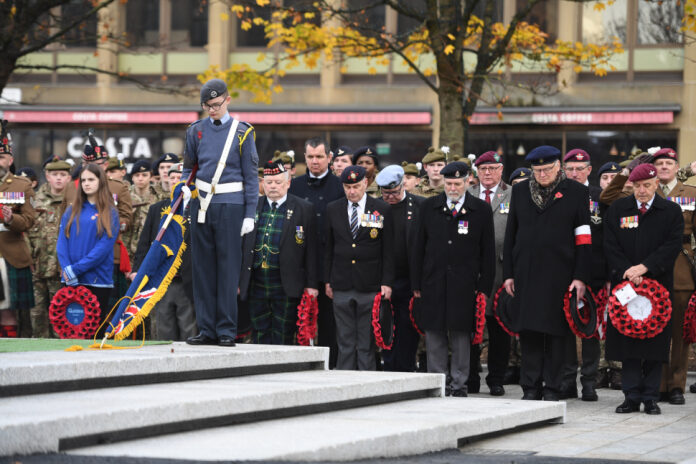
Communities across Scotland fell silent on Remembrance Sunday as veterans, serving military personnel and members of the public gathered to remember those who lost their lives in war and conflict.
Services and wreath-laying ceremonies were held in cities, towns and villages on Sunday (8 November), with a two-minute silence observed at 11am.
In Edinburgh, First Minister John Swinney joined veterans, military representatives and civic leaders at the Stone of Remembrance outside the City Chambers on the Royal Mile.
A military parade made its way from Edinburgh Castle, led by the RAF Central Scotland Pipes and Drums, followed by veterans, cadets and the Highland and Lowland Bands of the Royal Regiment of Scotland.
The One O’Clock Gun at Edinburgh Castle fired at 11am to mark the beginning of the silence, before a short service led by the Rev Dr Scott Rennie, minister of St Giles’ Cathedral.
Among those attending was 100-year-old Second World War veteran George McLeod, who served with the 4th Battalion of the King’s Own Scottish Borderers.
Mr Swinney laid a wreath alongside Scottish Secretary Douglas Alexander, Edinburgh Lord Provost Robert Aldridge and senior representatives of the Armed Forces.
The First Minister also paid tribute to Charlie Horne, one of Scotland’s last surviving D-Day veterans, who died aged 100 shortly before Remembrance Sunday.
Mr Horne served aboard a minesweeping vessel off Omaha Beach during the Allied landings in Normandy in June 1944.
Mr Swinney said: “The people of Scotland will always remember and honour those who gave the ultimate sacrifice to defend our freedom and values.”
In Glasgow, the city’s main Remembrance Sunday service returned to George Square for the first time since redevelopment work forced last year’s ceremony to move to Glasgow Cathedral.
The gathering at the Cenotaph was also the first major public event in the newly transformed square, where a £20 million redevelopment is nearing completion.
Glasgow Lord Provost Jacqueline McLaren led the commemorations, attended by veterans, serving personnel, faith leaders and members of the public.
A Guard of Honour was provided by the Scots Guards, with military bands and pipers taking part in the ceremony.
The Last Post and Flowers of the Forest formed part of the commemorations before the two-minute silence and the laying of wreaths at the Cenotaph.
In Aberdeen, hundreds gathered for a military parade through the city centre to the War Memorial on Schoolhill.
Veterans, serving personnel and civic leaders joined the procession before observing the silence and laying wreaths in remembrance of the fallen.
Commemorations were also organised in Dundee, with a parade through the city centre and services at St Mary’s Church, Dundee Law and the Submariners’ Memorial.
In Stirling, a service at the Church of the Holy Rude was followed by a procession to the Cenotaph on Corn Exchange Road, with serving personnel from HMS Stirling Castle among those taking part.
Across North Lanarkshire, ceremonies were arranged in Coatbridge and Motherwell, while representatives of the Lanarkshire Lieutenancy were due to lay wreaths at nearly 70 war memorials over the weekend.
Scottish Secretary Douglas Alexander said Remembrance Sunday was an opportunity to honour the sacrifices of previous generations and recognise those who continue to serve.
He said: “We owe a debt to those who have served that can never be fully repaid.”
The commemorations in Scotland coincided with the national service at the Cenotaph in London, where King Charles led the country in remembering those who died in the two World Wars and subsequent conflicts.
Further commemorations will take place on Armistice Day on Wednesday (11 November), marking 108 years since the guns fell silent at the end of the First World War.