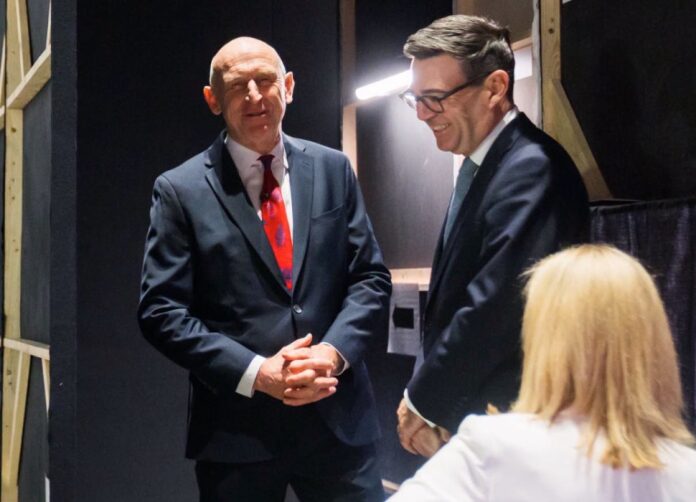
Prime Minister Andy Burnham and Chancellor of the Exchequer John Healey have used speeches to Labour conference to lay out priorities for the UK Government.
Healey forecast a positive future for young people yesterday and signalled new investment in industrialisation across the economy. Today it was Andy Burnham’s first Labour conference speech as Prime Minister. He chose to focus on plans for reform of pensions, social care, enegry and housing.
Speaking to delegates in Liverpool, Burnham said Britain needed an “honest conversation” about how some of its biggest long-term problems would be paid for.
Among the announcements that emerged during his address was his intention to replace the state pension triple lock after the next general election, with savings used to help fund a new National Care Service.
The existing triple lock guarantees that the state pension rises each year by whichever is highest out of average earnings growth, inflation or 2.5%.
Burnham said it would remain in place for the remainder of the current Parliament. Under the proposed replacement, pensions would continue to rise by inflation or 2.5%, whichever is higher, while the Government would seek to maintain their value relative to earnings over the longer term.
The Prime Minister linked the change directly to his ambition to establish a National Care Service offering free care without means-testing.
Social care is devolved, meaning the proposed National Care Service would principally affect England rather than replace Scotland’s existing social care system. Changes to the state pension, however, would apply across the UK.
Burnham confirmed plans for Great British Grid, a new publicly owned body within Great British Energy which would invest directly in electricity infrastructure.
The Government says the organisation will help accelerate connections to the electricity grid, support renewable energy projects and increase competition in an industry currently dominated by private network operators.
Up to £4 billion could initially be available through existing Great British Energy funding, although substantially more investment will be required across Britain’s electricity network over the coming years.
Scotland’s electricity network is currently operated principally by Scottish Power Energy Networks and Scottish and Southern Electricity Networks, while the National Energy System Operator oversees strategic planning for the wider Great Britain system.
The Scottish Government says significant new network infrastructure is needed to transport increasing amounts of renewable electricity from Scottish projects to homes and businesses across Scotland and the rest of the UK.
Burnham’s plan is intended in part to tackle long delays in securing grid connections. Some electricity projects across the UK currently face waits stretching many years before they can connect to the network.
Faster investment could have consequences for Scottish offshore wind farms, onshore renewable developments and major industrial projects requiring access to additional electricity capacity.