Harry Kane’s prestigious Ballon d’Or win follows another incredible season as Bundesliga club Bayern Munich’s predatory striker – making him the first Englishman to pick up the trophy in a quarter of a century.
Kane collected the award at the Palladium Theatre in London.
But for a certain generation north of the border the mention of the prestigious award will bring back memories of the one and only Scot to have won it.
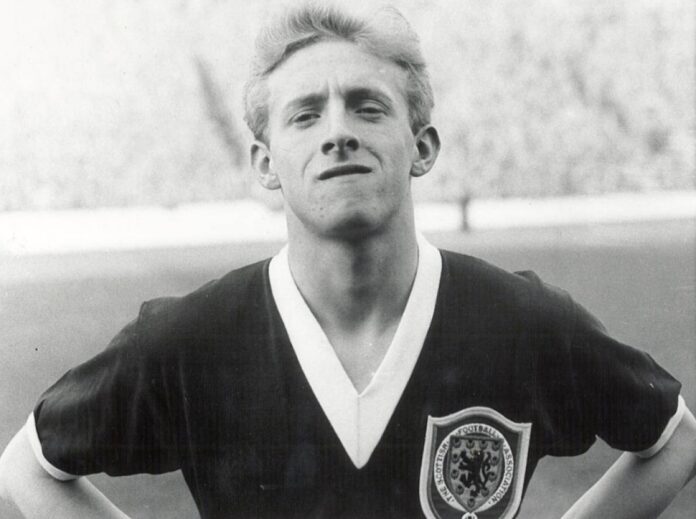
Denis Law, the son of a trawlerman from Aberdeen, remains a sporting hero long after he collected the Ballon d’Or in 1964.
Law, who died in January last year aged 84, grew up a bespectacled boy with a squint but he went on to become one of the world’s greatest footballers of all time.
He made his debut in the English second division, playing for Huddersfield Town when he was just 16.
Manchester City paid a British record transfer fee of £55,000 for him in March 1960.
At Maine Road, he once scored six goals in an FA Cup tie at Luton, only for the referee to abandon the match on a waterlogged pitch. City lost the replay. Law scored in that one too.
Italy’s Torino came calling in 1961, but he didn’t settle and it was another Scot, Manchester United manager Matt Busby, who next signed him for £115,000 – the third time in little more than two years that Law had smashed the UK transfer record.
Known as ‘The King’ at Old Trafford, he scored 237 goals in 404 appearances for Manchester United, a tally bettered only by Wayne Rooney and Sir Bobby Charlton.
The 1963-64 season saw him bag 46 goals in all competitions, a club record that still stands – leading to his Ballon d’Or win.
His medals came from an FA Cup in 1963, league titles in 1965 and 1967, and the European Cup in 1968 – though cruelly, a knee injury meant he missed the Wembley final against Benfica and watched the game from a hospital bed.
Alongside George Best and Charlton, Law formed the Holy Trinity, now immortalised in bronze outside Old Trafford.
All three won the Ballon d’Or, a statistic no club side in Britain has matched since.
But it was in dark blue that Law’s legend was truly forged in Scotland. At 18, he scored on his international debut against Wales.
He won 55 caps and scored 30 goals, a record he shares with Kenny Dalglish – who needed 102 games to reach the same mark.
His contempt for the Auld Enemy was the stuff of folklore. On the afternoon England won the World Cup in 1966, Law refused to watch and took to the golf course.
When the news reached him, he said it had ruined his round.
Within a year he had his revenge, scoring the opener as Scotland taunted and beat England 3-2 at Wembley in 1967, a day in which Scots crowned themselves unofficial champions of the world.
Released by Manchester United in 1973, Law returned to the club’s rivals City for one last season.
In April 1974 he backheeled the winner in the Manchester derby. He didn’t celebrate. He trudged off, head bowed. United went down that season.
That summer, he finally reached a World Cup, playing his last game for his country against Zaire in West Germany – Scotland’s first ever World Cup win.
England captain Kane’s numbers are staggering.
He scored 61 goals in 51 club matches last season, the most a Bayern player has ever struck in one campaign. Including England matches, it was 73 goals - plus eight assists - in 65 matches.
Like Kane, Law had a predator’s instinct for goals.
His trademark salute – one arm raised, cuff clutched in his fist – became one of the most imitated celebrations in British football.
Every schoolboy in Scotland who played in the street tried to emulate it after putting the ball between jumpers for goalposts or rattling it against the railings.
Scott McTominay’s presence on last year’s Ballon d’Or shortlist might offer a flicker of hope that another Scot might one day follow Law’s achievement.
McTominay finished 18th in the 2025 voting after an outstanding Serie A title-winning campaign with Napoli.
Caroline Weir achieved Scotland’s highest-ever finish in the women’s award, placing 25th in the 2026 Ballon d’Or Féminin, after starring for Real Madrid.
The Ballon d’Or – French for “Golden Ball” – is the most prestigious individual award in world football. Launched in 1956 by the Paris-based magazine France Football, its first winner was England’s Sir Stanley Matthews, which is why this year’s 70th edition was staged in London, the first time the ceremony has been held outside Paris.
For its first four decades the prize was open only to European players, which meant legends such as Pelé and Diego Maradona never won it in their pomp.
Non-Europeans playing for European clubs became eligible in 1995, and the award went fully global in 2007.
Between 2010 and 2015 it was merged with FIFA’s World Player of the Year award before the two went their separate ways again. A women’s Ballon d’Or was added in 2018.
The winner is chosen by a panel of 100 journalists from around the world, who rank their top players from a 30-man shortlist.
Since 2022 it has been judged on a player’s performances over the previous season rather than the calendar year.
Lionel Messi holds the record with eight wins, while only a handful of British players – Matthews, Denis Law, Bobby Charlton, George Best, Kevin Keegan, Michael Owen and now Harry Kane – have ever got their hands on it.
Scotland’s Ballon d’Or record
1964, Denis Law – Winner, nominated seven times.
1983, Kenny Dalglish – 2nd Place (runner up), nominated six times
1967, Jimmy Johnstone – 3rd Place
1983, Gordon Strachan – 4th Place
1967, Tommy Gemmell – 6th Place
1984, Graeme Souness – 6 th Place
2025, Scott McTominay – 18th Place