Adam Sinclair: “Returning to the stage at the Fringe reminds me why I fell in love with acting in the first place”
Adam Sinclair has spent most of last 25 years living in Los Angeles, building an acting career in television and film. This summer he is back where it began – on a Scottish stage.
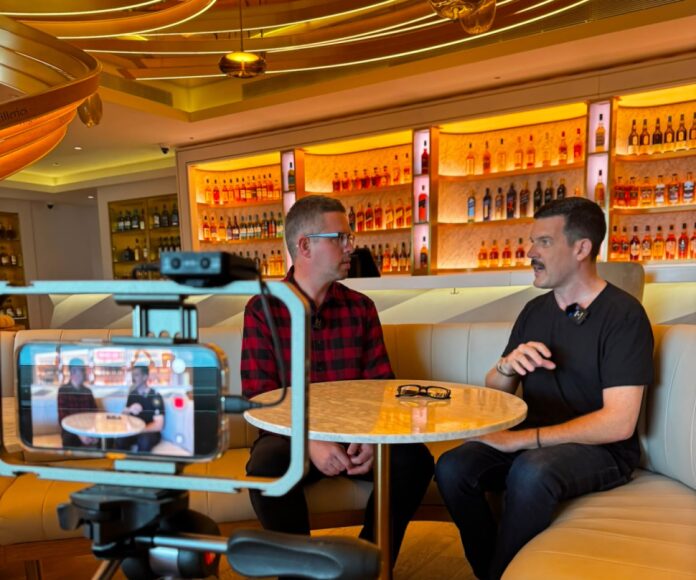
We meet at Johnnie Walker Princes Street in Edinburgh, in suitably Caledonian surroundings, to talk about what brings him home to perform at the Fringe Festival.
The East Kilbride actor trained at the Royal Scottish Academy of Music and Drama, now the Royal Conservatoire of Scotland, before landing an early television role in Boyz Unlimited alongside James Corden. His career went on to include Mile High, 24: Live Another Day, Rizzoli & Isles, Lip Service and film work on both sides of the Atlantic, including To End All Wars and Irvine Welsh’s Ecstasy.
Los Angeles is where he has raised his family with his wife Michelle Kath Sinclair, the American film director, DJ and producer. It’s been 27 years since he last acted in a Scottish theatre production, at Perth Rep, he recalls.
Now he has returned for the Edinburgh Festival Fringe with An Echo in the Void, a new one-hour thriller about artificial intelligence, identity, grief and the increasingly blurred boundary between real life and the versions of ourselves we create online. Sinclair is one of four actors in the stripped-back production at Assembly Roxy.
For Sinclair, it seems like a timely return. Hollywood is going through upheaval while Scotland’s film and television industry has expanded dramatically since he last lived here. At the same time, the Fringe continues to provide somewhere new talent and new ideas can emerge without an existing franchise, huge social-media following or familiar piece of intellectual property attached to it.
After more than two decades working predominantly in front of cameras, he is rediscovering the reason he became an actor in the first place.
It has been 27 years since you were last on a stage in Scotland. What have you been doing since then?
Perth Rep was the last place I was on a stage in Scotland. And then for the last 27 years, I’ve been in Los Angeles for 25 of those, via London. There was a crossover time with London, but I’ve been doing Los Angeles, doing the Hollywood studio scene and working in television there and the odd film and whatnot.
What started drawing you back towards Scotland?
I came back to do a TV show here. It was called Gifted, for the BBC. I came back, it was a year and a half ago, and I shot that and I saw what was happening in Scotland. Scotland’s changed an awful lot in terms of film and television.
Famously, when they made Braveheart in Scotland, there were no sound stages, so they had to go and film in Ireland so they could have a sound stage for wet weather cover. But now, I think there’s five sound stages, and there’s more being built all the time.
I made a decision that I was going to start coming back here more and more, and then all of a sudden Hollywood started to take a bit of a nosedive. The studio system – some of the studios, they’re turning into pickleball courts. It’s that empty.
All these big companies realised that they could film elsewhere for a fraction of the cost. Glasgow stood in for New York. Edinburgh has been involved in big productions. We had Frankenstein filming here last summer. Running Man came through here. There’s so much happening.
Is this a major opportunity for Scotland?
I think it’s a massive opportunity for Scotland. I think Scotland’s always been a wonderful destination, but it let itself down with not having a sound stage.
My first movie I did with Jimmy Cosmo, and he was talking about why it didn’t have a sound stage, and it was something that needed to be done. That was back in 2000.
Now it’s starting to happen. I think Outlander really paved the way for that. That was the first sound stage they opened. And now there’s one down in Leith Docks, there’s one in Cumbernauld, there’s one in Coatbridge, they’re opening one in Stirling. I think there’s another couple.
It’s getting a major foothold in world cinema and television.
It is good to have Scotland standing in for other places, but when do we get more productions in which Glasgow is Glasgow and Edinburgh is Edinburgh?
That’s very true. There’s always been a plethora of talent that comes out of Scotland, Glasgow specifically, in terms of actors, musicians, writers and especially in the film and TV world.
Now, in cinema these days, we’re making movies that cost 350 million with the same 20 actors over and over and over again, and we just keep seeing the same faces.
Wouldn’t it be nice if we made three 350 one-million-dollar movies and we just set them here in Scotland?
There are stories to be told. There’s so many great stories to be told here. There are so many great writers.
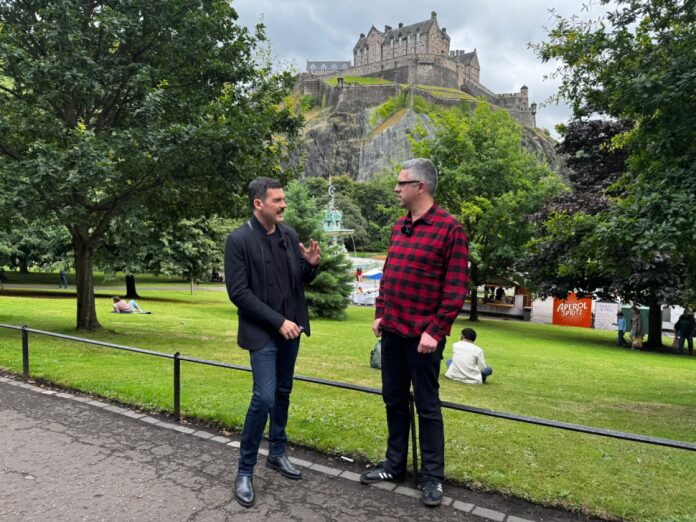
You came through the Royal Scottish Academy of Music and Drama. There was an extraordinary generation of Scottish actors emerging around that period.
In my year – not my year specifically, but the three years round about me – Cora Bissett’s here doing a big play. She’s a big writer now. McAvoy was two years below me. Tom Ellis, he’s done really well. He did Lucifer.
I think it was voted the fifth best drama school in Europe. And I know kids now coming from LA who are going to Glasgow to study at that school.
I’m meeting kids. I work as a mentor for this, so they hook me up with various kids that come out, and I talk to them. We’ve really got a good, strong foothold, and now they’ve started a filmmaking course there as well. So it’s just growing and growing and growing.
Do international successes such as Netflix series Department Q, filmed and set in Edinburgh, show audiences are more comfortable hearing authentic Scottish voices these days?
I think there is power in the Scottish accent, and I think it’s very worldwide accepted.
I think when you start getting into colloquialisms and colloquial chat and banter and things, that’s where it gets lost a little bit. Famously, Trainspotting, when it first played in America, had to have subtitles because they were speaking in real dense Leith and the way Irvine wrote, basically. They were honouring the way that Irvine wrote.
But the purest form of the English language is spoken in Inverness. So why shouldn’t we be heard?
And now you’re back at the Fringe. What is An Echo in the Void about?
It’s a play about AI. It’s so relevant, and it’s about how AI and how it’s taking – not just AI, but the internet itself – and how we’re presenting ourselves, this life that we want people to think that we’re having.
What happens when the lines start to blur between the life that you’re living online and the life that you’re living in real life?
It’s really going into that and exploring that. It’s a kind of allegory for how much time we’re spending on the internet and how much time we’re spending on social media.
My youngest, he goes out to play with his friends, and then he’s like, “Right, everybody go home, and we’ll get online, and we’ll play.” And you’re like, “Whoa, whoa, go on your bikes and just disappear. It’s summer.” Like we all did as kids. But they don’t do that anymore.
People date online now. They shop online. All the high street’s closing. So all our life is moving onto this online platform, and AI is absorbing all that information.
Facebook, Meta are absorbing all that information, and they’re using it, and they’re marketing it back to us. They’re taking our information and marketing it back to us. We are feeding it, and so that’s what the play is about.
What do you want the audience to take away from it?
It’s a one-hour play. It’s very fast. I don’t want to go into too much detail and give too much away because I think it explains itself throughout the play.
But the idea is to make everybody in the audience walk out of there and look at their phone and decide whether they’re ever going to switch it on again. Simple as that.
Why does the Edinburgh Fringe itself remain so important?
I think especially with the rise of film and TV within Scotland, the festival is world famous. It always has been, but now it’s being more famous for producing and nurturing talent.
We mentioned Phoebe Waller-Bridge doing Fleabag and Baby Reindeer that came out of here. Lin-Manuel Miranda we mentioned, and these are major players in the world of entertainment now, and they’re being nurtured at the Edinburgh Festival.
The film world has to have so much IP attached to it and back catalogue, hence the reason they do comic books, because as soon as you can make a comic book or superhero movie, you’ve got an instant fan base of so many millions of people.
So how do you nurture new talent if you’ve got to have something backing up? Here it’s happening. The amount of producers and directors that are coming here now looking for that is unbelievable, and they’re putting Scotland on the map in terms of that.
After 25 years living and working in California, what do you miss most about Scotland?
Food a lot. The first stop is a pint of Tennent’s and a deep-fried haggis. Always, every time. But I miss everything. There’s so many things, and I think I took a lot of it for granted when I lived here.
The beauty of Scotland is something that still shocks me every time. Even that 10-minute drive up and you’re out of the city and you’re into the beginning of the Highlands, and it blows me away every time.
I failed to see it when I was here because you’re just a kid trying to get through things and trying to get through life and working out where your next move was going to be.
Now I get the chance to come back and I get to enjoy it, and so I see it slightly as a tourist, I must admit. And that’s a hard pill to swallow as well. This is my home, so I want, “I belong here,” and people are like, “Oh no, your accent’s changed,” or, “That’s not an East Kilbride tan you’ve got anymore.”
But I love it. My heart lies here. As soon as the wheels touch the tarmac in any airport I’m coming into, I feel it.
If you were starting your acting career now, would you still feel you had to leave Scotland?
I only left Scotland simply because the opportunities came up. First I got pulled down to London, started in a TV show called Boyz Unlimited with James Corden. We started in TV together.
That was my first gig, and that sort of pulled me. It was the first big TV gig because there were no big TV gigs here. You either did Taggart or you did Take the High Road, or you were lucky if you got something. There were a couple of things going on, but never much.
Whereas now, it’s a major player.
There’s a lot of American productions coming over and using Glasgow to Edinburgh and the countryside for various different things. I think we need to start nurturing Scottish talent and bringing it up to the surface.
Scotland has always produced talent, we really just need to start pushing that to the forefront.
And after so long working in film and television, what is it like being back on a stage, particularly somewhere as immediate as the Fringe where you are close to the audience?
I’ve not been on stage in Scotland for 27 years. Four years ago I got asked to do a play. I’m so used to being in television and film and using the camera, and makeup gets done and you hide behind all that.
You’re mic’ed so you can use your voice in different ways, and you build up a bag of tricks. You use those tricks and you get through. When you go onto the stage, it’s gone. It’s all stripped back.
Our production, we have no set. It’s a blank stage. We have some lights, a little bit of music, but other than that we’re on stage for one hour solid, four actors just hashing it out. When I did it for the first time four years ago, I remembered why I got into it in the first place.
I started acting at school, Claremont High School, and I did all the school plays, and I remember falling in love with it when I was 14.
When I stepped back onto stage I was so nervous. I was in the wings and I was looking at my script. I was, “Oh, how am I going to remember all this dialogue?”
I remember going in, sitting down when the lights were dark, the lights came up, and I just went, “Oh, I’m home. I’m home. I remember this.” It was such muscle memory.
It’s actually relaxing when it happens. You go, “Oh, this is what I’ve been doing, and I’ve honed this skill for so many years, and now I really get to use it.” And you don’t get to hide behind all the BS of television and film.
Adam Sinclair has spent most of last 25 years living in Los Angeles, building an acting career in television and film. This summer he is back where it began – on a Scottish stage.
We meet at Johnnie Walker Princes Street in Edinburgh, in suitably Caledonian surroundings, to talk about what brings him home to perform at the Fringe Festival.
The East Kilbride actor trained at the Royal Scottish Academy of Music and Drama, now the Royal Conservatoire of Scotland, before landing an early television role in Boyz Unlimited alongside James Corden. His career went on to include Mile High, 24: Live Another Day, Rizzoli & Isles, Lip Service and film work on both sides of the Atlantic, including To End All Wars and Irvine Welsh’s Ecstasy.
Los Angeles is where he has raised his family with his wife Michelle Kath Sinclair, the American film director, DJ and producer. It’s been 27 years since he last acted in a Scottish theatre production, at Perth Rep, he recalls.
Now he has returned for the Edinburgh Festival Fringe with An Echo in the Void, a new one-hour thriller about artificial intelligence, identity, grief and the increasingly blurred boundary between real life and the versions of ourselves we create online. Sinclair is one of four actors in the stripped-back production at Assembly Roxy.
For Sinclair, it seems like a timely return. Hollywood is going through upheaval while Scotland’s film and television industry has expanded dramatically since he last lived here. At the same time, the Fringe continues to provide somewhere new talent and new ideas can emerge without an existing franchise, huge social-media following or familiar piece of intellectual property attached to it.
After more than two decades working predominantly in front of cameras, he is rediscovering the reason he became an actor in the first place.
It has been 27 years since you were last on a stage in Scotland. What have you been doing since then?
Perth Rep was the last place I was on a stage in Scotland. And then for the last 27 years, I’ve been in Los Angeles for 25 of those, via London. There was a crossover time with London, but I’ve been doing Los Angeles, doing the Hollywood studio scene and working in television there and the odd film and whatnot.
What started drawing you back towards Scotland?
I came back to do a TV show here. It was called Gifted, for the BBC. I came back, it was a year and a half ago, and I shot that and I saw what was happening in Scotland. Scotland’s changed an awful lot in terms of film and television.
Famously, when they made Braveheart in Scotland, there were no sound stages, so they had to go and film in Ireland so they could have a sound stage for wet weather cover. But now, I think there’s five sound stages, and there’s more being built all the time.
I made a decision that I was going to start coming back here more and more, and then all of a sudden Hollywood started to take a bit of a nosedive. The studio system – some of the studios, they’re turning into pickleball courts. It’s that empty.
All these big companies realised that they could film elsewhere for a fraction of the cost. Glasgow stood in for New York. Edinburgh has been involved in big productions. We had Frankenstein filming here last summer. Running Man came through here. There’s so much happening.
Is this a major opportunity for Scotland?
I think it’s a massive opportunity for Scotland. I think Scotland’s always been a wonderful destination, but it let itself down with not having a sound stage.
My first movie I did with Jimmy Cosmo, and he was talking about why it didn’t have a sound stage, and it was something that needed to be done. That was back in 2000.
Now it’s starting to happen. I think Outlander really paved the way for that. That was the first sound stage they opened. And now there’s one down in Leith Docks, there’s one in Cumbernauld, there’s one in Coatbridge, they’re opening one in Stirling. I think there’s another couple.
It’s getting a major foothold in world cinema and television.
It is good to have Scotland standing in for other places, but when do we get more productions in which Glasgow is Glasgow and Edinburgh is Edinburgh?
That’s very true. There’s always been a plethora of talent that comes out of Scotland, Glasgow specifically, in terms of actors, musicians, writers and especially in the film and TV world.
Now, in cinema these days, we’re making movies that cost 350 million with the same 20 actors over and over and over again, and we just keep seeing the same faces.
Wouldn’t it be nice if we made three 350 one-million-dollar movies and we just set them here in Scotland?
There are stories to be told. There’s so many great stories to be told here. There are so many great writers.
You came through the Royal Scottish Academy of Music and Drama. There was an extraordinary generation of Scottish actors emerging around that period.
In my year – not my year specifically, but the three years round about me – Cora Bissett’s here doing a big play. She’s a big writer now. McAvoy was two years below me. Tom Ellis, he’s done really well. He did Lucifer.
I think it was voted the fifth best drama school in Europe. And I know kids now coming from LA who are going to Glasgow to study at that school.
I’m meeting kids. I work as a mentor for this, so they hook me up with various kids that come out, and I talk to them. We’ve really got a good, strong foothold, and now they’ve started a filmmaking course there as well. So it’s just growing and growing and growing.
Do international successes such as Netflix series Department Q, filmed and set in Edinburgh, show audiences are more comfortable hearing authentic Scottish voices these days?
I think there is power in the Scottish accent, and I think it’s very worldwide accepted.
I think when you start getting into colloquialisms and colloquial chat and banter and things, that’s where it gets lost a little bit. Famously, Trainspotting, when it first played in America, had to have subtitles because they were speaking in real dense Leith and the way Irvine wrote, basically. They were honouring the way that Irvine wrote.
But the purest form of the English language is spoken in Inverness. So why shouldn’t we be heard?
And now you’re back at the Fringe. What is An Echo in the Void about?
It’s a play about AI. It’s so relevant, and it’s about how AI and how it’s taking – not just AI, but the internet itself – and how we’re presenting ourselves, this life that we want people to think that we’re having.
What happens when the lines start to blur between the life that you’re living online and the life that you’re living in real life?
It’s really going into that and exploring that. It’s a kind of allegory for how much time we’re spending on the internet and how much time we’re spending on social media.
My youngest, he goes out to play with his friends, and then he’s like, “Right, everybody go home, and we’ll get online, and we’ll play.” And you’re like, “Whoa, whoa, go on your bikes and just disappear. It’s summer.” Like we all did as kids. But they don’t do that anymore.
People date online now. They shop online. All the high street’s closing. So all our life is moving onto this online platform, and AI is absorbing all that information.
Facebook, Meta are absorbing all that information, and they’re using it, and they’re marketing it back to us. They’re taking our information and marketing it back to us. We are feeding it, and so that’s what the play is about.
What do you want the audience to take away from it?
It’s a one-hour play. It’s very fast. I don’t want to go into too much detail and give too much away because I think it explains itself throughout the play.
But the idea is to make everybody in the audience walk out of there and look at their phone and decide whether they’re ever going to switch it on again. Simple as that.
Why does the Edinburgh Fringe itself remain so important?
I think especially with the rise of film and TV within Scotland, the festival is world famous. It always has been, but now it’s being more famous for producing and nurturing talent.
We mentioned Phoebe Waller-Bridge doing Fleabag and Baby Reindeer that came out of here. Lin-Manuel Miranda we mentioned, and these are major players in the world of entertainment now, and they’re being nurtured at the Edinburgh Festival.
The film world has to have so much IP attached to it and back catalogue, hence the reason they do comic books, because as soon as you can make a comic book or superhero movie, you’ve got an instant fan base of so many millions of people.
So how do you nurture new talent if you’ve got to have something backing up? Here it’s happening. The amount of producers and directors that are coming here now looking for that is unbelievable, and they’re putting Scotland on the map in terms of that.
After 25 years living and working in California, what do you miss most about Scotland?
Food a lot. The first stop is a pint of Tennent’s and a deep-fried haggis. Always, every time. But I miss everything. There’s so many things, and I think I took a lot of it for granted when I lived here.
The beauty of Scotland is something that still shocks me every time. Even that 10-minute drive up and you’re out of the city and you’re into the beginning of the Highlands, and it blows me away every time.
I failed to see it when I was here because you’re just a kid trying to get through things and trying to get through life and working out where your next move was going to be.
Now I get the chance to come back and I get to enjoy it, and so I see it slightly as a tourist, I must admit. And that’s a hard pill to swallow as well. This is my home, so I want, “I belong here,” and people are like, “Oh no, your accent’s changed,” or, “That’s not an East Kilbride tan you’ve got anymore.”
But I love it. My heart lies here. As soon as the wheels touch the tarmac in any airport I’m coming into, I feel it.
If you were starting your acting career now, would you still feel you had to leave Scotland?
I only left Scotland simply because the opportunities came up. First I got pulled down to London, started in a TV show called Boyz Unlimited with James Corden. We started in TV together.
That was my first gig, and that sort of pulled me. It was the first big TV gig because there were no big TV gigs here. You either did Taggart or you did Take the High Road, or you were lucky if you got something. There were a couple of things going on, but never much.
Whereas now, it’s a major player.
There’s a lot of American productions coming over and using Glasgow to Edinburgh and the countryside for various different things. I think we need to start nurturing Scottish talent and bringing it up to the surface.
Scotland has always produced talent, we really just need to start pushing that to the forefront.
And after so long working in film and television, what is it like being back on a stage, particularly somewhere as immediate as the Fringe where you are close to the audience?
I’ve not been on stage in Scotland for 27 years. Four years ago I got asked to do a play. I’m so used to being in television and film and using the camera, and makeup gets done and you hide behind all that.
You’re mic’ed so you can use your voice in different ways, and you build up a bag of tricks. You use those tricks and you get through. When you go onto the stage, it’s gone. It’s all stripped back.
Our production, we have no set. It’s a blank stage. We have some lights, a little bit of music, but other than that we’re on stage for one hour solid, four actors just hashing it out. When I did it for the first time four years ago, I remembered why I got into it in the first place.
I started acting at school, Claremont High School, and I did all the school plays, and I remember falling in love with it when I was 14.
When I stepped back onto stage I was so nervous. I was in the wings and I was looking at my script. I was, “Oh, how am I going to remember all this dialogue?”
I remember going in, sitting down when the lights were dark, the lights came up, and I just went, “Oh, I’m home. I’m home. I remember this.” It was such muscle memory.
It’s actually relaxing when it happens. You go, “Oh, this is what I’ve been doing, and I’ve honed this skill for so many years, and now I really get to use it.” And you don’t get to hide behind all the BS of television and film.