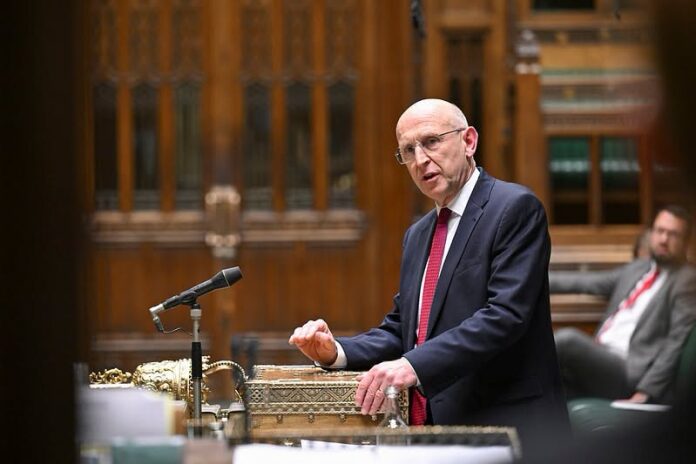
Chancellor John Healey is delivering his first Budget as he sets out the UK Government’s plans for tax, spending and the economy.
The Budget comes against a backdrop of pressure on household finances, rising energy costs and tight public finances.
Healey has promised what he calls “breathing space for today and fresh hope for the future”, with measures expected to focus heavily on the cost of living.
For Scotland, attention will also be on any additional funding flowing to Holyrood, North Sea oil and gas, whisky duty, energy costs, businesses and changes to UK-wide taxes and benefits.
One of the first major measures of Budget day has already been confirmed.
The UK Government will abolish standing charges on household gas bills for around 23 million homes.
Standing charges are the fixed amount households pay each day regardless of how much gas they use.
The typical gas standing charge currently costs around £108 a year.
The Government has asked Ofgem to remove the charges in 2027, or as soon as possible afterwards.
Instead, the fixed costs currently covered by standing charges will be moved into the price households pay for each unit of gas.
Treasury modelling suggests around 60 per cent of households with gas accounts could save an average of approximately £45 a year.
The change will apply across Great Britain, including Scotland.
Healey said the existing system was “unfair and outdated” and said the Budget would begin a wider reform of energy policy.
Several areas of today’s Budget could have a particular impact north of the border.
Any increase in spending on devolved services in England could generate additional funding for the Scottish Government through the Barnett formula.
There will also be close attention on energy policy and the North Sea, particularly following the continuing political debate over new oil and gas developments including Rosebank.
Scotland’s whisky and hospitality industries will be watching for changes to alcohol duty, while motorists will be looking for confirmation of the Government’s plans for fuel duty.
Changes to UK-wide benefits, pensions, National Insurance, corporation tax and VAT would also apply in Scotland.
The Government has already unveiled a package of measures ahead of today’s statement.
These include increasing the tax-free mileage rate for people who use their own cars for work to 55p per mile for the first 10,000 miles, with the rate above that level rising from 25p to 35p.
The Government has also announced plans to replace the Carer’s Allowance earnings “cliff edge” with a taper. Under the proposed system, support would reduce by £1 for every £1 earned over the limit rather than the entire allowance being lost when earnings move above the threshold.
That change is planned for 2030-31.
Import tariffs are also being suspended on more than 100 products as part of a package designed to reduce costs for consumers and businesses.
Announcements already made ahead of the Chancellor’s statement.
Suspending tariffs on over 100 supermarket products
The new Pension Tax Allowance: pensioners with income up to the value of the full new state pension will not pay income tax “in this Parliament”
Carers Allowance, so people don’t lose their entire allowance when they earn over the threshold
Minimum Wage: Increasing both the National Minimum Wage and the National Living Wage by 3.9% “for 2.3 million of our lowest paid workers”
Paternity leave: Self-employed fathers and partners will be eligible for paid parental leave
The Chancellor has revealed a significant downgrade to the economic outlook for next year.
The economy is now forecast to grow by just 1 per cent in 2027.
That compares with the 1.6 per cent growth forecast previously.
Growth this year is expected to be slightly stronger than previously forecast at 1.2 per cent, against an earlier prediction of 1.1 per cent.
Clean-energy policy costs to be taken off household bills
Healey has announced a significant change to the way energy policy is funded.
The Chancellor said clean-energy policy costs have historically been loaded onto household bills through levies.
He said the Government would now put an end to that approach.
A new cost-control framework will also be introduced in an attempt to bring down energy bills.
Healey said new clean-power projects would only be bought or built when they lowered bills and could connect to the electricity grid.
Electricity VAT cut extended until July
The temporary removal of VAT from household electricity bills will be extended through the winter and spring until July.
Healey said the move would take £50 off the annual energy price cap.
Healey has announced a further extension of the 5p fuel duty cut until next July.
The chancellor says the war in the Middle East is still driving high fuel prices and that’s why the government is extending those tax cuts for motorists through the winter and spring.
Household energy payment
Twenty million households in council tax bands A to D will receive a £100 “household energy payment” this winter to help with rising energy bills, Chancellor John Healey announced.
The money will be paid directly into bank accounts.
The scheme will operate through the council tax system in England, while Healey said Scotland would receive equivalent funding through the Barnett formula, leaving the Scottish Government to decide how that money is used to provide support north of the border.
Changes for business rates
Healey says he wants businesses to invest, to recruit, to expand and is therefore taking action to support high streets.
He announces an increase in the threshold for small business rate relief for retail hospitality and leisure businesses from £12,000 to £18,000.
This means 70,000 businesses will be taken out of paying business rates altogether, Healey says.
Banks to pay extra 3% on surcharge
The chancellor says to banks: “I celebrate and I am grateful for the role that you play”.
The chancellor says banks will pay an extra 3% on the banks surcharge. It will start in January and end 15 months later, he says.
More key announcements
Workers aged between 18 and 20 years old will see their pay rise by 3.9%. That’s the same increase as those aged 21 years and over.
Tax-free cash ISA allowance to remain at £20,000
HMRC handed powers to collect overdue tax from those who can afford to pay and ignore requests
The Chancellor has scrapped plans to reduce the amount people can save tax-free in a cash ISA. Former chancellor Rachel Reeves had planned to reduce the cash ISA allowance from £20,000 to £12,000. Healey told MPs the £20,000 annual tax-free allowance will now remain.
A new trading allowance, raising the amount people can earn from a new venture tax-free from £1,000 to £3,000.
Healey announces a “founders’ relief”, a 10% rate on lifetime gains up to £10m for the founders of successful firms.
The Chancellor has announced another £20.4 billion for the National Wealth Fund and British Business Bank.
Healey says this “fiscal devolution” will see “100% of business rates retained locally by the end of the decade”.
Healey says the Government will provide an additional £40 billion a year for day-to-day spending on public services.
Healey has confirmed the Government intends to increase defence spending to 3 per cent of GDP by 2030 on its way to 3.5 per cent by 2035.
The Chancellor has announced an additional package of economic and military support for Ukraine worth £10 billion.
A new review of NHS productivity announced as part of a wider programme to reform public services.