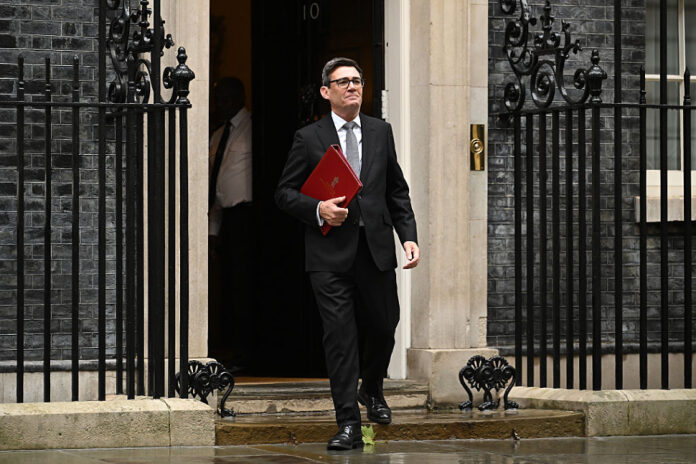
Prime Minister Andy Burnham has proposed scrapping standing charges on household gas bills as his government gave the green light to the controversial Jackdaw gas field off the Scottish coast.
Burnham told MPs that Chancellor John Healey and Energy Secretary Miatta Fahnbulleh had been asked to examine whether the daily charge could be removed and report back to Parliament.
The proposal came as the UK Government approved production from Jackdaw, which is expected to begin supplying gas to British homes and businesses as early as the end of October.
Standing charges are fixed daily fees paid by households regardless of how much energy they use.
Under Ofgem’s price cap for October to December, the average gas standing charge for a household paying by direct debit is 29.68p a day – equivalent to around £108 a year.
Electricity customers face a considerably higher average standing charge of 54.83p a day, although Burnham’s latest intervention relates specifically to gas.
The Prime Minister said ministers were examining whether the charge could be removed as part of wider efforts to reduce household energy costs.
It follows the government’s removal of VAT from domestic electricity bills for six months from 1 October, which ministers estimate will reduce the typical annual bill by around £45.
The government has also said it wants to reform the way electricity prices are linked to gas prices.
Burnham’s intervention came on the same day ministers approved the Jackdaw gas development in the North Sea.
Energy Secretary Miatta Fahnbulleh has agreed that the regulator can grant consent for production at the field, which the government says could begin supplying gas by the end of this month.
Ministers argue the project will strengthen Britain’s energy security, reduce reliance on imported gas and protect hundreds of jobs.
The government has acknowledged that producing gas from Jackdaw will not itself bring down household energy prices, which are determined by international markets.
Jackdaw was originally approved in 2022 before its consent was overturned following a legal challenge over the way emissions produced when the gas was eventually burned had been assessed.
A fresh environmental assessment has now cleared the way for the development.
Alongside the decision, the Chancellor announced plans for a new £2 billion Energy Wealth Fund, intended to reinvest revenues generated by North Sea oil and gas into renewable energy and the transition towards cleaner power.
The government insists approval of Jackdaw is compatible with its commitment to reach net zero by 2050 and says it will not issue new licences for oil and gas exploration.
Environmental campaigners have strongly criticised the decision, while supporters of the North Sea industry have argued that domestic production will remain necessary while Britain continues to use significant quantities of gas.
Standing charges have meanwhile become an increasingly contentious part of household energy bills.
They cover a range of fixed costs associated with supplying energy and maintaining the wider system, meaning consumers pay them even when they use little or no gas.
The House of Commons Library estimates that combined gas and electricity standing charges account for around 18 per cent of a typical dual-fuel bill under the current price cap.
Ofgem has already been examining ways of shifting some of those costs away from standing charges, although doing so could result in higher unit prices for energy.
Burnham’s proposal raises the prospect of the government going further by attempting to remove the gas charge altogether.