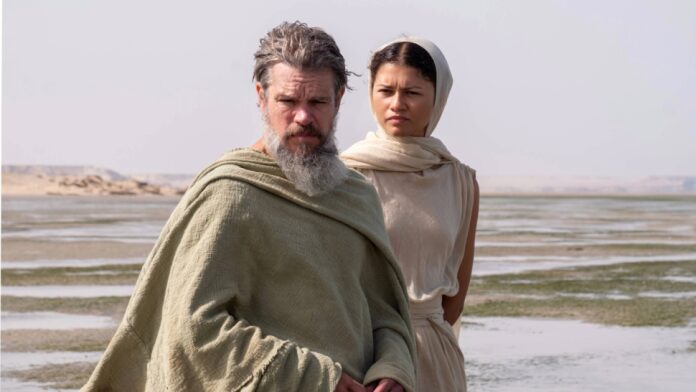
A ruined castle, a secluded beach and a forest shaped by shifting sand were among the locations used to create the mythical world of Homer’s ancient epic.
Christopher Nolan travelled across the world to bring The Odyssey to the cinema screen. The production used real landscapes in Greece, Morocco, Italy, Iceland and Scotland as Nolan recreated the dramatic journey of Odysseus, the Greek king attempting to return home after the Trojan War.
Scotland’s contribution came from the Moray Firth coast, where remote beaches, rugged cliffs and dense forest were transformed into parts of the ancient world.
The summer blockbuster stars Matt Damon as Odysseus alongside Tom Holland, Anne Hathaway, Zendaya, Robert Pattinson, Charlize Theron and Lupita Nyong’o. We’ve taken a closer look at Scotland’s starring role in the hit film.
Findlater Castle
The ruins of Findlater Castle occupy a narrow, dramatic point on the coast between Cullen and Sandend. The remains appear to rise directly from the cliffs, surrounded on three sides by the Moray Firth. Its isolated position made it an effective substitute for the islands and coastal strongholds encountered by Odysseus.
Moray Council identifies Findlater as one of the production’s principal Scottish filming locations and says it provided the main backdrop for scenes involving Damon’s character.
In the finished film, the castle is connected to the island of the sorceress Circe, where Odysseus’s men are transformed into pigs. The weathered ruins, steep cliffs and open sea allowed Nolan to create the impression of an ancient place removed from the modern world.
The present castle largely dates from the 15th century, although the site has a considerably older history. Its name is thought to derive from Norse words referring to a white cliff, while the fortress was involved in conflict during the reign of Mary, Queen of Scots.
Visitors should not attempt to enter the ruins. The structure and surrounding cliffs are dangerous. A viewpoint can be reached after a walk of around 500 metres from the nearby car park, while the Moray Coast Trail continues in both directions.
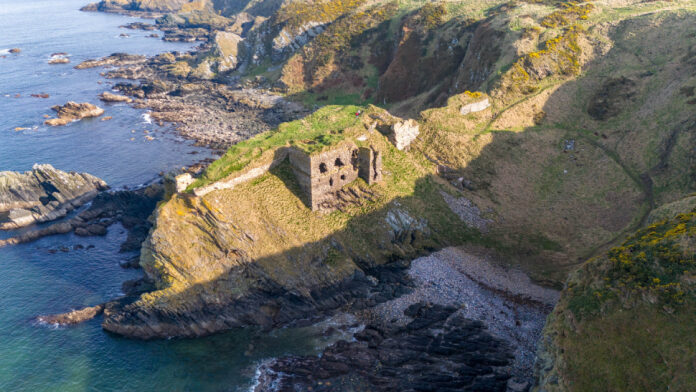
Findlater Castle on the Moray Coast has a starring role in Christopher Nolan’s epic film The Odyssey
Sunnyside Beach
Sunnyside Beach lies below the cliffs to the east of Cullen. It is reached on foot rather than by road, helping to preserve the sense of isolation that attracted the filmmakers. Golden sand is enclosed by grass-covered slopes, rocky outcrops and the open waters of the Moray Firth.
The beach appears in scenes showing Odysseus and members of his crew arriving on an unfamiliar shore.
The production’s ships, costumes and practical sets allowed the coast of north-east Scotland to stand in for a landscape supposedly thousands of miles away in the Mediterranean.
Sunnyside is also associated with the wreck of the Artemis, which was driven on to rocks there during the 20th century. All of its crew survived. The ship’s name provides an accidental connection to the Greek goddess Artemis, who also belongs to the mythology surrounding Homer’s world.
The beach can be approached along the coastal path from Cullen or from the Findlater Castle area. The route crosses rough and uneven ground, with steep cliffs nearby.
Culbin Beach and Sands
To the west, close to Findhorn, the production found a very different coastal landscape. Culbin Beach forms part of an enormous system of sands, dunes, salt marsh, mudflats and shingle along the Moray coast. Its shape changes with the wind, tides and movement of sand, allowing it to appear ancient and unfamiliar.
The beach was used for another arrival sequence involving Odysseus and his crew. They come ashore before moving inland towards the forest. The location is specifically identified as appearing in the film by Moray Council’s official guide.
Reaching the most remote stretches requires a substantial walk from Forestry and Land Scotland car parks. Visitors must also be conscious of tides and changing coastal conditions.
Culbin Forest
After landing on the beach, Odysseus and his men enter Culbin Forest. The woodland rises immediately behind the coastal dunes. Its straight pine trees, shadowed paths and sandy ground offer a sharp visual contrast with the bright, exposed shoreline.
The forest provided the setting for atmospheric scenes following the crew’s arrival. Reports on the completed film identify Culbin as the place where Odysseus encounters the Laestrygonians, a race of destructive, giant-like people in Homer’s poem.
The modern forest was largely established during the 20th century to stabilise the shifting sands. It now contains an extensive network of walking and cycling routes through woodland, dunes, ponds and coastal habitats.
Wildlife found around Culbin includes red squirrels, roe deer and numerous woodland and coastal birds. The wider Moray Firth is also known for bottlenose dolphins, seals and porpoises.
Walking routes vary significantly in length and difficulty. The beach is several miles from some of the main parking areas, making preparation important for anyone attempting to follow the production’s route from the shore into the trees.
Filming brought some of the world’s most recognisable actors to Cullen, Buckie and the surrounding communities during the summer of 2025.
The Seafield Arms in Cullen was occupied by members of the cast and crew. Its ballroom became a private screening room where footage was reviewed, while other rooms were converted into editing suites. Matt Damon also stayed at the hotel during the Scottish shoot. Burghead Harbour was used by the production to dock a 35-metre longship.
Within a limited area of Scotland, the Moray coast offered atmospheric ruins, sheltered bays, vast open sands and an apparently impenetrable forest, a landscape capable of standing in for some of the most ancient locations in literature.