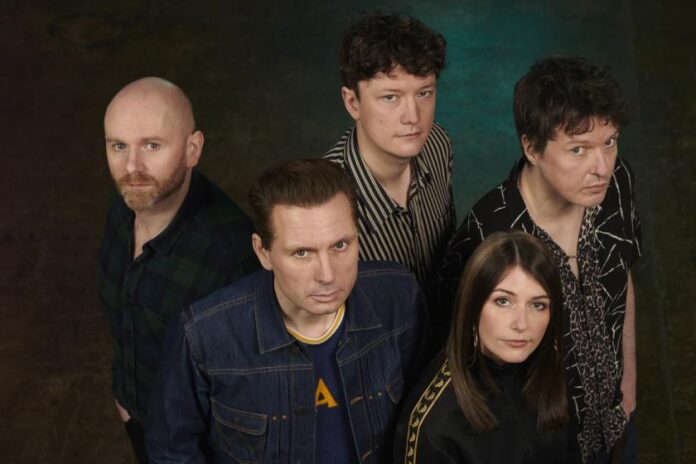
Franz Ferdinand began as an imaginary band, a conceptual art project dreamed up in the kitchen of a fashionable Glasgow restaurant.
Long before they were selling millions of records, winning the Mercury Prize and performing on the world’s biggest stages, Alex Kapranos and Bob Hardy were preparing food and washing dishes at Groucho St Jude’s on Bath Street.
It was the early 2000s and the restaurant, bar and hotel, which had opened in 1999 as an outpost of London’s exclusive Groucho Club, was one of Glasgow’s coolest hangouts.
Behind the scenes, Kapranos and Hardy were dreaming of forming a band that would play at their friends’ parties.
More than two decades later, Franz Ferdinand are returning to their art roots with a new collaboration at Glasgow Print Studio, celebrating the city’s creative community that helped launch their remarkable career.
Members of the band will attend the launch of a limited-edition artwork at Trongate 103 tonight (Thursday 5 November).
For bassist Bob Hardy, who graduated from Glasgow School of Art’s Painting and Printmaking course in 2003, the project is particularly personal.
The band’s beginnings were closely connected to Glasgow’s network of galleries, studios, clubs and bars, where musicians and artists mixed freely and often collaborated.
Hardy had never played a musical instrument when he and Kapranos began imagining what their band might sound like.
In an interview with The Times, Hardy recalled: “Alex showed me how to play a song he had written called This Fire, which only had two chords.”
The group eventually came together with guitarist Nick McCarthy and drummer Paul Thomson, putting some shape on conversations between two colleagues passing the time in a restaurant kitchen.
Kapranos has recalled how Hardy worked washing dishes while he prepared starters and desserts. As the last diners lingered over their meals, the pair would share music and discuss their ideas for a hypothetical band.
They were interested in the music they might make, but also in creating a distinctive identity and finding a way to connect with audiences.
Bob said: “Alex showed me how to play a song he had written called This Fire, which only had two chords, and then we met Nick and Paul. Our first gig was in a friends’ bedroom in 2002. Before I knew it we were recording our first album in Sweden.”
Alex recalls: “The songs simply come from me and Bob talking about the things on our minds. That is how we started: as an imaginary band. Most bands are made up of people who want to play guitar and be good musicians, but we had no desire for craft for craft’s sake.
“Bob had never played an instrument in his life at that point. He was still at art school and doing the dishes in the evenings. I was doing the starters and the desserts.
“While the last couple in the restaurant were having their romantic night and were taking their time over whether to have the chocolate pudding or the cheese plate or petit fours, me and Bob would sit there in the kitchen, glum as anything, wishing they would hurry up and order.
“But during those times we would sit and play each other music and talk about what it would be like if we got this hypothetical band together and things we would write about. I think Bob thought it would never happen and was a fantasy world.”
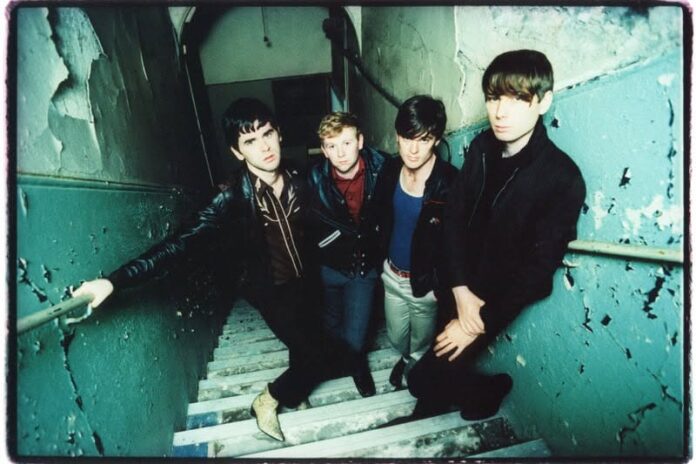
Franz Ferdinand reflected the atmosphere of Glasgow at the time, when the city’s music, art and nightlife scenes overlapped.
The band began performing in unconventional spaces, including the Glasgow School of Art’s Vic Bar, where some of their earliest performances took place.
They also became closely associated with The Chateau, a disused warehouse in the Gorbals that was transformed into an underground arts and music venue.
The band and their friends helped create somewhere artists could exhibit their work while musicians and DJs performed.
The warehouse became a meeting place for Glasgow’s creative community, attracting crowds through word of mouth.
The Chateau opened in December 2002 with an event featuring exhibitions by ten artists and live performances from Franz Ferdinand and other bands.
It was an expression of the do-it-yourself culture that flourished around Glasgow’s independent galleries, studios and music venues.
The warehouse parties grew increasingly popular, although the original venue was eventually closed following police intervention over safety concerns and an unlicensed bar. By then, Franz Ferdinand were beginning to attract attention far beyond Glasgow.
Their breakthrough came in 2004 with the release of Take Me Out and their self-titled debut album, which won the Mercury Prize later that year.
The band’s angular guitar music and striking visual identity helped make them one of the defining acts of the decade.
Their record sleeves and stage designs drew inspiration from movements including Russian Constructivism, reflecting an interest in bold graphics and geometric shapes.
That artistic connection continues with the band’s latest project.
The new work, titled L’Olympia Paris, March 2026, transforms a photograph taken during Franz Ferdinand’s residency at the famous Paris venue earlier this year into an original fine art print.
French photographer Julien Courbe captured the band on stage before a performance, standing in front of a striking set designed by lighting engineer Dan Williams. The photograph has been transformed into a photopolymer gravure print by Glasgow Print Studio master printer Alistair Gow. 100 copies will be produced, priced at £100 each.
The collaboration is part of Glasgow Print Studio’s Call & Response project, which brings together figures from music, theatre, television and other creative disciplines to work with professional printmakers.
Bob says: “Glasgow’s role as a world-class centre for art and culture played a pivotal part in the formation of Franz Ferdinand, and being given the opportunity through this project to support Glasgow Print Studio, a non-profit organisation that provides access and opportunities to printmaking for all, felt particularly meaningful to us.”
He said the project felt like a homecoming, reconnecting Franz Ferdinand with the creative scene that played such an important part in the band’s formation.
The collaboration also involves another Glasgow School of Art graduate, guitarist Dino Bardot, who completed a master’s degree in Sound for the Moving Image in 2016.
Glasgow Print Studio, founded in 1972, has spent more than five decades supporting artists and promoting contemporary printmaking.
The exhibition launch takes place at Glasgow Print Studio, Trongate 103, between 6pm and 8pm tonight.
Members of Franz Ferdinand will attend, with the limited-edition print available to purchase in person and online from 6pm.
More than two decades after two aspiring musicians began discussing their imaginary band in a Bath Street kitchen, the connection between Franz Ferdinand and Glasgow’s artistic community remains intact.