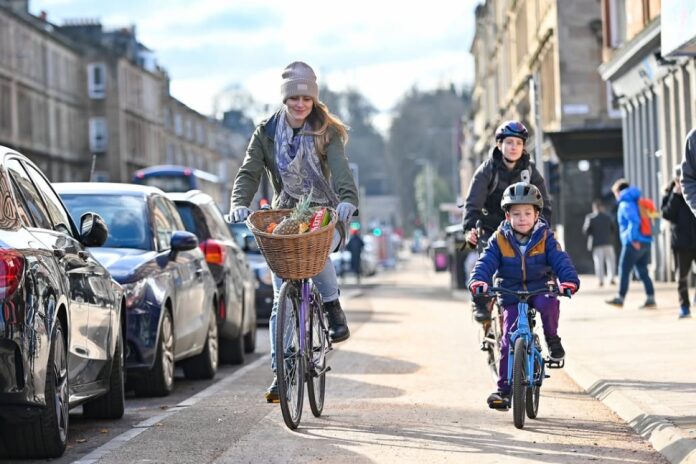
Traffic data analysed by Cycling Scotland, Scotland’s national cycling charity, shows the continuing success of high-quality cycle lanes in Glasgow, with record levels of cycling seen on key routes across the city.
According to their report published today (17 September) over a 48-hour period in May 2026, traffic surveys recorded 5,637 bikes on Victoria Road - 38% more bike journeys than in May 2025, showing the continued impact of the landmark protected cycling route between the Southside and the city centre.
Overall, cycling accounted for 16.6% of all travel methods counted on Victoria Road, itself a new record modal share for the location and for an urban street in Scotland.
More bikes than cars were recorded at all rush hour travel peaks on Victoria Road, a trend which has been established since the previous traffic survey in September 2025.
Clyde Street and Garscube Road, streets which have also had protected cycle lanes installed in recent years, similarly recorded their highest ever number of cycle journeys in a Cycling Scotland traffic survey.
2,146 bikes were recorded on Garscube Road over the two-day survey period, where a 1km protected bi-directional cycle lane connects Maryhill to the city centre. 3,489 bikes were recorded on Clyde Street, where several cycle routes meet at the edge of the city centre.
Records were broken for cycling modal share - the percentage of journeys that are made by bike - at Garscube Road (6.2% of journeys, up from 5% in May 2025) and Clyde Street (13.6% of journeys, up from 12.5% in May 2025).
Additionally, 1,955 people were recorded cycling on Byres Road in the city’s West End, where cycle lanes have been completed between Dumbarton Road and University Avenue. Cycling represented 7.9% of all methods of travel on this section of Byres Road.
At all of these locations, strong peaks in cycling were seen at morning and evening rush hours, indicating that the new infrastructure is helping more people to travel by bike for everyday journeys, like commuting to and from work.
Analysis of traffic levels shows that long-term increases in cycling modal share at these locations are primarily due to more people cycling, rather than any corresponding decrease in vehicle traffic.
Alongside these snapshot traffic surveys, data from the fixed cycle counter network also shows the long-term impact of investment in new, high-quality cycle lanes elsewhere in Glasgow.
The East City Way cycle route counter on London Road shows cycle traffic more than doubled from an average of 300 cycle journeys a day in May 2024 to nearly 700 journeys a day in May 2026.
This follows significant improvements to the 8km route connecting communities in the East End to the city centre, including physical protection for the cycle lanes and completion of a Dutch-style cycle priority junction at the corner of London Road and the Clyde Gateway road.