
There is a moment in Love Actually when Keira Knightley’s character Juliet watches a video of her wedding and realises that the man behind the camera, her husband’s best friend, is in love with her.
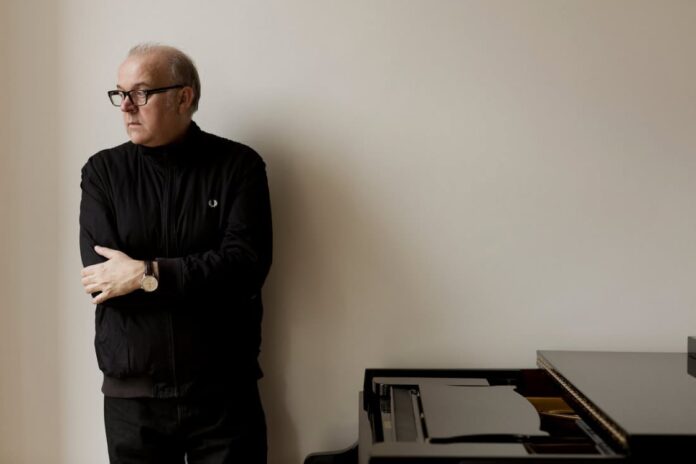
As the camera lingers on her face, a delicate piano melody accompanies the scene. It is one of the most recognisable pieces of music from the film and was written by composer Craig Armstrong in his home city of Glasgow.
Coincidentally, Keira Knightley’s mother, the award-winning playwright and screenwriter Sharman Macdonald, was born in Glasgow, while her brother Caleb was married at Pollokshields Burgh Hall in 2011.
Twenty-three years after the release of Richard Curtis’s romantic comedy, Glasgow Love Theme has become part of the soundtrack to Christmas.
For Armstrong, the enduring popularity of the film and his compositions was unexpected: “I don’t think anybody really realised the impact the film Love Actually would have when we were working on it,” he told me when we spoke last December.
“It’s been really great people have taken music to their hearts as well, very special.”
Released in November 2003, Love Actually brought together an ensemble cast including Hugh Grant, Emma Thompson, Colin Firth, Liam Neeson, Alan Rickman, Bill Nighy and Keira Knightley.
Its interwoven stories of love, friendship, heartbreak and family in the weeks leading up to Christmas have since become an annual viewing tradition in households around the world.

Armstrong had already established an international reputation through his work with Australian director Baz Luhrmann on Romeo + Juliet and Moulin Rouge, but Love Actually was his first experience of composing the score for a romantic comedy.
Curtis encouraged Armstrong to focus on the emotional lives of the characters rather than the comedy.
His compositions include Portuguese Love Theme, which accompanies the developing relationship between Colin Firth’s character Jamie and Portuguese housekeeper Aurélia, and PM’s Love Theme, written for the romance between Hugh Grant and Martine McCutcheon’s characters.
While popular songs feature prominently throughout the film, it is Armstrong’s original music that provides a sense of continuity between its different stories.
“The music can be a vital element in finding a thread that connects an entire film together,” he said.
“It can sometimes take quite a while to find the musical essence of a film but once you’ve succeeded with that it can be an important element.”
Armstrong’s ability to move between classical composition, electronic music, popular songs and film scores has its roots in his childhood in Glasgow.
“When I was very young at nine years old, I had an aunt who had gone to the Royal Academy of Music in London, which is also where I ended up going myself much later on.
“This aunt taught me piano. She was a great musician and a big influence on my musical start in life.
“My mother was a huge music fan with a varied music collection from classical, jazz and pop and this also had a huge impact on my early listening.”
His formative musical experiences in the city included playing in an orchestra and working alongside a young Peter Mullan, who would go on to become one of Scotland’s most celebrated actors and directors.
“When I was in my teens I played the violin in the Glasgow Schools Orchestra. It was invaluable to hear amazing orchestral pieces being performed around you and being a part of that creating.
“My connection with Peter Mullan during our years at the Tron theatre in Glasgow and our early film collaborations had a very big impact on learning the craft and being creative.”
Armstrong would find international recognition through his work with Massive Attack and his collaborations with Luhrmann, winning a BAFTA for Romeo + Juliet, a Golden Globe for Moulin Rouge and, later, a Grammy for his score for Ray, the film about American musician Ray Charles.
Of his collaborations with Luhrmann, Armstrong singles out The Great Gatsby as the one with which he feels the strongest personal connection.
“The Great Gatsby because I feel this score is probably the best work I did for Baz. I think we both really related to F. Scott Fitzgerald’s novel and I hope the score succeeded in helping the film tell the story.”
Despite the variety of his projects, Armstrong approaches each new composition with the same creative instincts.
“I feel when I write film music I don’t really specifically try to write in the genre of film music and when I do song work my classical influences are very prevalent so I really don’t try and wear different hats for different styles, I try to compose with my own voice each time.”
In 2023, to celebrate the 20th anniversary of Love Actually, Armstrong revisited his original score, releasing an album entitled Love Actually – The Love Themes for Orchestra.
Featuring 15 compositions recorded with the Budapest Art Orchestra, the album gave him an opportunity to develop the short pieces of music he had written for individual scenes into fuller orchestral arrangements.
As with the original score, the compositions were written in Glasgow.
Despite a career that has taken him to Hollywood and recording studios around the world, Armstrong has never felt the need to leave his hometown.
“I have always lived in Glasgow and still do, although a lot of my work has been international so it’s quite hard to pin point exactly how Glasgow has had an effect on my work however I would say the Scottish landscape and indigenous music has definitely had an effect on my compositions and one of the amazing parts about living in Glasgow is that we are half an hour away from incredibly beautiful landscapes and countryside.”
He also continues to enjoy being part of the city’s musical life.
“I live in Glasgow but when I return from working away it’s always great to catch some concerts at the City Halls or Celtic Connections to catch up with fellow musicians.”
Love Actually has several other Scottish connections. Gregor Fisher plays Joe, the manager of ageing rock star Billy Mack, while Glasgow band Texas contributed I’ll See It Through to the soundtrack.
Billy Mack’s Christmas Is All Around is, of course, a festive reinvention of the song that spent 15 weeks at number one for Wet Wet Wet following its inclusion in another Richard Curtis film, Four Weddings and a Funeral.
Armstrong’s contribution is rather more subtle. Glasgow Love Theme contains none of the conventional musical hallmarks of Christmas, yet its opening piano notes have become inextricably associated with the festive season.
What began as a piece of music written in Glasgow to accompany a brief moment of cinematic heartbreak has become a Christmas classic in its own right.