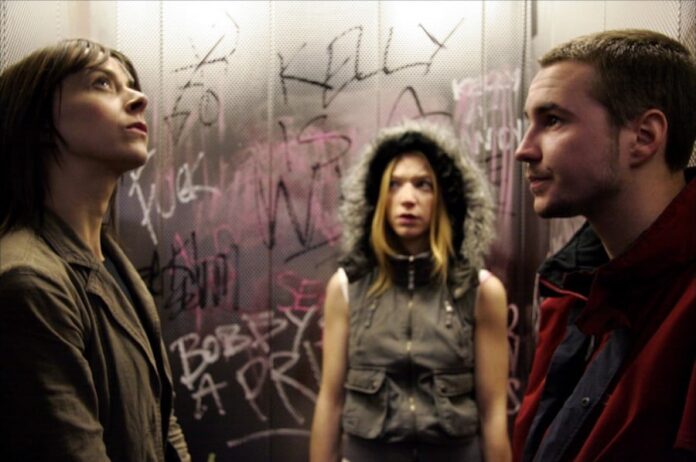
Twenty years ago, director Andrea Arnold arrived in Glasgow with a collection of characters, a set of filmmaking rules and no clear idea of the story she would tell.
The result was Red Road, a dark, intensely atmospheric psychological thriller that transformed the city’s CCTV control rooms, streets, pubs and towering Red Road flats into the setting for one of the most acclaimed Scottish films of the century.
Released in 2006, Arnold’s first feature starred Kate Dickie as Jackie Morrison, a lonely CCTV operator who becomes fixated on Clyde, a man from her past played by Tony Curran. Martin Compston appeared as Stevie, Natalie Press played April and Paul Higgins completed the principal cast as Avery.
The film emerged from Advance Party, an experimental project created by Glasgow production company Sigma Films and Danish company Zentropa. Three first-time feature directors were challenged to make separate films in Scotland using the same group of characters and actors.
Red Road became the project’s great success. It was selected for the main competition at Cannes and won the festival’s Jury Prize. Dickie received best actress awards from BAFTA Scotland and the British Independent Film Awards, while critics praised Arnold’s command of tension, place and character.
The Guardian described it as an “extraordinarily mature and thoughtful film”. Three years after its release, an Observer poll placed Red Road at number 20 among the best British films of the previous 25 years.
The towers that gave the film its name were demolished by 2015, giving Red Road another significance as a record of a Glasgow landscape and community that have since disappeared.
Here, Arnold recalls discovering the city, casting a remarkable group of Scottish actors and arriving at Cannes as “rabbits in the headlights”.
Arriving in Glasgow
It was really the beginning of my career as a filmmaker. I had just made a short film and that had done quite well.
Sigma, the Glasgow-based production company, were working with Zentropa, Lars von Trier’s company. Lars and his colleagues had created Dogme, where they gave themselves certain rules and all had to make films using those rules. It had been very successful and they had made all these brilliant films.
Sigma and Zentropa had the idea of doing something similar. They would get a group of filmmakers and give them a different set of rules.
They picked three people: Morag McKinnon, who is a Glasgow filmmaker, the Danish filmmaker Mikkel Nørgaard and me.
Two writers had created a group of characters and given us short descriptions of each of them. The rules were that we all had to include those characters in our film, we all had to cast them together and the films had to be set in Glasgow.
The characters were quite broadly drawn, so they were not too specific. You could interpret them and take them in the direction you wanted. Jackie was the character I picked to be at the centre of my film.
I actually quite liked having the rules. They gave you a structure, a puzzle and something to start with.
Normally, I begin with something in my head and start pulling at a bit of string to see how far it goes. This gave me quite a lot to play with.
Lars always felt that challenges, boundaries and obstacles were brilliant for creativity because they gave you something to bounce off. Filmmaking is challenging anyway. You are constantly navigating obstacles. You think you are going to do one thing, something happens and you cannot do it, so you have to find another way.
I made the project very much my own. Morag later made Donkeys. Mikkel’s film never happened, as far as I know, but from the beginning I was always going to make mine.
I have a mentality that when I commit to something, there is no such thing as it not happening. I am going to make it happen.
Discovering the Red Road flats
I do not think I had been to Glasgow before, so I came up and started trying to get to know the city.
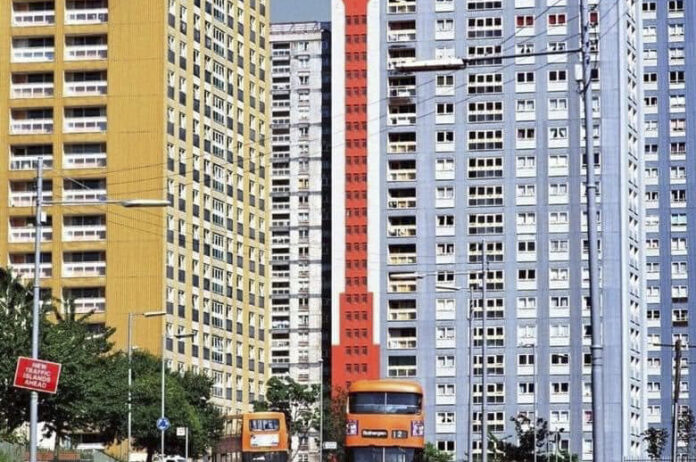
I walked about and talked to people. I remember getting a bus out to the Red Road flats and walking around by myself, trying to get under the belly of the place and feel it.
I have to feel somewhere before I feel that I can write about it. I do that kind of work at the beginning of every film.
I cannot quite remember the first time I saw the flats because it was 20 years ago. I think somebody was taking me around different areas of Glasgow when I first saw them.
I was so struck by how incredible they were. I could not forget them or put them down. Usually, when that happens, the place is going to appear in whatever I am doing.
They felt very symbolic of what I wanted to write and became a distinct part of the film.
I do not know if I would have called them beautiful. They were striking and staggering because they were so high. But there were things about them that I did find beautiful.
From a distance they were these great blocks of concrete. When you got closer, you saw the humanity and the people living there. That always makes something beautiful for me.
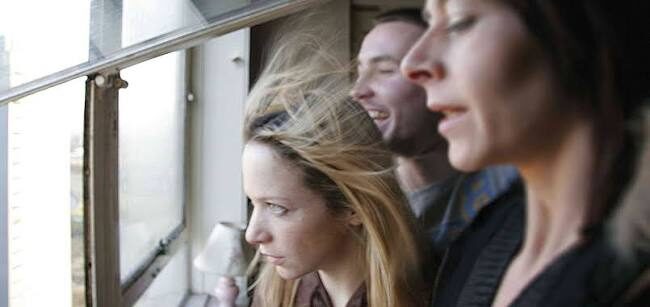
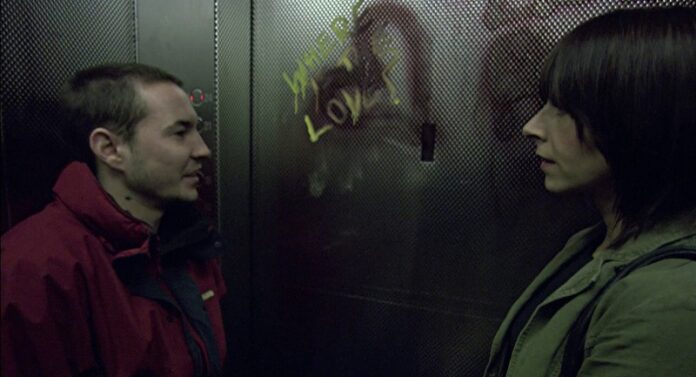
When you went to the top, the wind would blow like crazy. I also remember going into an empty flat and seeing the words “Where is the love?” written in graffiti. It broke my heart. I took a picture of it and I think it found its way into the film.
For me, the location is like another character and you need to know it properly. I spent a lot of time walking, going into pubs and hanging around the areas where we would be filming. I wanted to soak up as much as I could and understand it better.
A lot of the people who appeared in the film came from the area. The men in the pub were the men in the pub. The children on the streets were the children who lived on those streets.
We used the people who were actually there and that added an authentic quality.
Watching the city
When I start writing, I do not really know what I am going to write. I do not have a plan. I have a feeling and then I explore that feeling.
We had those characters as a starting point, but I was also obsessed with CCTV.
I had been reading about surveillance and the people working inside those control rooms. There were stories about operators following people using the cameras and making judgments about what they saw.
This was 20 years ago, when I was already quite disturbed by the idea that our lives would be watched. Now we are filmed from just about every direction.
It has crept up on us and somehow we have accepted it without even blinking.
Casting Glasgow’s talent
We had the most incredible actors.
That was down to Kahleen Crawford and Des Hamilton, who did the casting. They are both from Glasgow and they brought all those people to us.
Because of the rules, the three directors had to cast the films together. We sat in a room and met actor after actor, almost all of them from Glasgow, and I thought they were fantastic.
It was not difficult because there was any shortage of talent. It was difficult because we were spoilt for choice.
It always makes me sad that there is not enough work for some actors because they are brilliant. We had to choose the cast between the three directors, who had their own ideas about the characters and the stories they wanted to tell.
There were big discussions around certain people, but we all got on well. There was no aggro. It was friendly and easy-going.
As I remember it, Kate had not made a feature film at that point. She had a strong theatre background. Tony was fantastic and I loved working with him. They were both great and lovely to work with.
Nobody was reluctant about the way we were filming. They were all completely up for it.
They have all gone on to do amazing things, haven’t they?
Rain, waterproofs and exhaustion
It was a very low-budget film and I remember being exhausted.
It seemed to rain all the time. We were outside every day and I practically lived in waterproofs.
I had to shoot all the CCTV material first because it needed to be edited and then placed back into the film. I spent a week shooting that footage and editing at night, so the days were incredibly long.
One night I came back to where I was staying, still wearing my waterproofs. I got a beer, lay down on the bed and woke up six hours later in exactly the same position with the beer still in my hand.
It was amazing that I did not drop it. That is a skill. That is a real skill.
We shot around October and November and Cannes was in May. That is an incredibly fast turnaround for finishing a film.
We must have gone almost straight into the edit. Then the calls from Cannes began.
First, it was being offered a place in Directors’ Fortnight, then Un Certain Regard and finally the main competition. I knew nothing about Cannes and asked one of the producers: “Which one do you pick?”
They said: “You never turn down the main competition, Andrea.”
I said: “Okay, I’ll do what you’re saying.”
We were carrying out a very rough sound mix because we did not have time to do a proper one. I was flying back to London and got the call saying the film had been selected for the main competition as the plane was taxiing towards the runway.
It was incredible. I had never, ever expected it. I do not think anybody had.
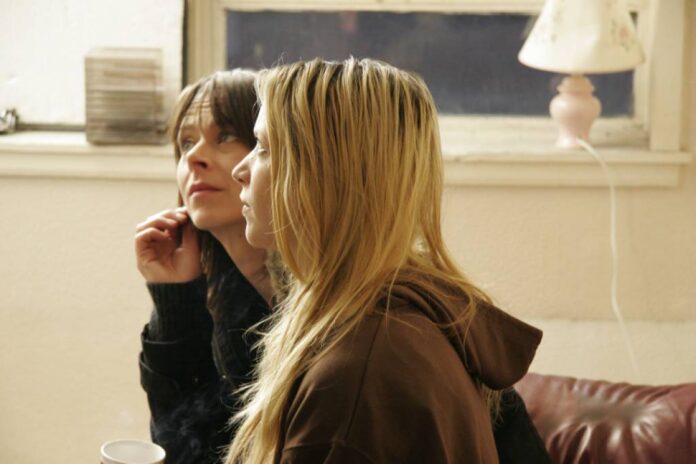
Red Road at Cannes
Kate and I were recently talking about how naive we were when we went to Cannes.
We were all broke and had no idea what you were supposed to wear or how any of it worked.
When I came back from filming Red Road, I received a letter saying that my earnings had been so low the previous year that my daughter was entitled to free school dinners and I was entitled to free prescriptions.
Then suddenly we were walking up the red carpet at Cannes. We were all rabbits in the headlights. We did not know what we were doing.
I have done it a few times now, so I have more experience, but that first time was quite daunting.
Red Road was absolutely a milestone for me, but I have never had a career plan. I still do not have one.
I am driven to make things. If I were not making films, I would probably be making something else. I just do one thing at a time and try to do the best I can or make it as truthful as I can at that moment.
When you are making something, you have no idea what the future will be or what the next thing is going to be.
I remember one of the producers saying it would be good if we could submit Red Road to Cannes. I said: “It’s not going to Cannes. Don’t be ridiculous.”
Then it did.
Even now, when I talk about it, I am still surprised.
Glasgow’s place in the film
I believe you can make something very specific and, at the same time, universal.
We all have so much in common, no matter where we live or what our background is. You can be very specific about somebody’s life, the details of where they live and the way they speak, while still exploring the things that make us all human.
That is what I hope for when I make a film.
At Cannes they put English subtitles on Red Road. It really annoyed me and I wanted to fight to have them removed.
Even if you cannot understand every word of a Glaswegian accent, you get it. You understand enough. Perhaps we should all work a bit harder at understanding accents instead of always translating them into something else.
I love accents and the beautiful details of people’s lives. Where somebody comes from tells you so much about them. You might live in a city where it is cold or raining all the time, and that affects the way you live.
I hate the idea of blanding everything out to make it understandable to millions or billions of people. With algorithms now, I feel things are becoming blander. It makes me want to be more quirky, more bizarre, more weird and more human.
I also fight like hell when somebody wants a location to pretend to be somewhere else.
The trees are different. The birds are different. The terrain is different. Those details matter.
I often have a lot of nature in my films. If you see a bird flying over, I will make sure the sound you hear belongs to that bird. There is so much cheating and pretending that one place is another.
I think we subtly recognise that fakery. There is something beautiful about real life and the extraordinary nature of it. The more truthfully we present a place, in all its strangeness and specificity, the richer we all are.
Glasgow had to be Glasgow.
Returning after the towers came down
When the Red Road flats were demolished, Kate messaged me. I came straight up and we went back there together.
I felt quite emotional. It was not only because of the film but because of the area and the people we had met.
The place certainly had its troubles and there were days when there could be trouble, but my sense was that many of the people living there were happy. Their lives were there.
We did not know them intimately, but we spoke to a lot of people and I felt there was a real community. There were a lot of flats and a lot of people.
The film has now become a period piece because that part of Glasgow has disappeared.
I am so happy that Red Road still resonates and that people in Glasgow treat the film as one of their own.
It was such a distinctive place.
I love Glasgow so much.