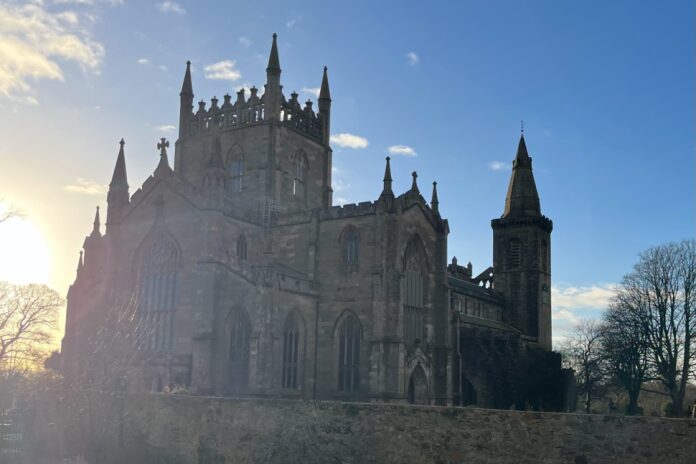
Dunfermline Abbey could be transformed into one of Scotland’s leading heritage destinations under an ambitious £18 million vision for the historic site.
The ten-year Dunfermline Abbey Reimagined programme aims to protect the ancient complex, improve the visitor experience and more than double the number of people it attracts each year.
Plans include new heritage trails, improved signs and interpretation, spaces for events, learning and culture and a potential visitor welcome building. Access around the abbey would also be improved, while stronger links could be created between the site, Pittencrieff Park and Dunfermline city centre.
The proposals have been developed by the Heart of Dunfermline Partnership, which includes Fife Council, Historic Environment Scotland and Dunfermline Abbey Church.
Fife Council’s City of Dunfermline Area Committee has now backed the vision as the partnership begins developing more detailed proposals and seeking external funding. An expression of interest has already been accepted by the National Lottery Heritage Fund.
A study found the abbey could eventually attract around 80,000 visitors annually, compared with approximately 32,000 currently. The project is also expected to support the wider regeneration of Dunfermline city centre by encouraging visitors to stay longer and spend more with local businesses.
One of the most significant elements is a proposal for Historic Environment Scotland to take the Abbey Church into state care. The heritage body already looks after the surrounding medieval complex, including the abbey nave, monastery remains, refectory, chapter house, palace ruins and grounds.
However, responsibility for maintaining the 19th-century church currently rests with its congregation. The Church of Scotland has said this arrangement is no longer financially sustainable. The building requires around £4 million of repairs over the next three to five years to keep it wind and watertight, while a further £4 million development programme has been proposed to upgrade its facilities.
The church has 413 members and spends around £60,000 annually to keep the building open to the public. Historic Environment Scotland is assessing the request and will prepare a report for the Scottish Government, which is responsible for decisions about bringing historic properties into state care.
Dunfermline Abbey is regarded as one of Scotland’s most important historic and religious locations. Its origins can be traced to a priory founded by Queen Margaret in the 11th century. The abbey was established in the 12th century and became a royal mausoleum, providing the final resting place for Scottish kings and queens.
Robert the Bruce was buried there following his death in 1329, while other royal figures associated with the abbey include Malcolm III, Queen Margaret, David I and Alexander III.
The present Abbey Church was constructed between 1818 and 1821, replacing the eastern section of the medieval abbey destroyed after the Scottish Reformation.
Its collection includes significant stained-glass works by Scottish artists and a Tiffany window commissioned by Dunfermline-born industrialist and philanthropist Andrew Carnegie.
The redevelopment plans arrive ahead of two major anniversaries. The abbey will celebrate its 900th anniversary in 2028, followed in 2029 by the 700th anniversary of Robert the Bruce’s burial.
Rev Dr MaryAnn Rennie, parish minister, said: “Dunfermline Abbey has been a home for worship and service for almost a millennium.
“This proposal to move the Abbey Church into state care will help secure its mission and preserve its magnificent built heritage for generations to come.
“However, the current model for looking after the building is unsustainable.”
If the transfer goes ahead, the congregation would remain active at the abbey and work alongside Historic Environment Scotland and a proposed Friends of Dunfermline Abbey group.
David Williams, joint session clerk of the Abbey Church, described the proposals as a “once-in-a-generation opportunity”.
He said: “It’s about ensuring this remarkable place remains relevant, accessible and at the heart of Dunfermline for generations to come.”