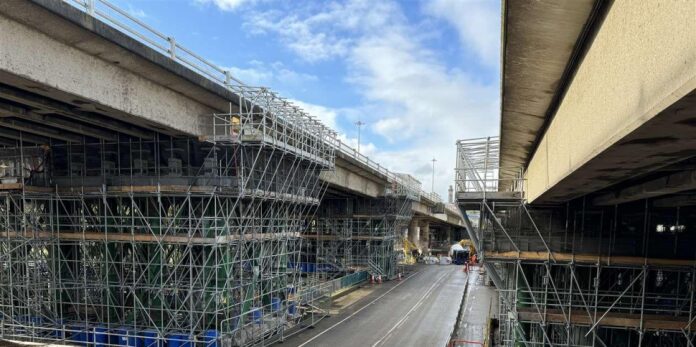
Motorists facing years of delays on Glasgow’s M8 could see further major disruption after the current £185 million Woodside Viaduct repair programme is completed.
The Scottish Government has confirmed another delay to the emergency works on the ageing motorway structures, with the eastbound carriageway now expected to eventually fully reopen in early 2027 and the westbound works scheduled for completion later that year.
However, the work currently taking place is only a temporary solution to structural problems affecting one of Scotland’s busiest roads.
Transport Scotland is developing proposals for a permanent solution, with three options under consideration – repairing the existing viaducts, replacing them entirely or demolishing this section of the M8.
The most expensive option could cost as much as £500 million, according to estimates published during a public consultation earlier this year.
It raises the prospect of further construction lasting several years, even after the current restrictions are lifted.
The Woodside Viaducts carry approximately 150,000 vehicles a day through the north of Glasgow city centre, connecting the M8 between Craighall and Charing Cross.
Restrictions have been in place since 2021, when structural assessments identified serious deterioration in the concrete supports beneath the elevated motorway.
The repair programme has involved installing temporary steel supports at 23 locations, transferring the weight of the motorway away from deteriorating structural joints.
Work has been complicated by underground infrastructure, including the Glasgow Subway tunnels and a sewer discovered in a different location from that shown in existing records.
The latest setback was confirmed in the Scottish Parliament on 17 November.
Transport Secretary Stephen Flynn said: “Extensive and essential concrete repairs are required to joints. We anticipate that the eastbound carriageway will reopen in early 2027 and we expect the westbound works to be completed in the second half of next year.
“It is opportune that I update the Parliament that we expect the costs of the completed project to be in the region of £175 million to £185 million.”
The projected cost represents an increase on the £81 million estimate reported in 2023.
Scottish Labour MSP Pauline McNeill expressed disappointment that another deadline had been missed and called for better communication with the public.
She said: “I hope that the cabinet secretary shares my disappointment, because the road was supposed to be opened in autumn 2026 after five years of work.”
Transport Scotland’s official position is that the steel supports that will cost £185 million have a limited lifespan, will require ongoing maintenance and are unsuitable as a permanent solution.
What happens after 2027?
Transport Scotland has already consulted on three potential approaches to the long-term future of the Woodside Viaducts.
Repairing and strengthening the existing structures is estimated to cost between £125 million and £200 million, with construction potentially lasting between one and three years.
Replacing the viaducts with new structures could cost between £200 million and £500 million and take three to four years.
The third option would involve demolishing the structures and rerouting traffic onto the M74 and Glasgow’s local road network.
Transport Scotland estimates that removal could cost less than £125 million and take between one and two years.
The prospect of removing the motorway has divided opinion.
Glasgow City Council has expressed support for exploring demolition. The council’s transport convener, Angus Millar, previously said replacing the motorway with a boulevard-style road presented regeneration opportunities.
He argued that the project could reconnect the city centre with surrounding neighbourhoods and help reverse the impact of the motorway’s construction.
Glasgow Chamber of Commerce has warned against taking a decision without fully examining the economic consequences.
Its chief executive Stuart Patrick said in July: “This is one of the most consequential infrastructure decisions Glasgow will face in a generation, and it shouldn’t be made on incomplete evidence.”
The chamber has called for detailed modelling of the impact on freight movements, businesses and the wider motorway network, particularly the ability of the M74 to accommodate diverted traffic.
Transport Scotland’s own consultation material acknowledges that removing the viaducts could result in increased traffic volumes and longer journey times elsewhere in Glasgow.
The agency is continuing to develop detailed options, with another public consultation expected before a preferred solution is selected.
For motorists, the immediate priority remains the reopening of all four lanes in each direction.
The latest timetable suggests that could finally happen more than six years after restrictions were first introduced.
The larger question of what should happen to this section of Glasgow’s motorway network remains unresolved – and the eventual answer could bring a further multimillion-pound construction programme and more disruption on one of Scotland’s busiest stretches of road.