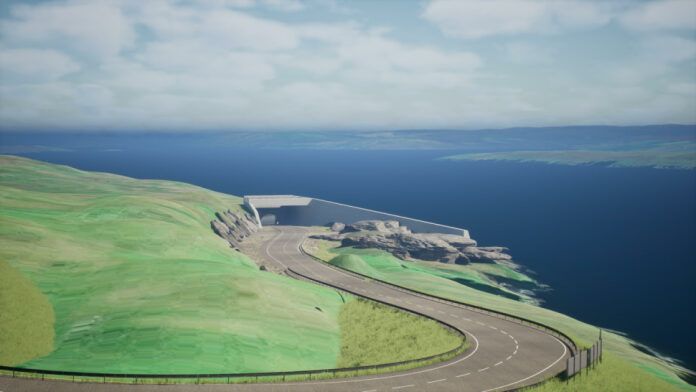
Work to develop Scotland’s first major inter-island road tunnel is set to move into its pre-construction phase after Shetland councillors backed a 30-year plan for the future of transport between the islands.
Shetland Islands Council today (Wednesday 23 September) approved its Inter-island Transport Connectivity Implementation Route Map, with a subsea tunnel across Yell Sound – connecting Mainland Shetland with Yell – identified as the first fixed link to be taken forward.
The decision means detailed work can now progress on the proposed tunnel, including further site investigations, environmental work, development of the business case and procurement preparations.
Crucially, the council has been told that £23 million of Scottish Government funding earmarked for inter-island connectivity remains available over the next three years to take the project through its pre-construction stages.
Council chief executive Maggie Sandison confirmed during Wednesday’s meeting that the funding is expected to comprise £3 million in 2027/28 followed by £10 million in each of 2028/29 and 2029/30.
Consultants Stantec estimate the Yell Sound tunnel could cost around £525 million, with the route map suggesting it could potentially be completed by 2034 if the required funding and approvals can be secured.
The proposed crossing would be just over four miles long. Previous evidence from engineering consultancy COWI suggested around three years would be needed for business case work, environmental studies, detailed geological investigations, planning and financing before full construction could begin. Building the tunnel itself could then take around three years.
Yell has been chosen ahead of the proposed tunnel between Yell and Unst because consultants believe it would benefit the greatest number of residents, connecting communities on Yell, Unst and Fetlar more directly with Mainland Shetland.
It is also considered easier to construct because part of the operation could be based on Mainland Shetland, while a tunnel between Yell and Unst would require workers, machinery and materials to first be transported to Yell.
The council’s long-term plan remains to pursue a second tunnel between Yell and Unst. Under one scenario presented to councillors, the two projects could overlap, with the Yell tunnel potentially finished in 2034 and the Unst link following in 2036.
The route map does not formally commit the council to constructing either tunnel, and the timetable will be heavily dependent on government and other external funding.
It nevertheless represents another significant milestone for a project which only a few years ago remained largely at feasibility stage.
A council-backed Fixed Link Model developed by Stantec and COWI has already involved international tunnelling contractors and concluded that a Yell Sound tunnel is both technically buildable and potentially investable.
In June, councillors formally chose fixed links as their preferred long-term option for both Yell and Unst, while retaining ferries for other parts of the network and keeping tunnels to Bressay and Whalsay as longer-term ambitions.
Investment in ferries will continue in parallel. The route map identifies an immediate need to improve the Bluemull Sound service and replace ageing vessels, including the Hendra serving Whalsay and the Snolda on the Papa Stour route. Fixed links to Bressay and Whalsay could be reconsidered during a later investment cycle.
Environment and Transport Committee chair Moraig Lyall said at Wednesday’s meeting that the council remained at an early stage of what would be a long process, adding: “We’re making progress.”
A more detailed delivery plan is expected to return to councillors next month as the programme moves from strategic planning towards implementation.