A bus company whose owners accused John Swinney of behaving like “the next Idi Amin or Robert Mugabe” received more than £45million in subsidies from the Scottish Government last year.
Sandy Easdale, who owns McGill’s alongside brother James, drew the comparison between the First Minister and two notorious dictators after the Scottish Government announced plans to bring buses back under public control.
Under powers under the Transport (Scotland) Act 2019 local authorities or transport partnerships can take public control of bus routes through franchising. In that scenario, the public authority would determine routes, timetables and fares, with private companies competing for the contracts.
Swinney said in his keynote speech at the SNP conference that buses would be brought back under public control by 2031 through a combination of franchising and regulation. It’s understood in that case the Scottish Government would outline routes and timetables and ask businesses to compete.
The successful companies for each route will be paid to operate the service and the government will receive the fare revenue.
Ralph Roberts, the chairman of McGill’s Group, said the company had been “built through years of private investment, hard work and commercial risk” and that Swinney’s plans amounted to “business confiscation”.
He further stated that the company had never been publicly owned, and therefore there is “nothing to ‘bring back’ into public control”.
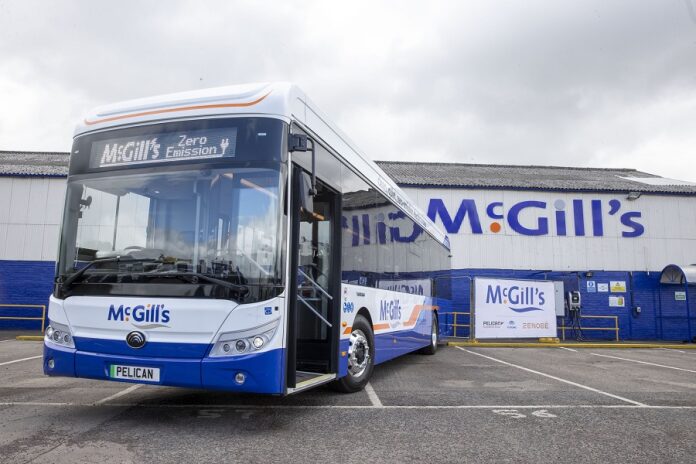
However, McGill’s and its various subsidiaries have been generously funded at taxpayer expense.
Figures released under Freedom of Information show that in just the last year McGill’s Midland Bluebird Ltd, McGill’s Bus Service Ltd and McGill’s Scotland East Ltd have been paid more than £45m by the taxpayer to subsidise free travel for the elderly, the young and the disabled as well as maintain routes.
Between the Bus NCTS Older and Disabled Persons Scheme, the Young Persons Scheme, the Volunteer Scheme and the Network Support Grant (NSG), McGills was paid a total of £45,243,463.02 for the 2024-25 financial year.
Of that £22.5m went to subsidise free travel for the over-60s and people with a qualifying disability, £18.3m on free bus travel for under-22s, £228 on the volunteer scheme and £4.4m on the NSG, which is designed to keep fares down and routes operating in less commercially attractive areas.
The company had previously been awarded £8,664,557 for 41 electric buses as part of the first phase of the ScotZEB scheme, which provides grants to help operators move away from older diesel models.
McGill’s is expected to receive a further £6.6m from the second phase of the scheme, as part of consortium Zenobe.
In July the company filed a legal complaint with the Competition Appeal Tribunal after it was not awarded funding in the third round.
For 2024-25 the group reported a turnover of £117,963,051 with an operating profit of £9,193,849 and had deferred government grant money of £19,558,686 recognised as a creditor, up from £15.4m the previous year.
Ellie Harrison, chair of Get Glasgow Moving, said: “All across Wales and in many English city regions steps are being taking to bring bus networks back into public control using ‘franchising’ powers. This is because it is now abundantly clear to all that it is the only way to deliver an affordable service that is planned around passengers’ needs and fully-integrated with other transport modes - and to ensure that public money is being used to provide the best possible service.
“Bus companies that operate in England and Wales like Stagecoach and First are resigned to this new franchising status quo, where they are still able to make modest profit for running services which are controlled by public bodies. There is only one bus company standing in the way of progress in Scotland, and that is McGill’s. It is desperate to do or say anything to hold onto the broken deregulated bus system that has made its owners so rich. Even if they are able to delay the deployment of bus franchising for a few years in Scotland, it will be worth millions more in public subsidy to their owners.
“The Scottish Government must stay strong and move ahead with its bold pledge to bring all buses in Scotland back into public control by 2031, otherwise we will only fall further behind England and Wales. We’ve created at ‘Routemap to Better Buses in Scotland by 2031’ which sets out exactly what they need to do.”
McGill’s has been contacted for comment.