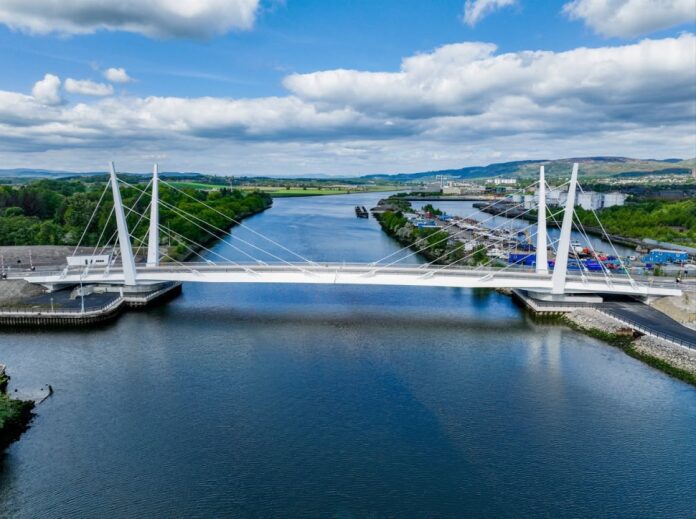
For commuters it cut lengthy drives around the Clyde to a matter of minutes. Walkers and cyclists gained a new route across the river. Communities in Renfrew, Yoker and Clydebank suddenly felt considerably closer.
Now, less than 18 months after it opened, the bridge is shut and it could be months before anyone can drive, walk or cycle across it again.
Renfrewshire Council confirmed the crossing would close to road users after Storm Boelo caused serious water damage to the electrical systems used to operate the bridge.
The damage is extensive enough that officials say repairs will take “a number of months”.
It is an abrupt interruption to the story of one of the west of Scotland’s most significant new pieces of transport infrastructure.
Renfrew Bridge opened on 9 May 2025, creating a direct road, walking and cycling connection between Renfrew on the south side of the Clyde and Yoker, Clydebank and Glasgow to the north.
The bridge was delivered as part of the £117 million Clyde Waterfront and Renfrew Riverside project.
Its popularity soon exceeded expectations.
Between 21 June 2025 and 16 April this year, more than 3.5 million crossings were recorded.
Around three million were made by cars. There were also 84,600 crossings by walkers and runners and 41,500 by cyclists.
The council’s WhatsApp channel providing information about bridge openings attracted 45,700 followers. For people living and working around the Clyde, its impact was measured in minutes shaved off their journeys.
One Renfrew resident working in West Dunbartonshire said her commute had fallen from around 20 minutes to seven.
A Scotstounhill resident working near Glasgow Airport said the bridge allowed her to reach work in around 12 minutes while managing childcare drop-offs and pick-ups.
Another Clydebank resident said journeys to Paisley could take around 20 minutes rather than having to travel via the Erskine Bridge or Clyde Tunnel.
The problem began when Storm Boelo brought an exceptional tidal surge to the Clyde on Saturday night. Water levels at Renfrew reached 6.7 metres – the highest recorded since digital records began in 1998 and more than twice the forecast level.
The bridge has two operating plant rooms, one on either side of the Clyde, which control its opening and closing. The plant on one side experienced relatively little impact. The electronic systems controlling the hydraulics on the Renfrew side were significantly damaged by water.
That creates an unusual problem. Renfrew Bridge is a swing bridge. It separates in the middle and its two sections rotate towards opposite riverbanks to allow vessels to pass along the Clyde.
Temporary equipment can be used to open the bridge, but officials say those arrangements cannot support normal day-to-day operations. Opening it using hired equipment and a reduced number of functioning motors can take several hours.
More importantly, once it has been opened, the council says it cannot reliably close and secure the bridge again using the temporary system.
The result is that the bridge must effectively remain open for ships – and closed to everyone trying to cross the river.
Gerard Hannah, Renfrewshire Council’s head of climate, public protection and roads, said: “We’re very sorry for the inconvenience this will cause all those who use the bridge.”
He said urgent work was under way to identify the problems and return the bridge to full operation. No reopening date has yet been announced.
The council says it is carrying out an urgent review with key partners to establish the exact circumstances behind the damage and decide on the most appropriate solution.