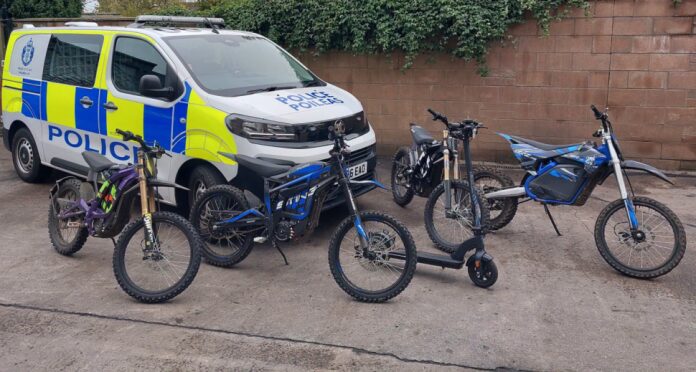
More than 1,100 e-bikes and e-scooters have been seized by police in Scotland this year as MSPs launch a new investigation into their links to crime and antisocial behaviour.
The Scottish Parliament’s Criminal Justice Committee will examine the growing use of the vehicles in criminal activity, their impact on communities and whether police have sufficient powers to deal with the problem.
Police Scotland had seized 561 e-bikes and 441 e-scooters – a total of 1,002 vehicles – by 16 October.
That compares with 569 across the whole of 2025.
A further 142 e-bikes and e-scooters were then seized during a week-long nationwide crackdown beginning on 19 October, taking the number recovered this year to at least 1,144.
Greater Glasgow recorded the largest number of seizures during the operation, with 54 vehicles recovered.
Police said all 142 vehicles seized as part of Operation Overlap would be destroyed.
The new Holyrood inquiry will look at why e-bikes and e-scooters are being used for crime and antisocial behaviour and what more can be done to prevent it.
MSPs will examine four main areas – the causes of the problem, its impact on communities, enforcement and prevention.
The committee said it wanted to hear directly from communities affected by the issue, as well as young people, youth workers, police officers and other frontline workers.
Evidence sessions are expected to begin in the middle of November, with MSPs initially examining the scale of the problem and the powers currently available to police.
The Scottish Government is due to give evidence in December, with the committee expected to publish its report in spring 2027.
Concerns about the vehicles have grown rapidly across Scotland.
Last week, Victims and Community Safety Minister Kirsten Oswald told MSPs that more than 1,000 e-bikes and e-scooters had been seized this year compared with 569 last year.
She said their misuse was causing “real concern to communities across the country”.
Glasgow Labour MSP Pauline McNeill also raised concerns about injuries involving children.
She told Holyrood that Glasgow’s Royal Hospital for Children had reported e-scooters and e-bikes as among the “most common causes of major trauma admissions” involving children.
What are the rules on e-bikes and e-scooters?
Standard electric bikes can legally be ridden on public roads provided they meet the requirements for an electrically assisted pedal cycle.
The motor must have a maximum power output of 250 watts and must stop providing assistance when the bike reaches 15.5mph.
Modified bikes which exceed those limits can be classed as motor vehicles, meaning riders may require a driving licence, insurance and an approved helmet.
Police Scotland said illegally modified e-bikes can pose a danger to riders, pedestrians and other road users.
Privately owned e-scooters cannot legally be ridden on public roads, pavements or other public spaces in Scotland. They can only be used on private land with the landowner’s permission.
Police can issue penalties for offences involving illegal vehicles and can seize them under road traffic laws.
The Scottish Government has also been considering stronger seizure powers for vehicles used in antisocial behaviour or criminal activity.
Superintendent Andy Barclay, deputy head of Road Policing, said following the latest operation: “We know this is a growing issue across Scotland and this week of actions shows how seriously we are taking it.”
The Criminal Justice Committee said its inquiry would seek to establish what further enforcement measures are needed to make communities safer and what action could prevent illegal use in the first place.