The Scottish Government has been urged to set out how it will measure the medium and long-term impact of its flagship Child Payment scheme to demonstrate overall value for money.
An audit found that while the payment has been delivered well and has contributed to reducing child poverty, for some medium and long-term goals there is “limited objective evidence” or no suitable data to draw upon.
Introduced in 2021, the Scottish Child Payment (SCP) is a key part of the wider strategy to reduce child poverty and offers financial support to low-income families.
The current weekly payment is £28.20 per eligible child and 37% of children in Scotland benefit from the payment, with £1.6billion spent since launch.
Eligibility is based on being in receipt of Universal Credit, a decision taken in order to quickly introduce the SCP using existing legislation rather than through primary legislation. Legislation passed in 2025 gives the government more flexibility to change eligibility criteria, but it has yet to use these powers.
A report by Audit Scotland, released on Thursday, examined how well the payment is being delivered, how sustainable it is, and what impact it is having.
It found that take up of the SCP is very high, with 96% of eligible children benefiting, and families are generally positive about the application and payment process.

Applications can be made online, by phone or through the post and processed to check for award criteria, after which applicants receive £28.20 a week for each child under the age of 16 paid out as £112.80 every four weeks. The median processing time is 22 days.
While take-up rates are high though, Audit Scotland found there is no breakdown available to assess the take-up rate among those most at risk of experiencing child poverty, with things like ethnicity, disability status or household composition not consistently available across datasets.
This means the Scottish Government cannot tell whether some priority family types are more or less likely to apply for and receive the
payment. As a result, it does not have a clear picture of which priority family types are being successfully reached or whether some family types make up a larger proportion of those who are eligible but not claiming.
It does not know how many of the four per cent of eligible children (around 13,000) not benefiting from the payment are in families that applied for it but experienced barriers during the application process. It is also unknown how many are unaware of the payment and have not applied.
When it came to the impact of the SCP, Audit Scotland said the consistency, availability and quality of the data make it difficult to assess.
There is a range of evidence that in the short-to-medium term the payment is helping those who need it, including a specially commissioned survey of 3,400 recipients and quantitative research on things such as food bank use, which has fallen in Scotland compared to England.
Scottish Government modelling has shown an important contribution to the long-term impact measure of reducing child poverty.
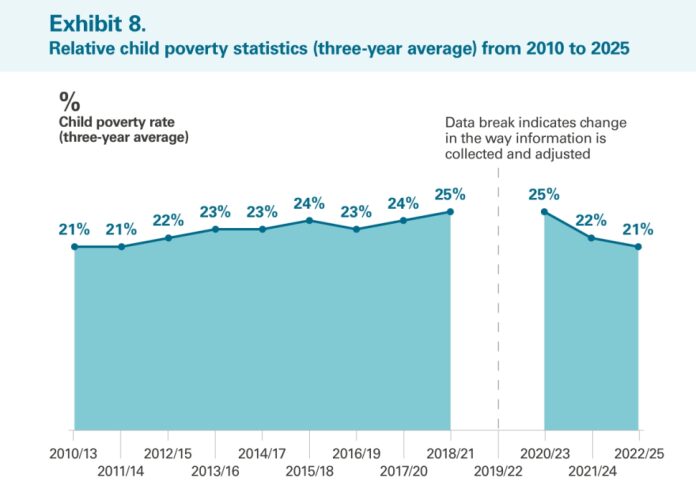
In addition, analysis by the London School of Economics and the Universities of York and Glasgow found that the SCP had contributed to a significant reduction in material deprivation in Scotland compared to England.
The medium-term outcomes were described as:
- Improved health and wellbeing
- Reduced incidence of material deprivation
- Positive impact on the Scottish economy
- Reduced incidence of debt
- Reduced incidence of food insecurity
- Reduced barriers to education and the labour market
For most of these there is only “limited objective evidence”.
As an example, an economic assessment would be required to measure the SCP’s impact on the economy but there are no plans to undertake such an assessment.
Four long-term impacts were set out when the SCP was introduced, but for three of the four the Scottish Government has not said how it intends to measure them.
They were:
- Reduced child poverty
- Reduced inequality of outcomes for children
- Reduced incidence of social exclusion
- Reduced health inequalities
There is currently no suitable data for the last three and the Scottish Government has not set out a plan for how it will collect or develop that data.
Audit Scotland said: “These gaps in the evidence base make it difficult to assess whether the SCP is successful in achieving its full range of intended outcomes. While some long-term impacts will take time to emerge, the existing evidence base is limited for some medium-term outcomes and arrangements for assessing several long-term impacts are not yet clear.”
The report concludes that the SCP has met its immediate outcomes and is contributing toward the short and medium term ones, strengthening arrangement for measuring and evidencing outcomes will be important to demonstrate the overall value.
Stephen Boyle, auditor general for Scotland, said: “The Scottish Government has made a good job of delivering the Scottish Child Payment, which is helping reduce child poverty.
“The government now needs to set out how it will evaluate the long-term impact of the payment and demonstrate the overall value for money of its investment.
“Ministers also need to show that all those children most at risk of poverty are able to access the benefit and set out plans for the future role of the payment.”