Scottish scientists are planning to send whisky into space in a remarkable experiment that could reveal how orbit affects the spirit’s maturation process.
Engineers from the University of Glasgow and Japan’s Kyushu Institute of Technology are working on a project known as Space Puffin, which would send tiny samples of whisky and its base ingredients into orbit in 2028.
The current plan is for the experiment to travel on a SpaceX supply mission to the International Space Station before being released into orbit from the Japanese module of the station. The small CubeSat satellite would then spend up to five years circling the Earth.
Researchers hope the mission will help them understand how the extreme conditions of space could change the chemistry of whisky.
As the satellite orbits the planet every 90 minutes, it would be exposed to repeated cycles of heat and cold, conditions the team believes could affect the way whisky matures.
Dr Gilles Bailet, of the University of Glasgow’s James Watt School of Engineering, said the project could open up entirely new ways of thinking about the spirit.
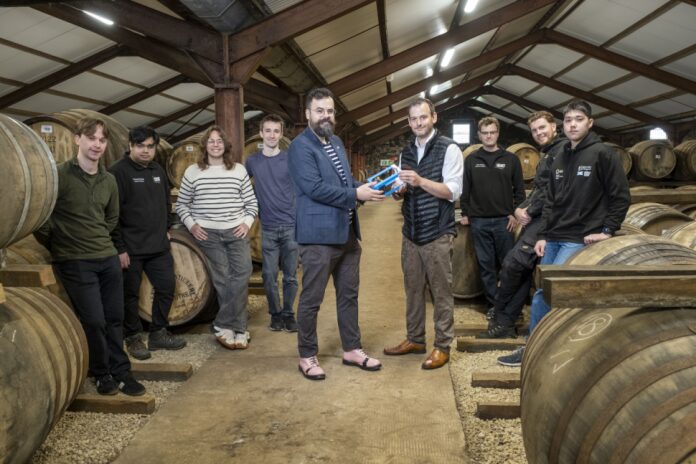
He said: “We want to see what the effect of a space environment is on the ageing of the whisky.
“We’ve got the best people here in Scotland to be able to inform that, with centuries of experience, so we can bring this whisky experience into space.”
The team believes the mission could provide new insight into the little-understood process by which whisky “breathes” as it ages in wood.
Dr Bailet said the changes that happen over years in a traditional cask on Earth could potentially be accelerated in orbit.
He said: “We build our spacecraft to be able to get an environment which is better for the whisky, but this wood will breathe faster than on Earth.
“And so we are hoping that we’ll be able to accelerate the ageing to be able to get something more interesting.”
Scientists will monitor the samples remotely while they are in orbit, measuring changes in colour and chemical composition and feeding data back to Earth.
Researchers say the work could also help advance the development of future orbital factories capable of producing complex molecules which are difficult to manufacture on Earth.
That could one day have implications for pharmaceuticals, including treatments for conditions such as cancer, diabetes and Alzheimer’s disease.
The project is being developed jointly by Scottish and Japanese engineers, with University of Glasgow students also involved in helping to design the spacecraft systems needed for the mission.
If the project goes ahead as planned, a tiny piece of Scotland’s whisky-making tradition could soon be heading far beyond the distillery to see what space can teach us about the country’s most famous export.