Sir Chris Hoy has revealed he has taken it upon himself “to try and change the world so there are fewer people dying with prostate cancer”.
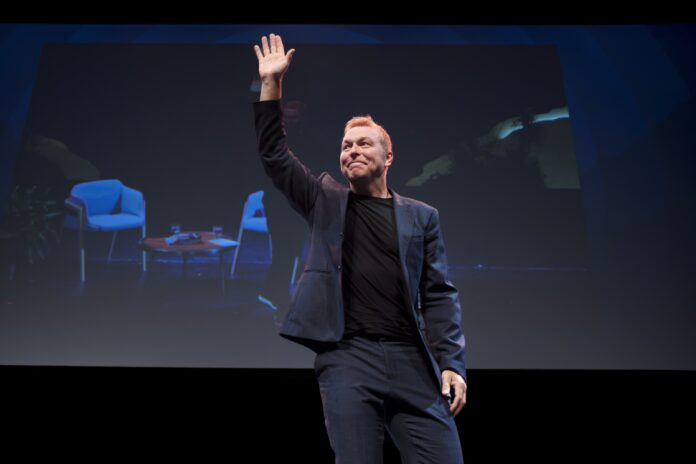
The Olympian was met with applause and cheers from members of the audience during his conversation on leadership with broadcaster Dan Walker at the SEC Armadillo in Glasgow on October 2, during the summit the cyclist also revealed his charity cycle, Tour de 4, for Prostate cancer charities had beaten the sum raised last year - £3.1m.
He was diagnosed with stage four prostate cancer in October 2024, when he was told at the time that the cancer had spread to his bones and he had between two and four years of his life to live.
Sir Chris said: “I usually don’t make a big deal about birthdays. It was a fantastic night, great to have all my friends from sport, from school, from university, from working, and from all backgrounds together under one roof. It made sense to celebrate it, even if it was six months late.”
Following his cancer diagnosis, the cyclist started a campaign pushing for wide-scale screening for prostate cancer. He said: “In the past, pressure the wasn’t life or death, but now it is. Stage 4 cancer, or incurable cancer.
“To me, there were where no warnings. I was given the news straight out of the blue. It was straight into the deep end. In the space of one sentence, you are essentially told the worst possible news. Your world turns upside down. It takes time to let that news sink in, to process it and to grieve, because you are grieving the life you thought you were going to live, all the things you assumed you would be doing.
He added: “No one knows what is going to happen tomorrow. A friend of mine was diagnosed with cancer years ago and he is doing really well now. He said to the doctor, ‘Tell it to me straight, what is the worst-case scenario?’ The doctor said, ‘Well, the worst-case scenario is you walk out of this surgery and get hit by a bus.’ He said, ‘I’m being serious.’ The doctor said, ‘I’m being serious too. You have to realise this is not great news. We’ve got a plan, we are going to treat you and hopefully we are going to get rid of it, but in the meantime you cannot allow this to take over your life, because none of us knows what is going to happen. If you spend your life worrying about one thing and it isn’t the thing that is your demise, you will kick yourself and think, I’ve wasted so much time.’
“You can’t rush that process. It took me a good few months to process it fully and drag me out of it. You will be able to experience joy and not have cancer as the first thing you think about, and it won’t be the last thing you think about at the end of the day. I didn’t think I would get there but I did.
He added: “It is important for me to talk about this for anyone out there who might hear this, and to challenge perceptions, including my own, about stage 4 cancer and what it means. I had a really clear image in my head when I was given that news. Touch wood, thankfully that hasn’t been the case. I’m very lucky that in my case there is treatment, and I’m making the most of the time that I have, having something positive to focus on, a new purpose: talking about it, raising awareness, making sure men over the age of 40 know their own individual risk.
“It is very treatable if you catch it early enough. Ten thousand men in the UK are told too late that they have cancer. We need to change that. There is no screening process for it in place in the UK, so I’m taking it upon myself to try and change the world and the future so there are fewer people dying from prostate cancer.”
The cyclist also took the opportunity to talk about his charity cycle that sees people cycle starting and ending at the velodrome following a 56 mile cycle through Glasgow and South Lanarkshire.
He added: “While doing that, I thought it would be nice to raise some money for some of the amazing charities that already exist, and the obvious way was to do a cycle challenge in Glasgow. It had to be here. You don’t have to be a middle-aged man in Lycra. Anyone with a bike, and even static bikes at the velodrome, so even if you are going through chemo or not well but you want to be part of it, you can sign up for 20 minutes or one minute.”
The Olympian also opened up about the emotional moment at the end of the day when he accepted the cheque of the money raised from the cycle, adding: “I totally crumbled. It was very hard to talk about cancer for the first year. T
“The lump in your throat starts to arise. I thought I was on top of it. I stood on stage at the end of this wonderful day, with 5,000 people taking part, 190 of whom had gold armbands with the number 4. 190 living with stage 4.
“They were the heroes; they were the rock stars. People knew the ones with the gold armbands were the stage four warriors. Every hill they came to, they were being cheered on. To me, that is a far cry from lying in a hospital bed waiting for the inevitable. It was just talking a good game and demonstrating it is another. It was such a powerful demonstration.
“You go out there, you are riding through the streets of Glasgow, and as we rode past, people were saying thank you. As cyclists, we are not used to being thanked. We are used to people in Range Rovers shouting at us.
“I stood on stage with Sara, my wife, to accept the cheque to pass on to the charities. We are about to announce the final total but I can’t say just yet how much but, it is more than last year. It was £31.1 million last year.”
When asked about how cancer changed his perception of life and what matter most, he said: “It is the people, your family, your loved ones. We often get sidetracked by the big goals. I believe in aiming high and having the ambition, but not at the expense of the little things, appreciating the small things in life, seeing your kids in the morning, dropping them off at school, picking them up. It is the little moments that get glossed over. It is being able to slow it down. The cancer has taught me to slow down and appreciate the little things.
“I’ve made it my mission to change the system because too many men are being diagnosed too late, but it shouldn’t just be down to me.”
The six-time Olympic champion also spoke about his “intimidating” thighs with Walker.
Walker said: “I’m sorry to go down this route, but I’ve always been fascinated by his [Sir Chris’s] thighs. Have you always had enormous thighs? Because they were very intimidating.”
Sir Chris replied: “No, I didn’t come out of my mother with big, massive thighs. It’s essentially a by-product of the training I was doing.
“It’s not as if, ‘Ah, you’ve got big legs, so you must be good at cycling.’ It’s more that you adapt to the training, and also you didn’t train to have big legs. You trained to be fast on a bike. Part of the training was strength work in the gym, and you didn’t want to get big in the upper body.
“I think in many ways cyclists’ legs are out of proportion because they don’t train their upper bodies. They want to be slimline, they want to be light, but they want to have power and speed in their legs.”
He joked about trousers and kilts: “You could always get trousers big enough to fit your thighs, but the waist would be difficult. Kilts were good because they were just free. Not good for cycling, though.”
When asked for advice on leadership, he said: “When there is chaos around you, it does come down to recognising what you have control over. The pressure can become disproportionate, and you can lose all sense of perspective of what you’re about to do.
“It’s also recognising that this is the bit you should be enjoying. Don’t throw it away. Don’t waste the moment. This is the reward for all the hard work. If you dread that moment, whether you step out on stage, get onto the track or walk out onto the pitch, you’re missing out on the joy of life.
“As I’ve said before about trying to predict the future, we’re always wondering what’s going to happen. We don’t know, so just enjoy the present and try to live the best you can in that moment.”