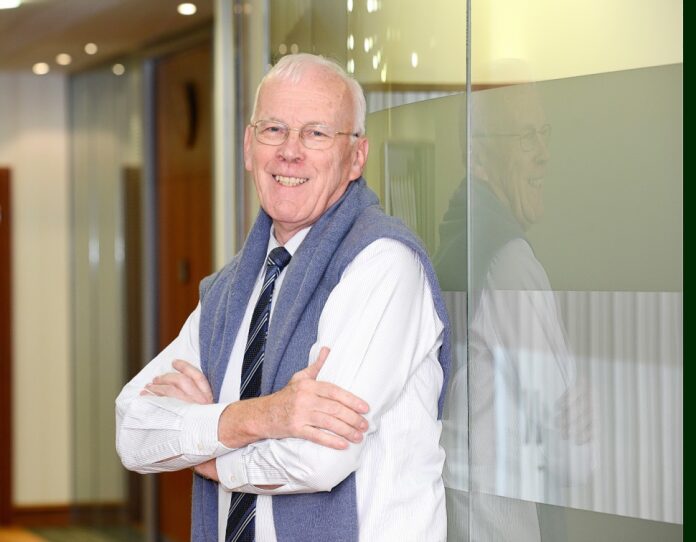
Sir Ian Wood (Pic: Wood Foundation)
Sir Ian Wood has died, aged 84. He was best known for building the Aberdeen-based Wood Group. At its height, the company was valued at more than £5 billion and operated across the world.
The business did not begin in oil, however. Its origins lay in the fishing boats, shipyards and marine engineering workshops of north-east Scotland.
In a statement, the Wood family said it is “deeply saddened to announce the death of Sir Ian Wood (84), who passed away peacefully at home, surrounded by his family.
“Sir Ian was a devoted husband, father, grandfather and friend. While many knew him as an entrepreneur, philanthropist and one of Scotland’s most influential business leaders, those closest to him will remember above all his kindness, generosity, determination and unwavering commitment to his family.”
The Wood family’s association with Aberdeen’s fishing industry began in the late 19th century, when it owned vessels operating from the city’s harbour.
In 1912, Sir Ian’s grandfather, William Wood, established Wood and Davidson. The marine engineering and ship-repair business was created to serve the fishing fleet.
The family company expanded to become a major fishing concern. It later operated through JW Holdings, which would provide the foundation for the Wood Group’s move into offshore energy.
Ian Clark Wood was born and educated in Aberdeen. He attended Robert Gordon’s College before studying psychology at the University of Aberdeen, graduating with a first-class degree in 1964. The university later awarded him an honorary doctorate.
He joined the family business and became its chief executive in 1967.
Wood recognised that the skills already found within the family company could be adapted for the emerging offshore industry.
Fishing businesses understood ships, engines, marine logistics and the difficult conditions of the North Sea. Aberdeen also had a workforce experienced in maintaining vessels and equipment. Wood began positioning the company to provide engineering and support services to oil producers.
The decision was not immediately welcomed by everyone in the family. According to the Financial Times, Wood’s father was alarmed by the amount his son spent promoting the company’s offshore capabilities at the first Offshore Europe exhibition in Aberdeen in 1973.
The investment proved worthwhile. The company secured work in the new industry and developed expertise that could be sold far beyond Scotland.
In the early 1980s, the oilfield-services operation was separated from the family’s fishing interests. The new John Wood Group provided engineering, maintenance and technical services to energy companies.
Wood Group grew alongside the North Sea oil industry during the 1980s and 1990s. The company supported the operation and maintenance of offshore installations. It also developed engineering and gas-turbine services, allowing it to work across different sections of the international energy industry.
Its expansion took the Wood name into markets including the United States, the Middle East, Asia and Africa. The company joined the London Stock Exchange in 2002. Sir Ian remained chief executive until 2006 and continued as chairman until 2012.
By the time he retired, Wood Group employed more than 42,000 people in over 50 countries. Its 2012 annual report described him as the leader who had guided the business from its North Sea roots into a major global oil and gas services company.
Sir Ian’s influence continued after he left the company. In 2013, the UK Government asked him to lead an independent review of the regulation and stewardship of offshore oil and gas.
The resulting Wood Review recommended closer cooperation between government, regulators and energy companies. It also called for a new arm’s-length regulator with greater powers and specialist expertise.
The government accepted the central recommendations and began establishing what became the Oil and Gas Authority, now known as the North Sea Transition Authority. Officials estimated that implementing the proposals could allow billions of additional barrels of oil equivalent to be recovered from the UK Continental Shelf.
Wood also chaired Opportunity North East, an economic development body created to support the diversification of Aberdeen and Aberdeenshire.
In 2007, Sir Ian and his family established The Wood Foundation. The Aberdeen-based foundation works in Scotland and East Africa. Its programmes have supported education, youth development, economic opportunity and projects intended to improve livelihoods.
Sir Ian was knighted in 1994 for services to the oil and gas industry. He was appointed Knight Grand Cross of the Order of the British Empire in 2016. Two years later, he was installed as a Knight of the Order of the Thistle, Scotland’s highest order of chivalry.
First Minister John Swinney said Sir Ian was one of Scotland’s “most influential business leaders and philanthropists, a figure whose vision, determination and generosity have left a lasting mark on the nation and far beyond.”
He said: “Through his leadership of Wood Group, he helped transform a modest family business into a global energy services company, playing a pivotal role in the growth of the North Sea oil and gas industry and establishing Scotland as a world-renowned centre of energy expertise.”
Scottish Secretary Douglas Alexander said: “Ian was a giant of Scottish business, philanthropy and society. A proud son of Aberdeen, he was a tireless advocate for the Granite City and its people.
“Personally, it was a privilege to be able to know him, work with him on his philanthropic endeavours, and like so many Scots, I mourn his passing.
“My thoughts today are with Lady Helen, Nicholas, Graham, Garreth and the whole family for whom his loss will be most keenly felt.”