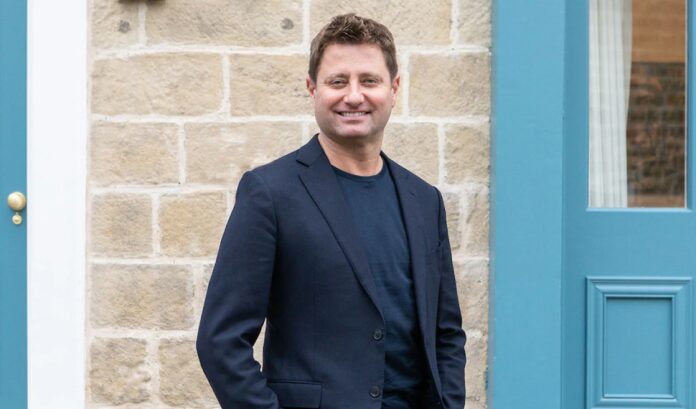
TV architect George Clarke joins calls for Mackintosh building full reinstatement
Leading architects have called for the Scottish and UK governments to help save the Mackintosh Building after Glasgow School of Art admitted it could not afford to reinstate the landmark on its own.
A new business case has estimated that reconstruction of Charles Rennie Mackintosh’s masterpiece would cost around £265 million. That is approximately five times the art school’s annual turnover.
The Glasgow School of Art said proceeding alone would put the financial future of the institution at risk. The school will instead use money from the settlement of its insurance claim to fund an stabilisation project. Work is expected to begin in 2027.
The project will replace the external scaffolding with an internal retention structure. Repairs will also be carried out to the surviving stone façades. This would secure the building, reveal its elevations to the city and leave open the possibility of a complete reconstruction if additional funding can be found.
TV architect George Clarke, the presenter of Channel 4 series including Amazing Spaces, The Restoration Man, and Old House New Home, contacted ScottishNews.com via Instagram to add his voice to calls for a recreation of Mackintosh’s world-famous design, saying “It needs a full and faithful reinstatement. It’s a national treasure and must be fully restored.”
The Royal Incorporation of Architects in Scotland and the Royal Institute of British Architects welcomed the decision to protect the surviving structure.
In a joint statement, the organisations described the Mackintosh Building as one of the most important buildings in Scotland and the UK.
They said: “The Glasgow School of Art should be commended for working proactively with architects to identify options focusing on a positive future for this amazing building.”
However, RIAS and RIBA said faithful reinstatement must remain the preferred outcome. They called for direct intervention from both the UK and Scottish governments.
They added: “A building of such national importance requires a national response if future generations are not to curse us for its loss or mutilation.”
The organisations said government leadership was needed to find the resources required to return the building to use as a creative and educational centre.
Other architects have responded more critically.
Professor Alan Dunlop, a graduate of the Mackintosh School of Architecture, described the prospect of a partial reconstruction as “utterly soulless”. He argued that retaining the façade while abandoning Mackintosh’s interiors would fail to recreate the qualities that made the building internationally important.
Architect and former Glasgow School of Art lecturer Gordon Gibb warned that the loss of the building would be “catastrophic”.
He said a partial rebuild or façade-retention scheme would diminish Glasgow’s architectural heritage. Gibb argued that the integrity of the building depended on reinstating Mackintosh’s complete vision rather than preserving selected external and internal features.
The Mackintosh Building was conceived as a complete work of art. Its furniture, fittings, windows, circulation spaces and interiors were designed as parts of one composition.
Paul Stallan of Glasgow architectural firm Stallan Brand said today: “Scotland risks losing one of the world’s greatest works of architecture for want of approximately £265 million while our government has committed the public to decades of ballooning payments through its private financed projects.
Scottish Government may bot meet the entire cost, but it must lead a national settlement involving GSA, insurers, the UK Government and philanthropic partners. Scotland has demonstrated it can make multi-billion pound commitments when private finance demands certainty. Failing to show similar resolve for Mackintosh’s masterpiece would represent not financial prudence, but a profound failure of national priority and leadership.”
The Category A-listed building was damaged by fire in May 2014. A £35 million restoration was approaching completion when a second and more disastrous fire tore through the building in June 2018.
The latest announcement in a protracted path towards clarity on the building’s future means the surviving shell will be secured, but no funding package or timetable is yet in place for a full reconstruction.
Architectural bodies now argue that the future of the Mackintosh Building can no longer be treated solely as a financial problem for Glasgow School of Art.
Leading architects have called for the Scottish and UK governments to help save the Mackintosh Building after Glasgow School of Art admitted it could not afford to reinstate the landmark on its own.
A new business case has estimated that reconstruction of Charles Rennie Mackintosh’s masterpiece would cost around £265 million. That is approximately five times the art school’s annual turnover.
The Glasgow School of Art said proceeding alone would put the financial future of the institution at risk. The school will instead use money from the settlement of its insurance claim to fund an stabilisation project. Work is expected to begin in 2027.
The project will replace the external scaffolding with an internal retention structure. Repairs will also be carried out to the surviving stone façades. This would secure the building, reveal its elevations to the city and leave open the possibility of a complete reconstruction if additional funding can be found.
TV architect George Clarke, the presenter of Channel 4 series including Amazing Spaces, The Restoration Man, and Old House New Home, contacted ScottishNews.com via Instagram to add his voice to calls for a recreation of Mackintosh’s world-famous design, saying “It needs a full and faithful reinstatement. It’s a national treasure and must be fully restored.”
The Royal Incorporation of Architects in Scotland and the Royal Institute of British Architects welcomed the decision to protect the surviving structure.
In a joint statement, the organisations described the Mackintosh Building as one of the most important buildings in Scotland and the UK.
They said: “The Glasgow School of Art should be commended for working proactively with architects to identify options focusing on a positive future for this amazing building.”
However, RIAS and RIBA said faithful reinstatement must remain the preferred outcome. They called for direct intervention from both the UK and Scottish governments.
They added: “A building of such national importance requires a national response if future generations are not to curse us for its loss or mutilation.”
The organisations said government leadership was needed to find the resources required to return the building to use as a creative and educational centre.
Other architects have responded more critically.
Professor Alan Dunlop, a graduate of the Mackintosh School of Architecture, described the prospect of a partial reconstruction as “utterly soulless”. He argued that retaining the façade while abandoning Mackintosh’s interiors would fail to recreate the qualities that made the building internationally important.
Architect and former Glasgow School of Art lecturer Gordon Gibb warned that the loss of the building would be “catastrophic”.
He said a partial rebuild or façade-retention scheme would diminish Glasgow’s architectural heritage. Gibb argued that the integrity of the building depended on reinstating Mackintosh’s complete vision rather than preserving selected external and internal features.
The Mackintosh Building was conceived as a complete work of art. Its furniture, fittings, windows, circulation spaces and interiors were designed as parts of one composition.
Paul Stallan of Glasgow architectural firm Stallan Brand said today: “Scotland risks losing one of the world’s greatest works of architecture for want of approximately £265 million while our government has committed the public to decades of ballooning payments through its private financed projects.
Scottish Government may bot meet the entire cost, but it must lead a national settlement involving GSA, insurers, the UK Government and philanthropic partners. Scotland has demonstrated it can make multi-billion pound commitments when private finance demands certainty. Failing to show similar resolve for Mackintosh’s masterpiece would represent not financial prudence, but a profound failure of national priority and leadership.”
The Category A-listed building was damaged by fire in May 2014. A £35 million restoration was approaching completion when a second and more disastrous fire tore through the building in June 2018.
The latest announcement in a protracted path towards clarity on the building’s future means the surviving shell will be secured, but no funding package or timetable is yet in place for a full reconstruction.
Architectural bodies now argue that the future of the Mackintosh Building can no longer be treated solely as a financial problem for Glasgow School of Art.