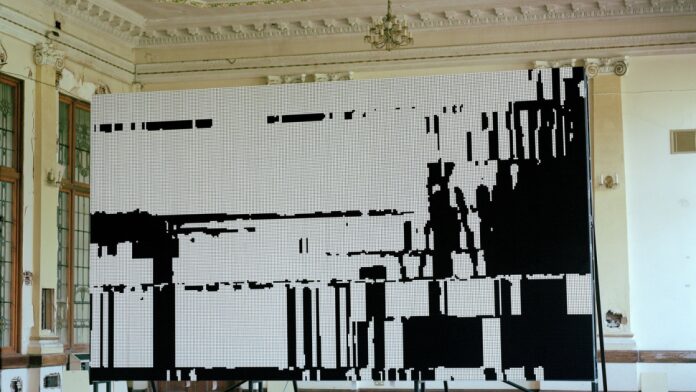
Artwork by Turner Prize winner (2014) Duncan Campbell
Thousands of artists and creative workers in Scotland could receive almost £15,000 a year under plans for a new minimum income scheme.
First Minister John Swinney confirmed that the Scottish Government will pilot a Scottish Artists Minimum Income as part of its new Programme for Government.
The scheme is intended to give selected artists a regular, guaranteed income, allowing them to spend more time developing their work without having to depend on irregular commissions, short-term funding or second jobs.
The Scottish Government has not yet announced when the pilot will open, how long it will run or which artistic disciplines will qualify.
However, the SNP’s manifesto proposed providing almost £15,000 a year to as many as 2,000 practising artists and creative workers, supported by a £30 million funding pot.
The commitment was announced alongside a wider package of support for Scotland’s cultural sector, including a Youth Culture Pass and plans for a new National Performing Company for Traditional Music.
Ministers have also reaffirmed a commitment to deliver an additional £100 million a year for culture by 2028-29, followed by a further £50 million increase in annual investment by the end of the parliamentary term in 2031.
Addressing MSPs at Holyrood, Mr Swinney said: “Scotland’s culture sector is at the beating heart of our national identity, but it is also close to our economy.”
He added: “We will also pilot a Scottish artists minimum income.”
The proposal is closely based on Ireland’s Basic Income for the Arts scheme, which began as a three-year pilot in 2022.
A total of 2,000 Irish artists and creative workers were selected to receive €325 a week, with eligible applicants chosen through a randomised process rather than a competitive assessment of the quality of their work.
Research commissioned by the Irish Government found that recipients spent an average of 11 additional hours each week on their creative practice. The evaluation also estimated that every euro invested produced €1.39 in wider economic and social value.
The Irish Government subsequently decided to establish an ongoing scheme.
Supporters believe a Scottish version could help prevent talented people from leaving the arts because they cannot cope with low and unpredictable earnings.
Equity, which represents performers and creative workers, campaigned for all parties to support the proposal before the Holyrood election.
Marlene Curran, Equity’s Scotland official, said the policy could help remove the financial barriers faced by working-class artists and create a fairer creative economy.
She said: “A Basic Income for Artists would transform the industry socially by removing the financial barriers to entry and be economically viable for Scotland.”
Equity has previously estimated that real-terms spending on the arts by Scotland’s councils has fallen by 18 per cent since 2010, equivalent to around £25 million a year.
Anna Selwood, co-founder of the Basic Income for Artists Scotland campaign, warned that financial insecurity was forcing people out of the sector before they had been able to fulfil their potential.
She said artists were too often expected to produce work with little or no guaranteed income, despite the contribution culture makes to Scotland’s economy and quality of life.
The plans have also secured a degree of cross-party support. Scottish Labour proposed its own £30 million Creative Enterprise Allowance before the election, which would have topped up the incomes of up to 1,000 artists, musicians and designers over two years.
Common Weal welcomed the pilot but said ministers must clarify that distinction and avoid creating another competitive funding process in which artists are required to repeatedly prove their eligibility.
The organisation also argued that the scheme should be designed to reach artists from deprived communities and those without the professional contacts or experience needed to navigate existing funding systems.
Culture Counts, the collective voice for Scotland’s cultural sector, welcomed the prominence given to culture in the Programme for Government but said it would now seek further detail on how the commitments will be delivered.