Edinburgh’s landmark Palm Houses have reopened to the public today following a five-year, £23.5 million restoration of the historic glasshouses.
The A-listed buildings at the Royal Botanic Garden Edinburgh welcomed visitors back on Friday (2 October) after one of the most significant restoration projects in the Garden’s history.
Almost all of the original sandstone and wrought-iron structure has been retained, while 5,750 panes of toughened glass have been installed to better protect the buildings and their internationally important plant collection from Scotland’s increasingly severe weather.
The two Palm Houses span almost 200 years of Edinburgh history.
The oldest, octagonal glasshouse dates from 1834, while the larger Victorian building was completed in the 1858 and is described by the Botanics as the tallest traditional Palm House in the world.
More than 600 square metres of repairs have been carried out to the original Georgian and Victorian ironwork as part of the project.
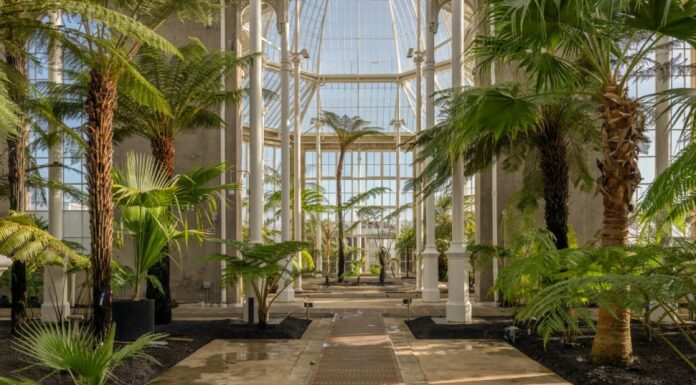
The restoration required around 800 valuable plants to be removed before work could begin, with most temporarily housed elsewhere within the Garden.
Around 600 specimens are being returned to the Palm Houses, including threatened species from around the world.
Among the most striking is an eight-metre-high stone gate palm, believed to be the tallest example of its kind being cultivated outside China.
Visitors will also be able to see a young sabal palm grown from the Garden’s famous historic specimen, which was thought to have been around 200 years old when it had to be felled before restoration work began in 2021.
The refurbishment has also created a single continuous space across the two Palm Houses for the first time in decades.
Professor Julia Knights, Regius Keeper at the Royal Botanic Garden Edinburgh, said she was “thrilled” to reopen the landmark following five years of restoration work.
The Palm Houses had become increasingly vulnerable to Scotland’s weather before their closure.
High winds could cause ageing panes to fall into the glasshouses, putting both staff and plants at risk.
The replacement toughened glass is designed to provide significantly greater protection, while the restoration has preserved historic features including the original pulleys and winches used to regulate conditions inside.
The work forms part of Edinburgh Biomes, a much larger programme to transform the Royal Botanic Garden’s ageing glasshouse estate and protect its scientific collections.
The Palm Houses restoration is part of a wider £58 million investment in the programme, supported by the Scottish Government and more than £10.6 million raised through philanthropic fundraising and a public appeal.
Work is not yet complete across the wider glasshouse complex, with the Front Range Glasshouses remaining closed while further restoration is planned.
The Palm Houses are now open every day, with timed admission between 10.15am and 4.15pm.