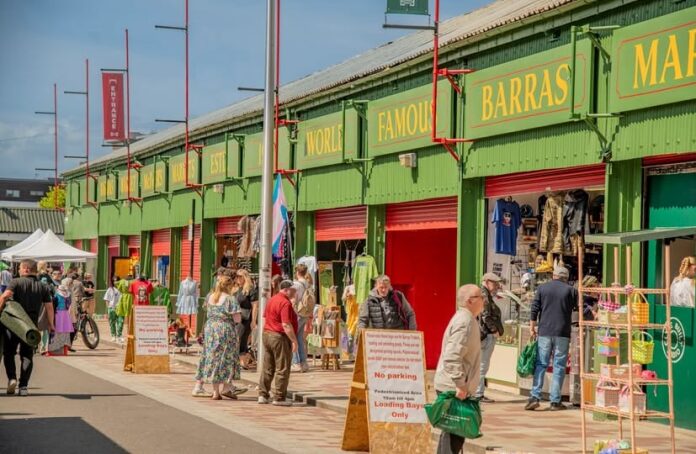
Few places hold Glasgow’s spirit as comfortably as The Barras. It is a family business that belongs, emotionally, to an entire city; a market built on hard trading and easy conversation; and a cluster of streets where old Glasgow survives beside new food, fashion, music and nightlife.
For older generations, The Barras can still summon memories of Sundays when the rest of the city’s shops were closed and the Gallowgate was so crowded that children could feel themselves being carried along by the crowd. For music fans, the glow of the Barrowland sign represents something almost sacred: a room where generations of bands and audiences have made memories on the sprung floor.
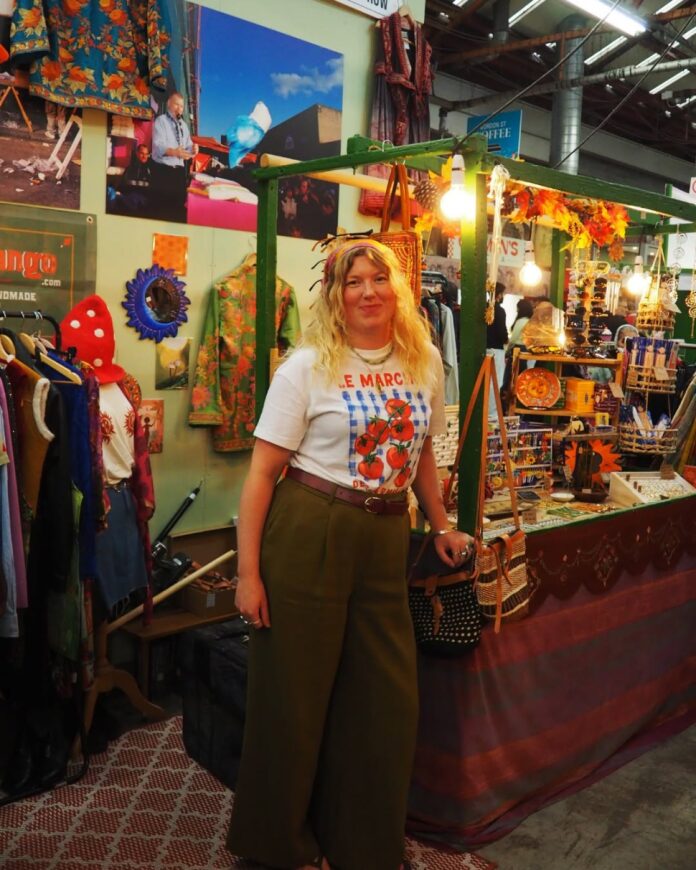
The crowds and the trade have changed. Department stores disappeared, shopping moved online and many of the market’s older traders were not replaced. Yet The Barras is not being allowed to become a museum. Vintage and sustainable fashion now sit alongside traditional stalls; food trucks and new kitchens are gathering around Maggie’s Way; special markets and cultural events are bringing in visitors who may never previously have thought of spending a weekend afternoon here.
There is a buzz around The Barras at the weekend; it’s somewhere I take my kids regularly for a wander between the stalls. A slice of New York style pizza, hot donuts, a visit to Saint Luke’s or a game of chess in 226 Gallowgate. Some takeaway food from Ho Lee Fook for going up the road.
Dugald McArthur, managing director of The Barras, sees change as essential to protecting what makes the place special. Maggie McIver, the entrepreneur remembered as the Barras Queen, was his great-grandmother. After a 44-year career as a chartered accountant in Canada, McArthur has turned his attention fully to the family business and to what he calls the two canvases in his care: the market and the ballroom above it.
His argument is that tradition only survives when people keep adding to it. The spirit of The Barras is not fixed in brickwork, neon or nostalgia; it lives in the traders, artists, promoters and visitors who use the place. The challenge is to make room for new Glasgow without erasing the old one - and to ensure that two of the city’s most recognisable landmarks never become relics.
I sat down with Dugald in his office.
Your connection to The Barras runs through the generations. How do you fit into the family story?
Maggie McIver is my great-grandmother. Her daughter Kitty Cairns was my grandmother, and Kitty’s oldest son, Victor, was the previous managing director. My mother and Victor owned the majority of the shares for years and, through their passing, that has come to me.
I was born in the UK and spent my summers coming to Scotland, at a time when travelling on airlines such as BOAC and British Caledonian was not as common as it is now. I was the number one grandson and I would be brought in here at weekends. I still have cashmere and lambswool sweaters that were bought in the market more than 50 years ago. At the dinner table at home, this place was always talked about because it generated the family’s income.
I became a director in the mid-1980s and had been involved tangentially in the business. As my uncle got older, we would speak most weeks about the problems in the business. I am the first of the McIver family to have a university education and I am a chartered accountant by trade. I worked for a global public accounting firm for 44 years. I retired, and now I have taken this on as a project to keep it going.
What do you remember about The Barras when you were growing up?
I remember Sundays in the 1960s, when all the shops in Glasgow were closed and the streets here were jammed. As a young kid, I was nearly terrified of being crushed in the crowd, but it was lively. The entertainment came from the pitchers selling their wares and the streets were full.
But times change. Who could have imagined Glasgow without Lewis’s or Wylie & Lochhead, or without places such as the Rogano? Retailers such as TK Maxx and Amazon have changed shopping, and the population of Glasgow has gone down. You combine all those things and people started to leave the market. For a period, I think the market got old. By that I mean the older generation were, unfortunately, dying off and were not being replaced.
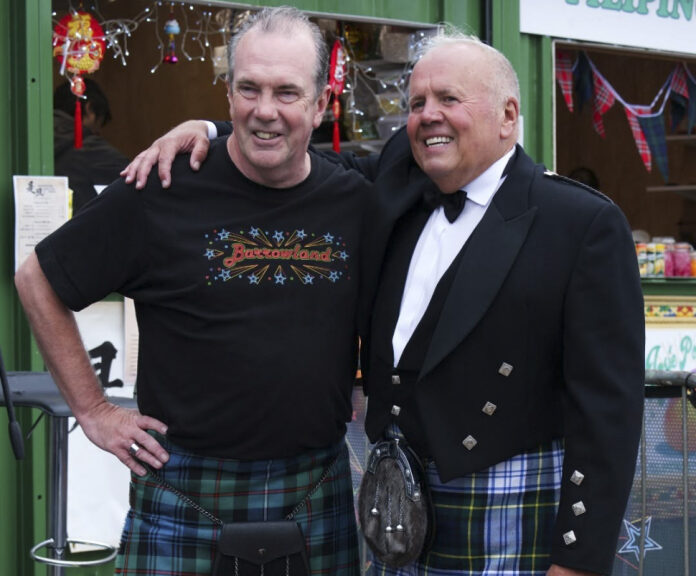
Gavin Mitchell and Dugald at the opening of Maggie's Way
You began our conversation with a statistic about Glasgow’s dance halls. What does the Barrowland’s survival say about the place?
The figure I always use is that Glasgow had 256 dance halls in 1937. Today, the Barrowland is the only one still operating under the same name. The other one still operating as a club is The Garage, which was the old Locarno, although it had several incarnations in between.
This place has always been a music venue. It began with live music for dancing, then it had roller disco, it tried disco, and later it became a live concert venue after Simple Minds. It has kept changing while remaining recognisably the same place.
How is the market responding to that change?
Many markets across the UK have disappeared, but there are also markets that are more vibrant than they have ever been. After the pandemic, we recognised that the mix had to change. Sustainable fashion, our wonderful second-hand book retailer and food are coming in. Food at The Barras in the 1960s was a steak pie. Think about how much people’s tastes have changed since then.
What you have to do is continually renew and build on the legacy. You have to create new excitement and enjoyable events because otherwise it gets boring. The last thing we want is to become like a cassette tape, an eight-track, a CD or a DVD - something that belongs only to history.
Could this become a place that is busy during the week as well as at weekends?
If you look at urban development, you need a place for people to stay, a place for people to play and a way for people to be paid. By that, I mean I can work and make money, trade and make money, or open a restaurant and make money. You need all three.
Could this part of the city become more than weekends? I think it is possible. It will not be easy because you need people to support retail trade. Our investment in social media allows the people here to be associated with The Barras websites and social platforms, and to build sales for the weekend.
Could businesses around the outside be open all the time? I really think that can happen, but it will be slow. We already have a barber and a hairdresser here through the week. I think it will come gradually.
A younger creative crowd is now part of the area. What has that brought to The Barras?
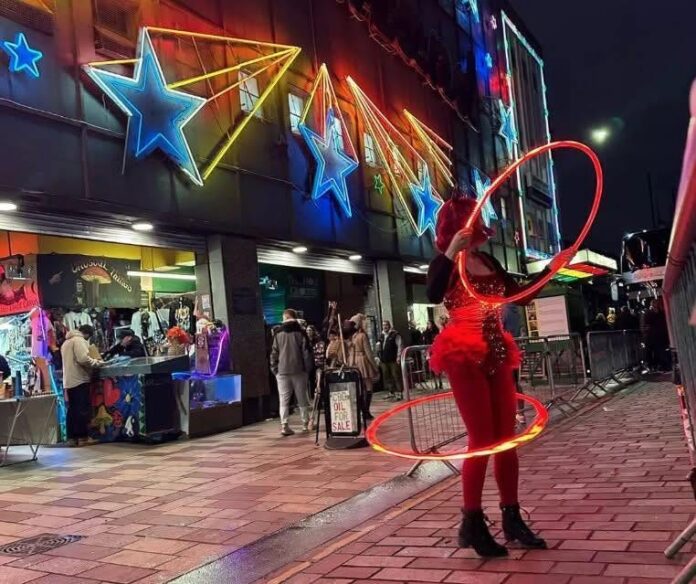
You need to keep a cross-section of people coming. Could you have imagined in the 1960s that Glasgow Pride would stop at The Barras? It would never have made it up the Gallowgate, yet it is now one of our busiest weekends of the summer and everyone is very welcoming. One of our most important values is inclusion, because you limit your possibilities as soon as you start to exclude people.
I use the idea that I have two canvases: one is the market and the other is upstairs in the ballroom. It is about the people who come here, the people who trade here and making an environment where every visitor, trader, artist, promoter and employee can work together and have fun.
When people start having fun, that brings more people in. Then you get commerce, excitement and the kind of atmosphere that is needed. Any urban renewal requires people to enjoy, intermingle and collaborate. That is the unique secret sauce we have. In the past five years, the market has become much more reflective of the new community in Glasgow.
Do special events help people rediscover the market?
It is almost like a social experiment. You hold one of these special events and people come because of the event, not because of The Barras. Then they discover what I like to call the renaissance of The Barras. It is not the place they remembered, heard about or read about. It is somewhere new and vibrant.
People buy something that night and then they come back because it has gone on their list of things to do when they have a free weekend. It is a great place to spend a few hours. There are lots of places to eat, drink and experience, and it is a great family place. The spillover effect of the events is that people rediscover The Barras.
I watch the tour bus go past and people point out the Barrowland, but it does not stop. How do you bring those people in? If the people come, the traders bring different things and the mix adjusts itself. There is huge potential for Glasgow. It is within walking distance of the city centre, it is different and it has tradition, but it is also going to create new traditions.
Some people use the word gentrification when they discuss change on the Gallowgate. How do you see it?
My biggest fear is that my two icons become relics. A relic can remain relevant, but it is going to die, fossilise and eventually become, to use a great Scottish word, a midden. You need vibrancy. You need to take the canvas or background that is here and make it relevant as a place to stay, play and be paid, because then you have a vibrant community.
Is it gentrification? I hate that word. Is it a renaissance or renewal? I think it is. It has to respect the legacy and tradition, but it also has to move on. Times change, so communities have to change and evolve. If you want the tradition to stay, and to retain something that is uniquely Glaswegian, it needs to move slowly and in the right way.
You have to remember that these buildings used to have tenements above them. People lived here and that has gone. If you want the area to be sustainable, you need people here. I wish people would refer to it as a renaissance, renewing traditions or moving forward carefully, because I think that has to happen.
What would you most like to see happen around The Barras over the next decade?
Glasgow needs to repopulate its centre and not swing too far towards student accommodation. I would like to see the route from Saint Luke’s towards the city centre fully connected, with no empty buildings and with activity all the way along. From there, the footprint can grow out. You have to create connections between communities. The entertainment in the Merchant City is a five-minute walk away, and when we have a concert here people walk down the Gallowgate and Trongate to enjoy other parts of the city.
I see this as an entertainment district, but also as a place where people can live and work. There is a very interesting co-operative across the street incubating new businesses. Being one of the cogs that makes all of that happen is important to me.
It is also about keeping the venue going as a legacy for Glasgow. If somebody built properties next to it and we had to close because of noise, what would that do to Glasgow? That would be biting the hand that feeds the city’s cultural life. Development has to fit with what is already here and help make this more of a destination. Glasgow has so much to offer as a tourist city. That creates jobs, opportunities for entrepreneurs and an even more exciting city. I see us as one of Glasgow’s iconic brands, along with the Duke of Wellington with a traffic cone on his head.
What role will food and drink play in the market’s future?
We have made a significant investment in social media and encouraged our traders and the groups that come here to invest in it too, creating an upward spiral and a buzz on people’s phones. We have seen a huge increase in followers, viewers and consumption by working with others. I do not look at the other bars around here as competitors. I see them all as part of the fabric.
Am I looking to build a new venue? No. Am I looking to make this one better, attract more people and create more buzz? Yes. We have enough here to work with, and the same is true of the market.
On Suffolk Street, which we now call Maggie’s Way after my great-grandmother, food trucks are coming in and some containers are being fitted out. We are putting in a proper stage. We see the need for street entertainment and buskers, and we see the need for more food. Are we going to cook it? No. Will we provide space for others to do it? Yes. I think it will evolve naturally.
Some concepts will not work and will disappear, while others will find their audience. On a damp day, custard and crumble from The Crumbleologist hits the spot, and the little coffee shop has done well. I have seen people selling new takes on haggis, and that is really cool. If you plant the seeds, the foodies will come. They will encourage people to reinvent their menus while staying close to their roots. I would not limit it, provided the business is safe, properly certified, honest and not ripping people off.
The Barrowland is a family business, but it means a great deal to people across Glasgow and beyond. Do you feel that?
I always knew it was an important part of Glasgow. I now appreciate even more how important it is to Glasgow and Glaswegians. When I told people that I was retiring and explained what I was going to do, they would say, ‘You are associated with the ballroom? You have got to be kidding. I was there when…’ It unlocks something that I knew was there but did not fully appreciate.
When you start peeling back that onion, you really see it. I can go upstairs, lean against a post or sit in a chair and watch people have a wonderful time. I call them the magic moments, and I see magic moments around here all the time. Our business is really about providing the space for those moments and creating a setting where everyone can enjoy themselves. It feels good.