Jack Vettriano told me he was not a Scottish artist. He was “an artist who was born in Scotland”.
It was a distinction from a painter whose relationship with the Scottish art establishment was never straightforward.
Scotland, and Fife in particular, runs unmistakably through the story of Vettriano’s life and work. More than most imagine, as he explained to me when we spoke before a retrospective of his art.
Born Jack Hoggan in Methil in 1951, he grew up in a mining community and left school as a teenager, following his father into the coal industry as an apprentice engineer.
There was no art school education and no obvious route from the Fife coalfields to international fame.
Instead, a set of watercolours given to him for his 21st birthday started what would become one of the most extraordinary careers in modern Scottish art.
Vettriano taught himself to paint, initially copying pictures and studying the work of other artists. Kirkcaldy Galleries became part of that education. He would examine the techniques of artists including the Scottish Colourists and William McTaggart, studying how they applied paint and trying to understand how pictures were constructed.
His breakthrough came in 1988, when two paintings were accepted for the Royal Scottish Academy’s annual exhibition and both sold. By 1992 he had his first solo exhibition in Edinburgh.
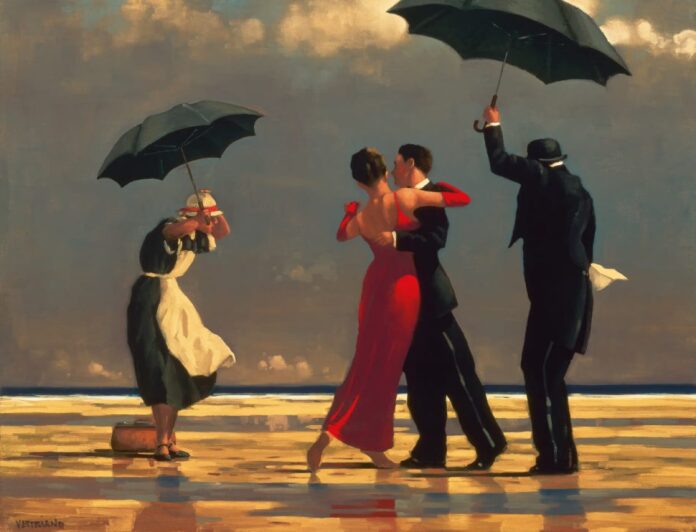
That was also the year he painted The Singing Butler.
The image of an elegantly dressed couple dancing on a windswept beach as a maid and butler struggle with umbrellas became one of the most recognisable artworks of its era.
Prints, posters and cards took Vettriano’s paintings far beyond galleries and into homes around the world. The Singing Butler became the UK’s best-selling art print and, when the original was auctioned in 2004, it fetched £744,800 – at the time a record auction price for a Scottish painting.
It created a contradiction which would follow Vettriano for the rest of his career.
The public embraced him. Critics were often far less impressed.
Vettriano was acutely aware of that divide and believed his commercial success, particularly the decision to reproduce his pictures as affordable prints, counted against him in parts of the art world.
“Popularity equates to trash, that’s their notion,” he told me.
Yet the numbers demonstrated the size of his audience.
His major retrospective at Kelvingrove Art Gallery and Museum in Glasgow in 2013 attracted more than 136,000 visitors during its five-month run.
Almost a decade later, Vettriano returned to the place where much of his education had begun.
Jack Vettriano: The Early Years opened at Kirkcaldy Galleries on 17 June 2022.
The exhibition traced the journey from the young amateur painter Jack Hoggan to the artist the world knew as Jack Vettriano. It included almost a dozen early paintings bearing his birth name alongside works from the period in which he developed his distinctive style.
When I interviewed Vettriano ahead of the exhibition, he was already contemplating the possibility that this might be a final homecoming.
“Everything started in Kirkcaldy Art Gallery,” he told me. “I’m not trying to be the harbinger of doom, but I think this might be my last exhibition in Kirkcaldy, so it’s a kind of sentimental journey.”
An exhibition of more than 70 of his works then opened at Palazzo Pallavicini in Bologna on 26 February 2025. Three days later, on 1 March, Vettriano died at his apartment in Nice. He was 73.
I enjoyed our conversation, Jack was aware of his own place of his own place in the art world and his legacy at this late stage of his career but secure in the decisions that he had made.
This is Jack Vettriano, in his own words.
How did the Kirkcaldy exhibition come about?
It came about, I think, because everything started in Kirkcaldy Art Gallery.
I’m not trying to be the harbinger of doom, but I think this might be my last exhibition in Kirkcaldy, so it’s a kind of sentimental journey.
I think, too, that I have come to the conclusion that I would like people to see how I started and what I did and copied under my first name, and then how I found my niche, if you like.
I didn’t want to contaminate one with the other, so I took my mother’s name, which was a fairly smart tactical move, I think.
How important was Kirkcaldy Galleries when you were first learning about art?
Just the way that other artists apply paint, whether they do it in a very fine way or whether they do it in a very thick way, like the Colourists.
Kirkcaldy’s got a wonderful collection of Colourist paintings, as well as the Scottish Impressionist, McTaggart.
Was art a form of escapism from the world you came from?
When I finished my apprenticeship with the Coal Board, I was on what I call a grand tour. I went to London and lived in a wee bedsit which had mice and I used to go to art galleries at the weekends.
I started to just think, I’d like to try that.
It’s important to me that artists don’t start off creating masterpieces. Everybody has to start somewhere.
I’ve come to the conclusion that it would be nice, it would be good, for people to see that my early work was a bit suspect and watch the progression, especially, I think, people who dabble with paint.
Generally speaking, you go to an art gallery and you see the very best of somebody’s work, which might be, for an amateur artist, as I once was, a bit intimidating.
I think I’m happy to show that you have to start somewhere.
Do you think people should create art regardless of their level of ability?
It’s certainly been a great way for me. It’s given me a very good living, because I was never going anywhere, and I found I could paint.
When I do book signings, when I meet the public, there’s so many of them say, ‘Oh, I was really good at painting at school’, and I say, ‘Well, why didn’t you continue?’
Anyway, you know the story. A girl bought me a box of watercolours, and that was it.
Twenty years later, I had my first solo exhibition.
I didn’t know I was teaching myself to paint, but I was. I was learning how to get it down on canvas.
Looking at those early paintings again, could you see the beginnings of the artist you became?
There is a painting in the exhibition, and it’s a copy of a painting by Singer Sargent.
When I finished that, I thought, That is a lovely painting, but what I lack is any imagination.
I finally realised that my life was my imagination, and so you get a mixture of a lot of broken hearts, and you get some nice, breezy beach paintings.
That’s me.
Were your paintings autobiographical?
It’s very comforting when people comment on the fact that these paintings, all of them, tend to be very autobiographical.
I once met a woman who said to me, ‘See that Singing Butler dancing on that Italian beach?’
I just thought, I’ll just leave her. Let her think that.
Don’t spoil her dreams. But it’s Fife. Or a version of Fife.
How much of Fife is in those famous beach paintings?
From the age of 10, I lived in Leven, which was very popular then with people from the West Coast.
Leven Beach is gorgeous. It’s the kind of beach where you can walk 400 yards and then your ankles start to get wet, you know what I mean?
It’s a lovely beach, especially the beach between Leven and Lower Largo. Lovely.
Sweet Bird of Youth, that’s not Leven Beach, that’s a beach from my imagination, but Billy Boys is Leven Beach.
Mad Dogs, Dance Me to the End of Love – they’re all based upon that beach that I’m referring to where you can walk for a while before you actually get water up to your knees, and then you’re too knackered to swim.
Your paintings became enormously popular as prints. Did the attitude towards that success frustrate you?
That’s just one of the most snobbish attitudes of critics and national galleries.
Popularity equates to trash, that’s their notion.
I thought long and hard before I created the prints, or I licensed them. I suspect that had the technology been available a few hundred years ago, many more artists would have done it.
I thought, Why don’t I just make some money off it now?
That has been enormously successful in spreading my work around the world, certainly the English-speaking world.
Show me an artist who wouldn’t mind a quarterly cheque for a few hundred thousand pounds, and I’ll show you a liar.
How did it feel as a Scottish artist, knowing paintings which began with your experiences in Fife were hanging in homes around the world?
I’m very humbled by it all.
You won’t find me sitting thinking about buying a Rolls-Royce or.
I’ll pick you up on a wee point there, Paul.
People talk about Scottish artists, but I am not a Scottish artist, I’m an artist who was born in Scotland.
We’re just artists, regardless of where we come from.
I look at my work sometimes, and I think, ‘Would anybody realise that?’ Because there’s no shortbread there, there’s no tartan…
Was that international quality something you deliberately set out to create?
Absolutely not, no.
A lot of these backdrops, including the beaches, are either imagined, or they’re real, and if they’re real, they’re either Edinburgh or Fife or London.
I’m astonished by the amount of interest there is across the English-speaking world.
Sometimes, I have to slap myself on the arse to remind me that, ‘Yeah, this is real’. Waking up and it’s all been a dream.
Did the exhibition show the point where painting stopped being a hobby and became your career?
Yes, that’s exactly what it is.
I would like to think that people will see that kind of progression that we talked about.
I think when they see the Singer Sargent – it’s a wonderful little painting.
That’s when I thought, ‘Right, you have to paint something that comes from you. You’re good enough to do it’.
So I did it.