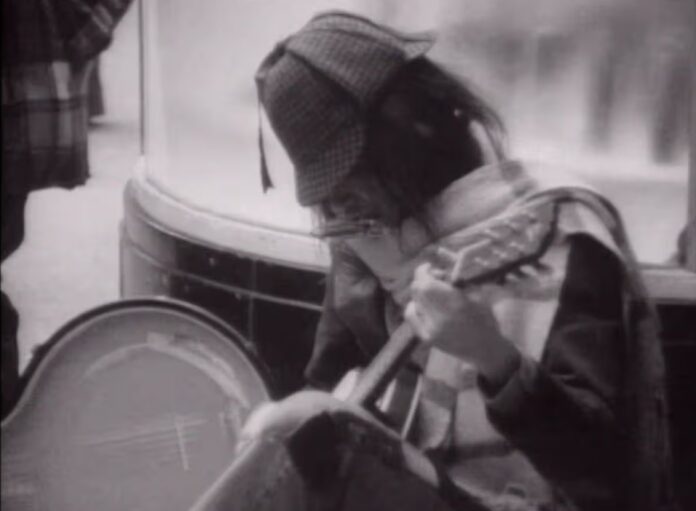
Neil Young has long been known for his down-to-earth nature, but one lesser-known story from his career saw the Canadian singer take to the streets of Glasgow to busk ahead of a major concert in 1976.
During his tour of Japan and Europe that year, Young arrived in Glasgow before an evening performance at the Apollo with his band, Crazy Horse. Rather than keeping a low profile or retreating to his hotel, he headed out into the city with his banjo and harmonica, entertaining passers-by with a few songs and soaking up the atmosphere of Glasgow.
Director Murray Grigor, cinematographer David Peat and a local film crew had been brought on board to document Young’s headline performance. The visit also offered a unique opportunity to capture the character of the city and its people during the mid-1970s.
Speaking to Online Culture, Peat recalled that he and Grigor were hardly experts on the rock music scene.
“The irony is that neither Murray or myself were particularly knowledgeable about the rock world, and we knew little of this guy Neil Young. So we turned up at the airport in sports jackets and ties to meet him.”
Young’s arrival in Glasgow was delayed after he missed flights from London, but when he finally arrived, he made it clear that he wanted something a little different from the usual concert documentary. According to Peat, Young asked the crew for some “funky s*** footage”, signalling that he wanted to capture something spontaneous and authentic.
Rather than shutting himself away in a hotel room, Young was keen to get out and experience the city for himself, meeting its people and capturing the everyday life of Glasgow.
The singer and his band checked into the Albany Hotel on Bothwell Street, a popular haunt for celebrities during the 1960s and 1970s. However, the visit got off to a chaotic start when one of the band members set fire to the paper decorations on a table in the hotel’s penthouse.
Young soon ventured out onto the streets, where he politely approached a local to ask for directions.
“Excuse me, could you tell me where the Bank of Scotland is?” he asked before making his way towards Glasgow Central Station.
It was on Gordon Street that Young settled down, wearing a deerstalker hat and performing “The Old Laughing Lady” on his own. With his banjo and harmonica to hand, he played to the passing crowds, seemingly curious to see whether anyone would recognise the internationally renowned musician busking in the heart of the city.
The reactions from Glaswegians were mixed, making for some memorable moments captured by the film crew. One unimpressed passer-by dismissed the performance, declaring: “They’re a lot of rubbish! They should get done, they should get the jail!”
Another recognised Young but wasn’t entirely convinced by the performance, remarking: “That’s him there. It’s not bad, but he’d be better with a PA system!”
In an era long before smartphones and social media, the impromptu performance offered a fascinating glimpse of a music legend blending into everyday city life, with many passers-by seemingly unaware of the star in their midst.
Young’s busking session also took on added significance later that evening. When he took to the stage at the Apollo with Crazy Horse, he opened the show with “The Old Laughing Lady” — the very song he had performed earlier that day on Gordon Street.
The concert featured a 19-song setlist, including some of his best-known tracks, such as “After the Gold Rush”, “Heart of Gold” and “Cinnamon Girl”.