
ScottishNews.com writer John Glover sends a report from Ukraine.
“Why are you not scared being here?”
A local asked me that, and I did not have an answer. If I had, I would be lying. The truth is, I don’t know.
Maybe it is the years of working in hard news. They give you grounding and a mindset. I have been physically threatened, and someone has kicked in my car, among other things.
I spent years keeping my stress under control and learned to neutralise fear by understanding it as a fight-or-flight response.
Maybe I have learned to dissociate and observe.
Or maybe it is simpler than that: To me, the drones currently flying overhead sound like aeroplanes going by, even if they are accompanied with the odd boom.
I don’t see the drone, and it isn’t near me, so it doesn’t scare me, even if it glides right over my head as we try to sleep.
Air raid sirens blare in the background, this is a part of daily life here in Ukraine.
Drones are above us.
They move on to their destination like jets rocketing through the skies.
Some land in nearby towns and villages.
This city is attacked so routinely that locals have compared it to Star Wars.
To anyone watching from the outside, the reference might sound strange, but one local explained the comparison to me.
When anti-aircraft fire chases drones through the night sky, tracer rounds light up the darkness like a laser dogfight from the films. You see the flashes overhead, glimpses of a battle whose full scale remains hidden from you.
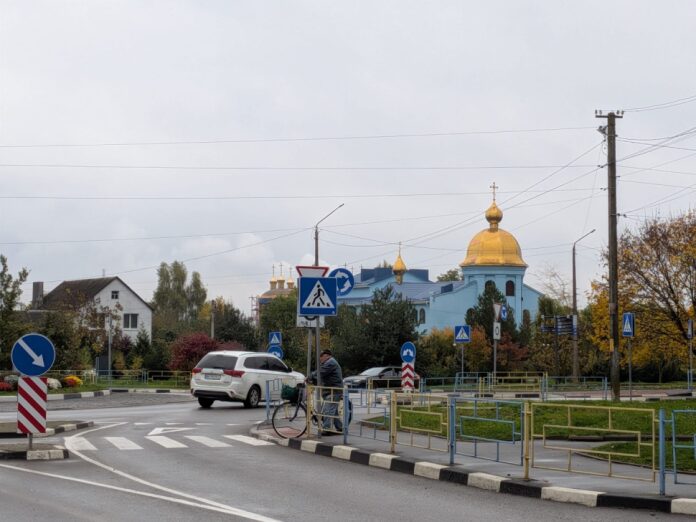
Spending a few days in Ukraine, you understand why many people ignore the sirens.
Outside the city, many places simply lack the infrastructure. The local shelter is often the neighbourhood school, which is no safer than your own house because there are no underground shelters or basement areas.
The sirens are so regular that people would end up spending their entire lives underground. No work would be done.
In Ukraine, if you don’t work, you don’t earn.
There is very little in the way of benefits, and no national health service like the NHS. Every siren you obey costs you money, and if the drones do find you, there is very little safety net waiting. It is a different world.
Because of the security situation and recent attacks, attendance at schools is currently not possible.
Education has mostly moved online, leaving children to learn at home using whatever technology the family owns, whether that is a laptop, a tablet or a cracked smartphone running Zoom lessons. I watched some of the children attending their lessons.
During the short breaks, they shouted and played, their voices coming through phone speakers. Even with school online, they were finding ways to keep some form of normality.
If the Wi-Fi crashes or the power cuts mid-class, the teacher keeps going, and the children are left to catch up on the work whenever the signal comes back. With no state safety net, many of these young children are left at home completely alone all day while their parents are forced to go out to work.
Life carries on. Visitors to the hospital have to wear plastic overshoes to stop the spread of disease. A set costs around 50p, but if the machine isn’t working, a kind nurse hands them over for free.
The hospitals are busy, with locals constantly going through the doors. A private blood panel covering iron, vitamin D, thyroid and other hormones costs 3,299 UAH, roughly £55. A comprehensive blood test in the UK costs well over £100.
We passed a memorial with dozens of pictures and flags commemorating the men from Rivne who have lost their lives in the war.
Local feeling is to carry on, even if the daily conversation always circles back to the war and drone attacks. People try to be happy.
The question reminded me of the office back home, where everyone seemed surprised and maybe terrified that I was going to Ukraine. Putting the war aside for a second, it is a beautiful country with great food and a deep culture and heritage.
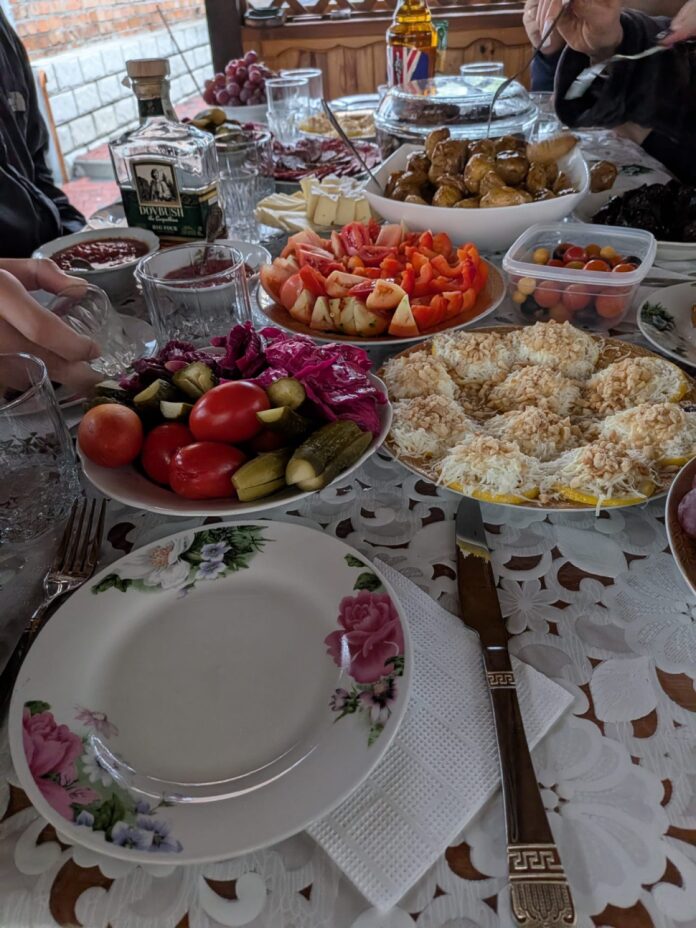
On Monday, we drank to lost friends and family, first with brandy, and then my father-in-law and I drank half a bottle of vodka between us. In between came a meal of BBQ chicken kebabs, deruny (potato pancakes), syrnyky (fried cheese pancakes), and lord knows the name of the rest of the food, but it was good. We ate like kings.
At the weekend, fifteen drones attacked the city.
They are targeting energy infrastructure, schools and shopping centres. One hit a local school, an old Soviet-era building. Locals described it as an attack by one of the weaker drones.
There was no huge explosion, more the sound of machine-gun fire, but every single window in the building was blown out.
Most parents keep their children at home for safety even if the schools are open.
Teachers were recruited to remove the glass and repair the frames, a local teacher and others told me, spending hours cleaning at the weekend to get the school ready for Monday morning, even as learning shifts online behind closed doors.
Just yesterday, a few miles from where we were staying, a Russian jet-propelled drone blew up a Metro supermarket.
A local tells me: “They are trying to kill us. First they attacked our medical supplies, now they are attacking our electricity and power so we freeze to death and now they are targeting our food so they can starve us. This is what is happening and what people can’t see.”
The thing I keep coming back to is how quickly the extraordinary becomes ordinary. A drone attack. Shattered windows. Teachers clearing glass at the weekend. Children logging back into lessons.
Life carries on, not because the danger has passed, but because it hasn’t. There is work to do, food to cook, children to educate and families to look after.
Still, the question stays with me. Maybe I am putting on a brave face for my wife and her family, acting brave when deep down I am terrified.
Maybe. I don’t know. I don’t live this every day; the people here, the people under relentless attack, they do.
It feels selfish to be scared when I am only visiting, and wrong when the locals endure this day in and day out.
I am only here for a visit. I can leave when I want to. The people I have met, including my friends and family, cannot simply step outside the reality of this war.
Perhaps that is why I still don’t have an answer to the question I was asked.
I am trying to understand what it means to live like this. I suspect that, as a visitor, I will never understand.