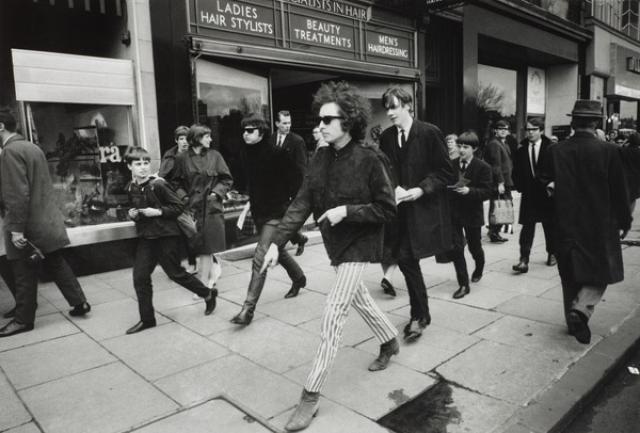
In May 1966, Bob Dylan arrived in Scotland at one of the most defining moments of his career.
Long before he became an enduring icon of American music, Dylan had become the centre of a fierce cultural debate. His decision to abandon the familiar confines of acoustic folk in favour of electric guitars had divided audiences around the world, turning a musical evolution into a symbol of a generation struggling to make sense of a rapidly changing world. Glasgow would become the setting for another memorable chapter in that controversy.
The Cold War was intensifying, the United States had escalated its involvement in Vietnam the previous year, and one of the most influential folk musicians of the era was challenging the very audience that had made him a star. For many listeners, Dylan’s move towards a louder, more modern sound felt like a betrayal of the political ideals and artistic authenticity they associated with his music.
On 18 May 1966, Dylan arrived in Glasgow to perform at the Odeon Cinema on Renfield Street. The atmosphere surrounding the concert was already charged. Just a day earlier, he had played the infamous Manchester Free Trade Hall show, where a member of the audience shouted “Judas!” as Dylan and his band launched into their electric set.
The incident became one of the defining moments of Dylan’s career. Reflecting on the hostility he faced, he remarked: “Judas, the most hated name in human history! If you think you’ve been called a bad name, try to work your way out from under that. Yeah, and for what? For playing an electric guitar?”
For traditional folk fans, the change represented more than a musical experiment. Many believed Dylan had abandoned his roots, embraced conformity and distanced himself from the social and political struggles that had helped establish his reputation.
The fact that he continued to open his concerts with solo acoustic performances did little to appease those who viewed the electric second half as an act of disloyalty.
Glasgow, however, offered signs that the balance was beginning to shift.
Although heckling was not absent from the Odeon that night, the opposition appeared less overwhelming than it had at some of Dylan’s earlier performances. Members of Glasgow’s Young Socialists group attempted to drown out the band when they returned for the electric set, but Dylan’s supporters were increasingly willing to stand behind his new direction.
When protesters began chanting “We want Dylan,” the singer responded with a characteristically dry remark: “Dylan got sick backstage. I’m here to take his place.”
It was a moment that captured the humour and defiance with which he approached the controversy. Dylan was not about to retreat from his artistic choices simply because sections of his audience refused to accept them.
By the time of the Glasgow concert, Dylan’s transformation was already well underway. Born Robert Allen Zimmerman, he had risen to prominence as a leading figure in the folk revival, drawing inspiration from the likes of Woody Guthrie and carrying folk music’s storytelling traditions and political conscience to a worldwide audience.
But Dylan had never been content to stand still. His decision to embrace electric instrumentation at the 1965 Newport Folk Festival had first split his audience, setting the stage for the more intense confrontations that followed during his 1966 world tour.
His backing musicians, The Hawks, became an immediate target for traditionalists. Their appearance on stage signalled a shift in sound and atmosphere, prompting some members of Dylan’s folk following to respond with boos and jeers before the music had even properly begun.
For Dylan, however, the electric band represented an opportunity to push his songwriting into new territory. His forthcoming seventh studio album, Blonde on Blonde, due for release in June 1966, would further demonstrate the creative ambition behind his changing musical identity.
Despite the tension inside the Odeon, the concert passed without a major incident. Dylan’s wider stay in Glasgow was not entirely peaceful, however. Reports from the visit include damage to the tour bus and the theft of equipment, while one particularly colourful story has become part of the city’s rock ’n’ roll folklore.
Dylan and his entourage were staying at the North British Hotel, beside Queen Street Station, when they ordered food to their room. According to the story, the waiter who arrived subjected the American singer to a furious outburst, allegedly branding him a traitor to folk music.
Tom Keylock, Dylan’s security man, intervened when the confrontation escalated. Recalling the incident, Keylock said the waiter pulled a knife on him, leaving him with a lasting scar.
“He pulls a knife on me. I’ve still got the scar to prove it. So I gave him a good kicking.”
Even amid the hostility, Dylan found opportunities to enjoy himself during his time in Scotland. He reportedly spent time playing music with Canadian musician Robbie Robertson, with the pair writing a song together that was never released. As he prepared to leave Glasgow, he also spoke with local children, apparently bemused by the intensity of the reaction his music had provoked.
The Scottish leg of the tour continued the following day, when Dylan and The Hawks travelled to Edinburgh to perform at the ABC Regal on Lothian Road. If Glasgow had offered a glimpse of a changing audience, Edinburgh provided a reminder that the traditional folk faithful were far from ready to surrender.
A contingent of committed folk purists turned out in force, with some attempting to disrupt the amplified second half by playing harmonicas over the band.
Their efforts proved futile. The harmonicas were no match for the volume and intensity of Dylan’s electric sound.
Dylan was moving forward, whether his audience was ready or not. And, as the years would demonstrate, he had no intention of looking back.